Effective Team Norms: A Guide to Setting Ground Rules for Success
What most managers miss about team norms is this: people do not trust the norm you announce. They trust the system signal behind it. When stated values and lived reality diverge, the norm collapses and friction takes its place.

What is your team actually learning from the system around it?
A manager can say all the right things about team norms and still train people not to believe them.
You can see this clearly when a workplace says it values people, care, and flexibility, then contacts someone on bereavement leave asking when they will return. The stated norm sounds caring. The lived signal says something else: your absence is already a problem.
That is how trust breaks.
People do not learn norms from the handbook, the meeting slide, or the values statement at the top of the page. They learn norms from what happens when life gets hard, when pressure rises, and when someone’s humanity collides with operational need. If the team is told one thing and shown another, the norm does not land. The system has already told the truth.
This is what many managers miss when they try to build team norms. They focus on the visible rule: response times, meeting etiquette, escalation steps, documentation protocols. But teams are reading something deeper. They are learning what the system actually protects when protecting people begins to compete with its goal of productive output.
That is why some teams can recite the norm and still not trust it. The issue is not whether the rule exists. The issue is whether the system behaves as if it means it.
Why do team norms break down when pressure rises?
Most managers approach team norms backwards. They think about the behavior they want to see, then draft the rules and policies that will supposedly produce it. Some examples:
Be transparent.
Collaborate better.
Escalate early.
Respond faster.
Keep people informed.
Norms only stick when the system underneath them behaves as if they are true.
When priorities are unclear, no norm about collaboration will make collaboration feel safe. When success is rewarded individually, no team-oriented language will override that signal. When decision-making authority is invisible, no meeting protocol will create real clarity about whose voice actually carries the most weight.
The behavior people are asked to adopt has to align with what the system actually rewards. If it does not, the norm becomes another rule people follow when watched and abandon when they turn a corner.
That is where team friction multiplies.
Now people are managing two competing realities at once: the norm that was announced, and the system that is quietly undoing it.
This is why teams start to look resistant, scattered, disengaged, or hard to align. It is not always because they reject the norm. It is often because they no longer believe it describes the world they are actually working in.
How do you know when a norm problem is really a signal problem?
Take the TERRAIN SURVEY: The Team Norms Trailhead
Before you redesign your team’s norms, locate where the real friction is. Team chaos rarely comes from bad rules. It comes from a system sending mixed signals about what actually matters.
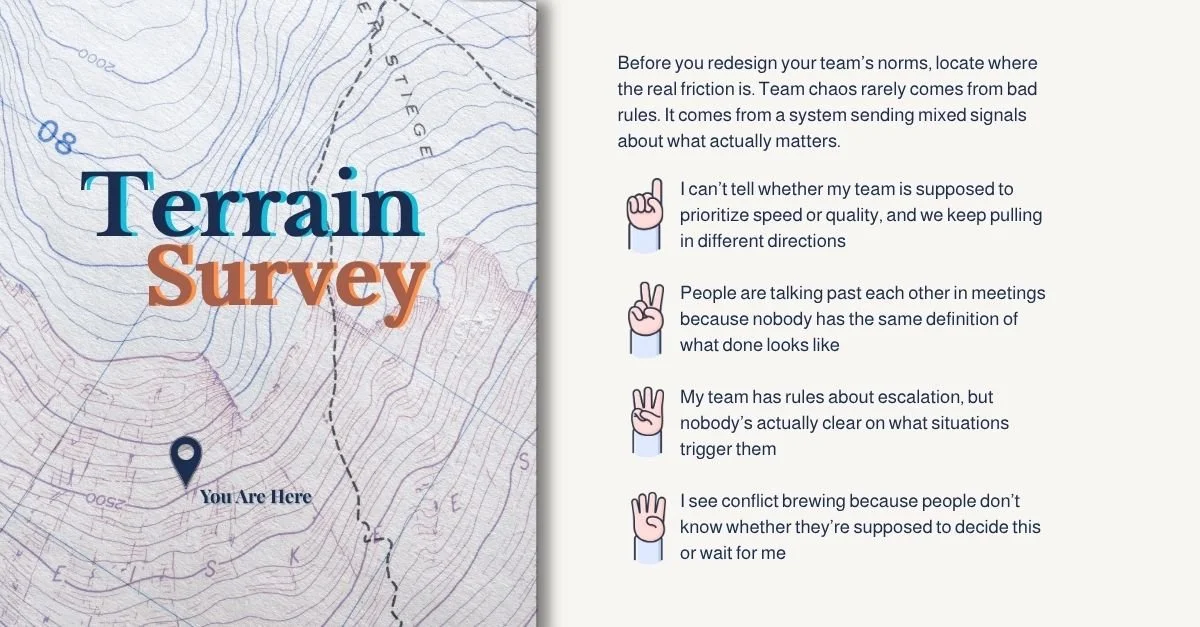
What is the system actually communicating when the rules and the conditions do not align?
Most managers experience team chaos as a norm problem. It rarely is. What feels like scattered priorities, unclear expectations, or people not following the protocol is usually a breakdown in how the system is signaling what matters. When decision-making authority is opaque, when priorities shift without explanation, and when the gap between stated and actual values grows, people stop trusting the norms. They start reading the system instead. And the system is always louder than the poster on the wall.
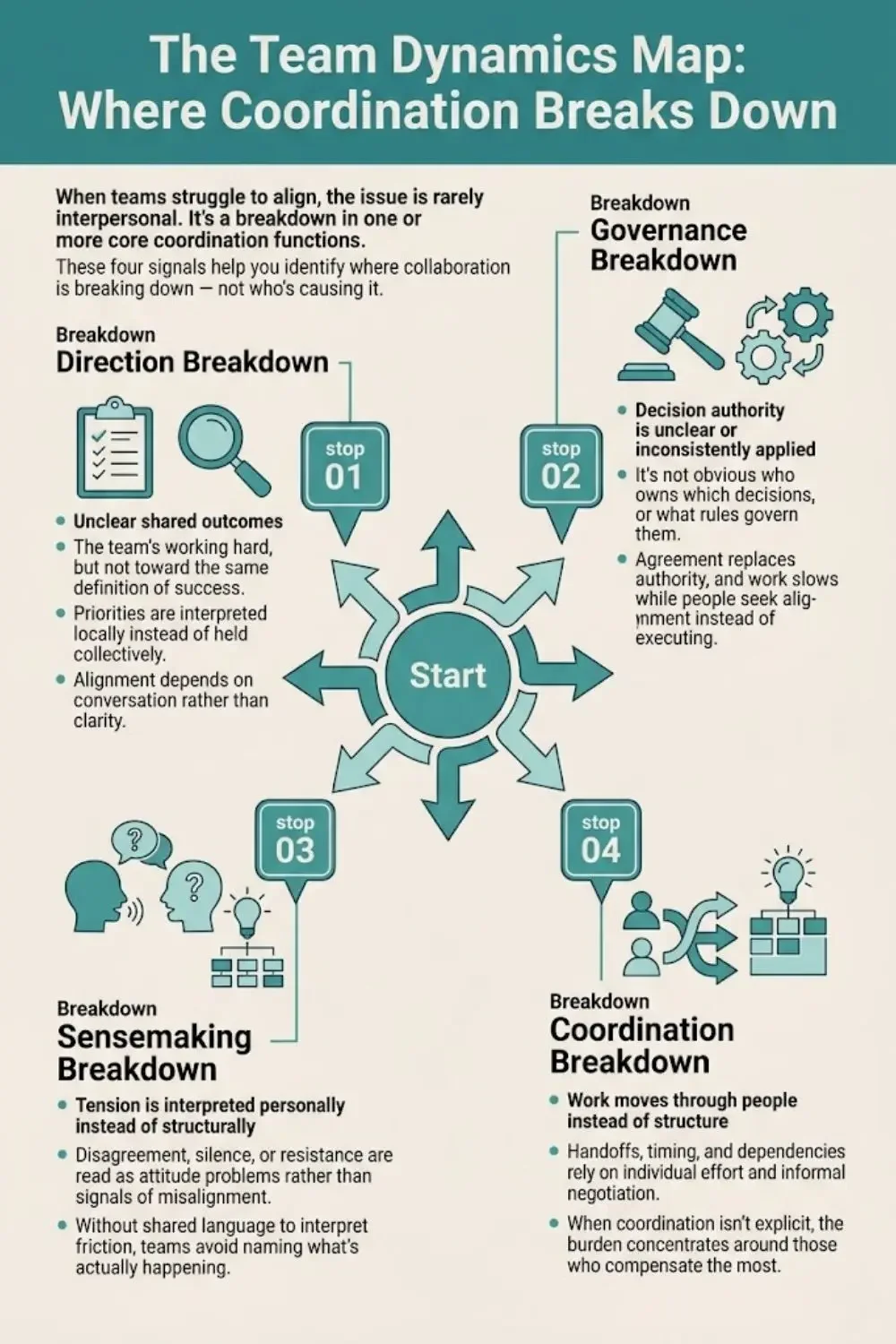
The Team Dynamics Map names four ways teams break down: Direction Breakdown, Governance Breakdown, Sensemaking Breakdown, and Coordination Breakdown. Each one points to a different kind of structural friction. Each one reveals why a norm is not landing.
Which kind of team breakdown are you actually dealing with?
The Team Dynamics Map does not work by adding more rules. It works by making the breakdown visible so the team can stop treating symptoms like causes.
Direction Breakdown happens when the team is working hard but not toward the same definition of success. Priorities are being interpreted locally instead of held collectively. Alignment depends on conversation instead of clarity. In this condition, norms about collaboration or accountability do not help very much, because people are not even oriented toward the same outcome.
Governance Breakdown happens when decision authority is unclear or inconsistently applied. People do not know who owns which decisions, what rules govern them, or when agreement is actually required. Work slows because teams start seeking alignment in places where authority should already be clear. In this condition, norms about escalation, responsiveness, or ownership often create more confusion because the underlying authority structure is still hidden.
Sensemaking Breakdown happens when tension is interpreted personally instead of structurally. Silence looks like disengagement. Resistance looks like attitude. Disagreement looks like a personality problem. Without shared language to interpret friction, teams avoid naming what is actually happening. In this condition, norms about communication or feedback can feel hollow, because the team still lacks a shared way to read conflict.
Coordination Breakdown happens when work moves through people instead of structure. Handoffs, timing, and dependencies rely on individual effort and informal negotiation. The burden concentrates around whoever compensates the most. In this condition, norms about follow-through or teamwork often fail because the system is still depending on human patchwork instead of steady design.
This is the deeper problem with team norms. Managers often try to write the rule before they have named the breakdown.
But the norm has to be built on something real.
If Direction is broken, the team needs shared outcomes.
If Governance is broken, the team needs visible authority.
If Sensemaking is broken, the team needs language for friction.
If Coordination is broken, the team needs structure that does not rely on overcompensation.
The norm only works once the breakdown is surfaced.
Why does this matter for team trust and performance?
This is why the Team Dynamics Map exists. Because managers are drowning in the gap between what they announced and what the system is actually communicating. Because the solution is almost never just a better rule. The solution is a system visible enough that rules can work.
Leadership Cartography’s approach to team dynamics starts from a simple truth: teams fail when the system sends mixed signals. Once the breakdown becomes visible, teams can build norms that actually land.
The shift is from compliance to alignment. People are no longer just following the rule. They are working from shared understanding.
Related Reading
Prioritization Matrix: Stop Being Reactionary and Start Leading