
How to Handle Team Conflict
What Is Team Conflict Really Telling You?
Team conflict is often misread as a personality problem when it is actually a signal that the relational infrastructure around your team has no pathway for tension to surface and resolve. Most managers interpret ongoing friction as evidence that two people are simply incompatible. What the system is actually revealing is that no shared agreements exist for how disagreements get named, addressed, and repaired. Without those structures, conflict compounds quietly until it becomes visible enough to force a reaction. The cost of that delay lands on the whole team, not just the two people involved.
The Moment You Recognize It
You can feel it before anyone says a word. The meeting starts and two people won't look at each other. Someone makes a comment that lands sideways. The rest of the team goes quiet. You sit there thinking: I should say something. But you don't know what to say that won't make it worse.
Maybe you pull one person aside and ask them to be the bigger person. Maybe you wait. Maybe you tell yourself that adults should be able to figure this out without you. These are not failures of courage. They are what happens when a manager has never been handed the language or the structure to move through conflict with any steadiness.
The tension stays. The team absorbs it. People start routing around each other instead of working together. You start dreading your own meetings. And the two people at the center of it are not learning anything. They are rehearsing resentment.
The problem is that no one handed you the language to move through this.
Why Team Conflict Resolution Fails
Most conflict resolution stalls at the diagnosis. No structure exists for what comes next.The friction is real, but the diagnosis is usually wrong, and a wrong diagnosis produces a response that makes things worse.
No shared agreements. Most teams operate on unspoken assumptions about how decisions get made, how credit gets distributed, and how disagreements are supposed to surface. When those assumptions differ between people, friction is the result. The team never failed to care. The agreements were never said out loud.
No repair pathway. Conflict without a structure for resolution tends to calcify. One conversation happens, or doesn't, and the tension goes underground. There is no mechanism for what comes next. Without a repair pathway, managers find themselves managing the same friction over and over.
No language for the manager. When a manager lacks exact language for a conflict conversation, the anxiety of getting it wrong often produces avoidance or vagueness. Vague language ("just work it out," "be professional") signals to both people that the manager is not equipped to help. That erodes credibility faster than the conflict itself.
The wrong frame. When managers frame conflict as a personality issue, the only available responses are removal or endurance. When they frame it as a system gap, the responses multiply. Role clarity, decision rights, communication rhythm, and shared norms all become workable terrain.
Mismatched interventions. A collaboration gap does not respond to the same intervention as broken trust. A team with no norms needs something different than a team navigating a personality clash. Applying a single framework to every conflict pattern is one of the most common reasons resolution attempts fail.
The cost of misreading conflict is not just a difficult team dynamic. It is the slow erosion of your credibility as the leader who sees what is happening and knows how to move through it.
Where you are standing on that terrain matters. That is what the survey below is built to locate.
The Friction Fault Line — Where Are You on the Conflict Map?

Each of these friction points maps to a different set of scripts, structures, and tools. Find yours and get what you need to move forward.
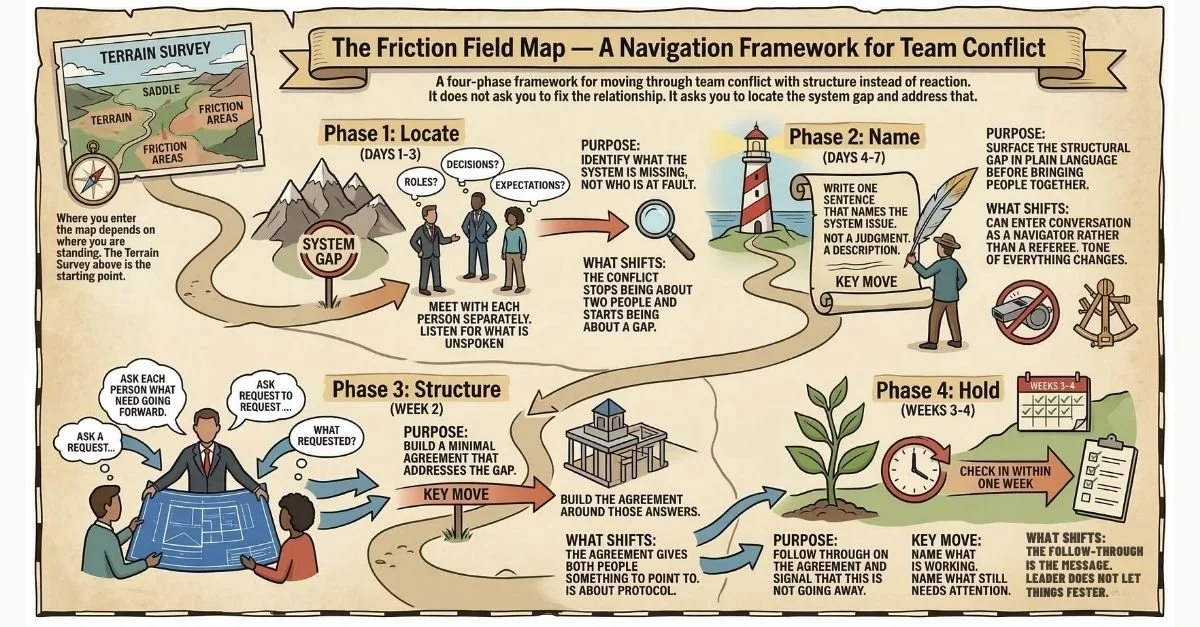
The Friction Field Map — A Navigation Framework for Team Conflict
The Friction Field Map is a four-phase framework for moving through team conflict with structure instead of reaction. It does not ask you to fix the relationship. It asks you to locate the system gap and address that.
Where you enter the map depends on where you are standing. The Terrain Survey above is the starting point.
Phase 1: Locate (Days 1-3) Purpose: Identify what the system is missing, not who is at fault. Key move: Meet with each person separately. Listen for what is unspoken about roles, decisions, or expectations. What shifts: The conflict stops being about two people and starts being about a gap. That shift changes what the next conversation needs to accomplish.
Phase 2: Name (Days 4-7) Purpose: Surface the structural gap in plain language before bringing people together. Key move: Write one sentence that names the system issue. Not a judgment. A description. What shifts: When you can name the gap, you can enter the conversation as a navigator rather than a referee. The tone of everything that follows changes.
Phase 3: Structure (Week 2) Purpose: Build a minimal agreement that addresses the gap. Key move: Ask each person what they need going forward. Build the agreement around those answers. What shifts: The agreement gives both people something to point to. It is no longer about trust or personality. It is about a protocol that exists.
Phase 4: Hold (Weeks 3-4) Purpose: Follow through on the agreement and signal that this is not going away. Key move: Check in within one week. Name what is working. Name what still needs attention. What shifts: The follow-through is the message. It tells your team that this leader does not let things fester.
Frequently Asked Questions About Team Conflict
What if one person refuses to engage? That response is information, not a dead end. You can make clear that the expectation for professional conduct remains in place, that the door is open, and that you will be checking back in. You cannot force participation, but you can make the cost of continued avoidance visible and consistent.
What if the conflict is personal, not work-related? If it shows up at work, it is a work issue. You do not need to resolve the personal relationship. You need to establish what the professional expectations are in this space. The distinction between what is theirs and what belongs to the team gives both people a clear frame to work inside.
What if you are part of the conflict? You are not the right person to facilitate. Bring in your manager, an HR partner, or a trusted peer. Trying to navigate a conflict you are inside will consistently produce more friction, not less.
What if the same conflict keeps recurring? Recurring friction is a structural failure, not a personality pattern. Something about how roles overlap, how decisions get made, or how credit gets distributed needs examination. The intervention point is the system, not the individuals.
What Team Conflict Is Actually Asking Of You
When two people on your team can't work together, it stops being about them.
It becomes a signal that the system around them never established how disagreements get surfaced, processed, and resolved. The people are not broken. The infrastructure is. Most managers were prepared to manage tasks and timelines. Managing the relational architecture of a team was rarely part of what the system thought you needed to know. That is not a personal failure. It is a gap in what leadership development has traditionally prioritized.
Leadership Cartography is built on the premise that conflict, friction, and misalignment are terrain features, not character tests. The manager who learns to read those signals clearly is the one who can move through them without losing steadiness or credibility. That capacity is not a gift. It is a set of tools, and the tools are learnable.
Naming the pattern is not a cure. It is a starting place. A way to step into the tension instead of around it. Every time you do that, your team learns something about what kind of leader is in the room.
What to Do This Week
Write down what the actual pattern is. Not the names of the people involved. What is the system gap? Decision authority, role clarity, communication rhythm, shared norms?
Schedule one private conversation this week. Listen more than you talk.
Before your next team meeting, set one ground rule out loud. It can be brief. The act of naming it matters more than the words.
Revisit How to Give Constructive Feedback That Actually Lands for the conversation skills that make conflict navigation possible.
Related Reading
How to Master the Former Peer Transition