
Imposter Syndrome in Leadership Isn't a Confidence Problem
It's an identity gap. And the system that promoted you created it.
Imposter syndrome in managers is often read as a confidence problem when it is actually an identity gap the system creates at the point of promotion. A manager can be technically excellent, operationally precise, and deeply competent in their domain and still arrive in a leadership role with no clear internal story about who they are as a leader. The promotion system rewards skill. It does not build identity. When a manager sits in a room that asks for vision, inspiration, or presence and finds no map for how to get there, that silence fills with self-doubt. That self-doubt then starts making decisions, slowing action, and pulling leadership attention inward, and the cost lands on the team.

I don't belong here.
That was the verdict I handed myself about six months into being a COO. It arrived clearly, the kind of internal assessment that runs like a post-mortem on a situation that hasn't even finished happening yet.
I had spent years as the person who could see how everything connected. I could trace a product from finished output all the way back to inception, finding every decision point along the way that shaped what it became. I could see where the marketing campaign landed wrong, where the operational SOP was creating drag, where the finance team's cash flow model missed the connection between the physical plant and the product output. I could see where IT systems supported delivery and where they worked against it. I could see where upper leadership was thin and the front lines were carrying weight that didn't belong to them.
All of it, the whole picture, at once.
That felt like leadership. I called it systems thinking. I was proud of it.
What I was describing was analysis.
The moment that distinction became clear was in a room full of people who needed something I hadn't built yet. I had the answers. I had done the homework. I knew where every weak point lived and what it would take to address each one. I stood up to present and felt the sweat in my palms and the nervous texture in my voice, and I watched something happen in the room. The words were right. The data was right. But the room wanted a story about where we were going, and I was giving them a diagnosis of where we had been.
My immediate response was to run an internal analysis. What went wrong? Why did I take this job? What is actually being asked of me here? The conclusion arrived fast: I didn't know how to communicate hope, vision, or inspiration. And if I didn't know how to do that, I had no business being in this chair.
Imposter syndrome works because it convinces you the exposure is coming. The rug will be pulled. Someone in the room will do the math and figure out the numbers don't add up. And the disorientation of carrying that feeling while people are looking to you to lead is one of the loneliest places a manager can land.
Maybe you recognize the version that runs in you. The sweaty palms before a meeting where you feel like everyone can see the gap. The careful preparation that still doesn't feel like enough. The moment after a success where you immediately start explaining why the credit belongs somewhere else. The quiet comparison between where you are and where everyone around you seems to be.
The system that promoted you built the conditions for that voice. Understanding that doesn't make the voice quieter overnight. But it changes what you do about it.
Why does imposter syndrome hit managers so hard?
The system that produces imposter syndrome in leaders is not designed to prevent it. It is designed to promote skill and reward results. Identity is not part of the architecture.
The promotion system advances competence without transferring context. A manager is elevated because they were excellent at what the previous role required. The selection criteria are backward-looking: what did this person deliver? What results did they produce? The new role asks something different, and there is rarely a bridge between the two. The system moves the manager forward and leaves the identity work undone.
The performance measurement system keeps rewarding individual output after the role has changed. The habits that made a manager successful as an individual contributor, thoroughness, precision, personal accountability for every outcome, become friction points in a leadership role. The system still visibly rewards those traits. Leadership behaviors like trust, delegation, presence, and direction are harder to measure. The manager follows the trail of what gets recognized and ends up in a loop where the previous identity keeps getting reinforced while the new role waits.
The feedback system confirms competence without building a leadership story. Managers receive feedback about tasks, deliverables, and outcomes. They rarely receive feedback that helps them understand who they are as a leader. When a manager cannot locate themselves on the leadership terrain, self-doubt fills that gap. The internal assessment becomes: if I cannot see myself clearly here, maybe I am not supposed to be here.
The role change is structural, but the identity shift is not. The org chart updates. The title changes. The responsibilities expand. The internal compass does not automatically recalibrate. A manager who was a brilliant operator, analyst, or specialist carries that identity into a seat that requires something different. The dissonance between who they have always been and who this role requires is not a personal failure. It is a structural gap the system created and left unaddressed.
When those four conditions operate at the same time, imposter syndrome is not a surprise. It is the predictable result of a system that moves people into unfamiliar terrain without giving them a map.
That is where the Terrain Survey below comes in.
The Identity Threshold
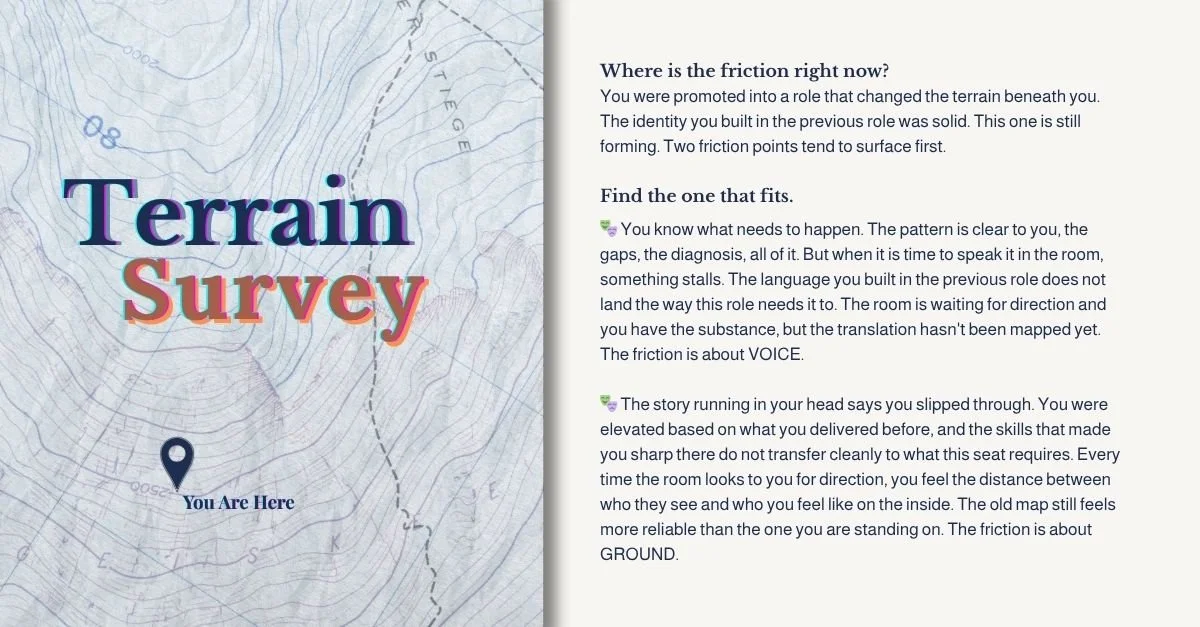
You don't need to have this figured out to take the next step. You just need to know where you are.
How do managers close the leadership identity gap?
The leadership identity gap doesn't close because time passes. It closes because the manager moves through four directions in sequence: locating which terrain they are actually standing on, building an evidence trail the imposter voice cannot override, finding the language for who they are as a leader now, and then operating from that identity once it has enough weight to hold. The sequence matters because each phase asks something different. Jumping to language before the evidence is built tends to produce the same self-doubt in a slightly more polished package.
Most managers stall in the second direction, the inventory, because documentation without structure tends to slip. The voice gets loud, the log stays empty, and the fraud story runs unopposed.
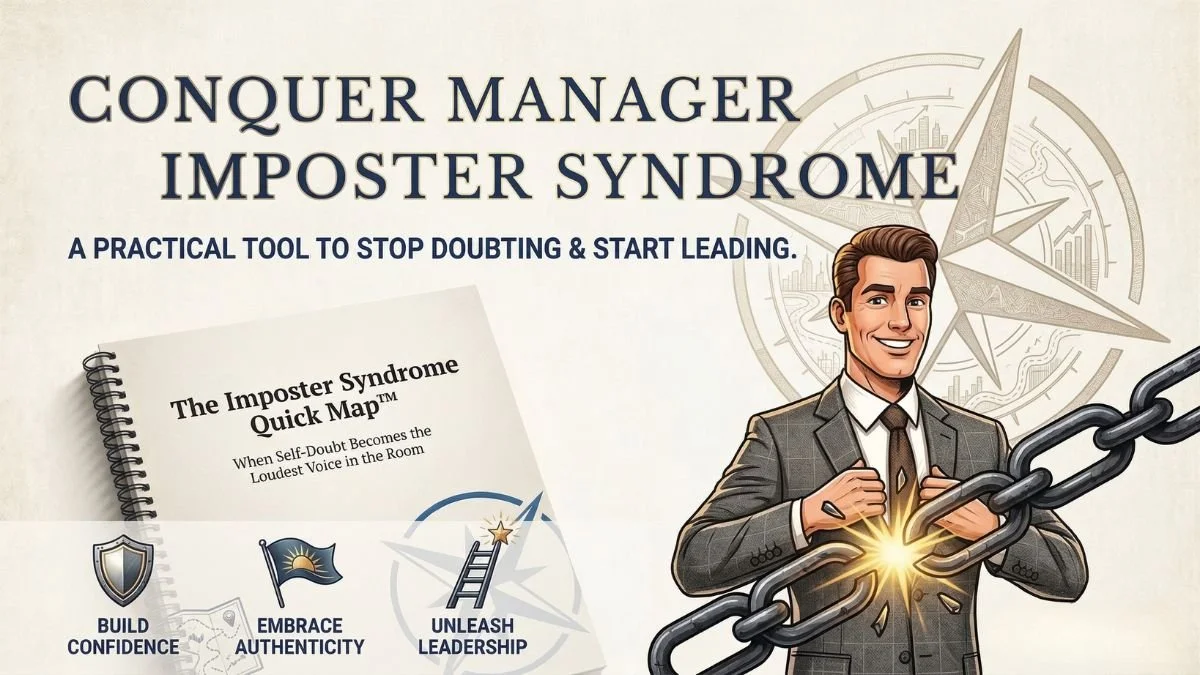
The Imposter Syndrome Quick Map is a fillable PDF tool built for exactly that moment. It names the four patterns self-doubt takes in managers, the over-preparer, the credit deflector, the comparison spiral, and the permission seeker, and gives each one a structural reset. The Evidence Log inside is designed to be filled out when the doubt is loudest, not when things already feel clear.
What do managers most often ask about imposter syndrome in leadership?
Is imposter syndrome a sign that someone was promoted too soon?
Occasionally. More often, it signals that the system promoted someone without equipping them for the identity shift the role requires. The experience of self-doubt is not evidence of a bad promotion. It is evidence of a gap the organization created and left unaddressed.
Does imposter syndrome go away on its own?
It can become quieter with time, but time is not the mechanism. What quiets it is accumulating evidence that the self-doubt narrative is inaccurate, and that requires deliberate documentation, not passive experience.
Why do high performers seem to experience imposter syndrome more intensely?
High performers have a precise internal measuring system. They know exactly what excellent looks like in the domains where they are strong. When they move into unfamiliar territory, that same precision turns inward and measures the gap accurately. The problem is that the measuring system doesn't update to reflect a new context. It is still using the old calibration.
Can a manager lead effectively while experiencing imposter syndrome?
Yes. The question is whether the self-doubt is in the background or making decisions. A manager who notices the doubt but acts from evidence can lead effectively. A manager whose doubt is controlling how they delegate, communicate, or respond to their team cannot.
Why does the leadership identity gap matter beyond the individual manager?
When I stopped arguing with my own self-doubt and started looking at what the system had and hadn't given me, something shifted. Not confidence in the way that phrase usually gets used. Something quieter. I stopped trying to prove I belonged in the chair and started trying to understand what the role actually required. Those are different inquiries, and they produce different results.
The imposter voice is loudest when there is nothing to put in front of it. Leadership Cartography is built around the idea that a manager needs a map before they need advice. The map doesn't tell you what to do. It tells you where you are. That distinction matters because a manager who knows their terrain can make decisions. A manager who is still trying to figure out whether they belong on the terrain is spending that energy in the wrong direction.
Imposter syndrome is terrain. It has friction points, and those friction points are specific. The Identity Threshold above exists to locate which one you are standing on, because the path forward is different depending on the answer.
RELATED READING
Manager Identity: Stop Being a Doer and Start Leading