
Prioritization Matrix: 5 Ways to Stop Being Reactionary and Start Leading
When your calendar runs you instead of the other way around, the problem is rarely your schedule
Reactive management is often misread as a personal discipline problem when it is a structural one. Most mid-career managers were promoted for their ability to respond quickly and handle what others couldn't. That skill served them well until the role changed and no one said so. The system that surrounds managers at this level generates more inputs than any prioritization method can absorb without intentional filtering. Without a structure for distinguishing urgent from important, managers default to the loudest signal in the room. Over time, the workday becomes an exercise in response rather than leadership, and the gap between what the role requires and what gets done widens quietly.

What Happens When Reacting Becomes the Job
There was a stretch in my leadership life when I genuinely believed the volume of my responsiveness was proof of my competence.
My inbox was answered. My calendar was full. My team knew they could reach me at almost any hour. I thought that availability was care.
Looking back, I was running a very efficient machine that was going nowhere in particular.
The thing about reactive management is that it mimics productivity. The days feel full. The effort is real. The exhaustion at the end of the week is legitimate. But when you pause long enough to ask what you actually moved forward, the answer is harder to sit with than you expected.
At some point in a mid-career manager's trajectory, the volume of incoming demands stops being manageable through sheer responsiveness. Something has to give. Most managers interpret that feeling as a personal failing. They go looking for a better calendar system, a tighter morning routine, a more elegant to-do list. They find one. It works for about three weeks. Then the inbox is full again and the calendar is back to running the day.
That cycle repeats because the structure underneath the tool is what needs attention, and most managers never get there.
Why Prioritization Systems Break Down
The role changes faster than the operating model does. Managers absorb new demands without a corresponding clarity about what to stop doing.
Urgency and importance get treated as the same thing. Without a filtering structure, the loudest signal in the room wins.
There is no permission structure for protecting time. Responsiveness is rewarded visibly. Boundary-setting is penalized quietly.
Prioritization frameworks are taught without context. The tool does not prepare managers for the organizational resistance that follows when they try to use it.
The cost accumulates in ways that are hard to trace. Strategic work gets postponed, development conversations get pushed, and the thinking that needs space cannot find it.
When reactive patterns settle into place, they are not usually reversed by trying harder. Something structural has to shift first.
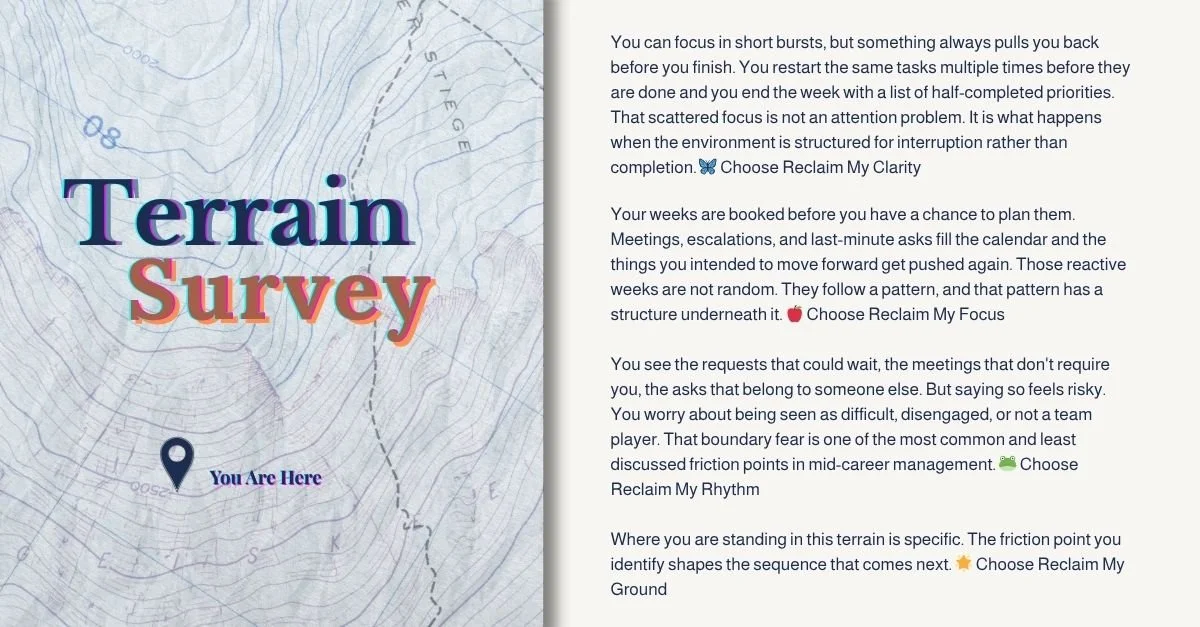
The Priority Fog Terrain Survey
Choose the friction that matches where you are standing.
You know what matters in theory, but when the week actually starts, everything feels equally urgent. You cycle through tasks without a clear sense of what to do first, and by the time you gain traction it is already mid-afternoon. The priority fog doesn't come from laziness. It comes from operating without a filtering structure that matches your actual role.
How to Build a Prioritization Structure That Holds
The system has four phases. Entry point shifts depending on which friction point you identified above.
Phase 1: Name Your Filters. Identify the two or three outcomes only you can move forward and use those as the filter for everything else.
Phase 2: Map the Week Before It Starts. Place strategic work in the hours when cognitive capacity is highest before the week erodes it.
Phase 3: Redesign Your Access. Examine communication patterns, meeting load, and availability expectations and make deliberate adjustments.
Phase 4: Build In Recovery. Protect the intervals that prevent the structure from collapsing under pressure.
Why This Matters
Prioritization tools are easy to find. Planners, matrices, blocking templates, focus trackers. They are not hard to locate and they are not inherently wrong. What they rarely account for is the organizational substrate underneath them, the norms about responsiveness, the invisible penalties for protecting time, the structure that makes certain kinds of work feel illegitimate to claim.
Leadership Cartography exists because the gap between what management books prescribe and what the actual work requires is significant. The five pathways are not productivity frameworks. They are ways of making sense of how different leaders experience pressure, time, and competing demands, and why the same tool works differently for different people.
A manager with a Precision orientation and a manager with a Heart orientation experience reactive management in genuinely different ways. The friction is not the same, the cost is not the same, and the shift is not the same. That difference matters when you are trying to build something that holds.
Reactive management is terrain. What it requires is a map that fits the actual shape of it.
Related Reading
Best Time Management Techniques for Busy Managers