
How to Say No to Your Boss Without Damaging Your Reputation

When you can't say no to your boss, the common default pattern is usually a lack of confidence. The system explanation is more specific though: most organizations never build a development structure for upward negotiation. Requests from leadership travel downward with full momentum and little or no friction. They land on a manager's team without any visibility into what saying yes will displace. So, the manager absorbs the ask, reprioritizes in silence, and delivers. Until they can't anymore or until the work becomes so flatten by the overproduction of tasks completed, that quality of work suffers.
The inability to redirect a senior leader's request isn't due to lack of skill. It's the predictable result of a communication gap that runs in one direction. Capacity information doesn't travel upward in most organizations because no shared language for it exists and no sanctioned pathway for using it was ever built. This is the barrier that makes saying no to your boss feel impossible, and it's a structural one.
Your boss sends a message at 4:30 on a Thursday. New deliverable. Ready by Monday. You look at your team's current load and you already know what this means: something slips, someone works the weekend, or you absorb it yourself and don't sleep. You type back "Sure, I'll figure it out," and then you sit there for a moment, slightly bewildered by your own answer.
That moment is tough to be with sometimes but, It's what happens when the system leaves you no other move.
The ask arrived without context for what it's landing on top of. Your boss doesn't know what Monday looks like for your team because that information hasn't traveled upward in a form anyone can act on. You don't have a framework for translating your team's capacity into language that lands in a conversation with a senior leader. And you've learned, over years of operating inside this structure, that pushing back reads as not being a team player. So you agree. Again.
The friction lives in the gap between what is expected of you to absorb and what it never taught to you when that absorption reaches a limit.
Why does redirecting a senior leader's request feel like a career risk?
The most common explanation is assertiveness. That framing produces the most common solution: confidence coaching, boundary-setting exercises, communication skills training. All of them position the manager as the variable that needs adjusting.
But what the system is doing is more specific than that.
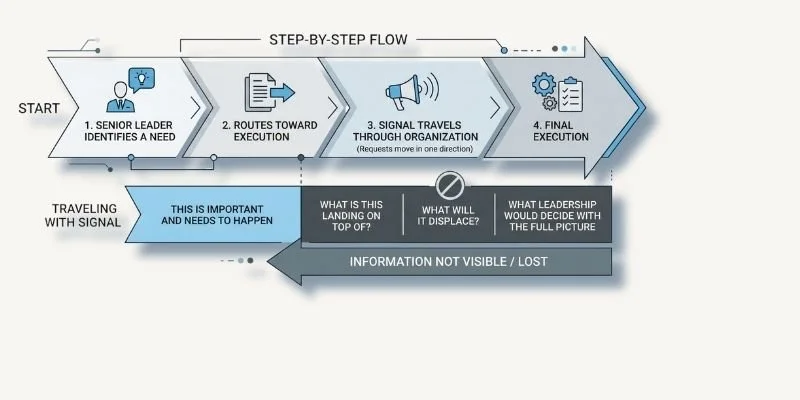
Requests move through organizations in one direction. A senior leader identifies a need and routes it toward execution. The signal that travels is: this is important and it needs to happen. What doesn't travel with it is: what is this landing on top of, what will it displace, and what would leadership decide if they could see the full picture.
The manager receives the request with no context about how much merit the directive requires. Is this a drop-everything priority, or a nice-to-have that would get reconsidered if leadership knew the cost? The manager almost never knows. And managers are rarely taught a structure for finding out.
So the manager guesses. They agree to things that stretch capacity past what's workable. They quietly absorb work that should have been redirected. Over time they become the person who always says yes, because saying no was never modeled as a legitimate option.
The longer this continues, the more invisible the team's actual capacity becomes to the people above them. Leadership isn't managing a team with real limits. They're managing someone whose limits haven't been made visible yet. And when that manager's yes finally breaks, the organization has no frame for why.
What makes the yes pattern so hard to interrupt?
Several system conditions reinforce it.
Requests arrive without consequence data. When a senior leader asks for something by Monday, they're operating on an assumption that the ask is feasible. .
The language of limits doesn't exist. Most managers were never given specific language for the redirect conversation. Not "no" as a flat refusal, but the particular sentence structure that names the constraint, surfaces the trade-off, and invites the senior leader into a decision rather than positioning the manager as the obstacle.
Pattern recognition runs backward. Managers who did push back once and had it go badly carry that forward. The system taught them that the block was real.
Capacity stays invisible. If a team's workload has never been communicated upward in a form leadership can see, every new ask arrives in a vacuum.
The Upward Pressure Terrain Survey
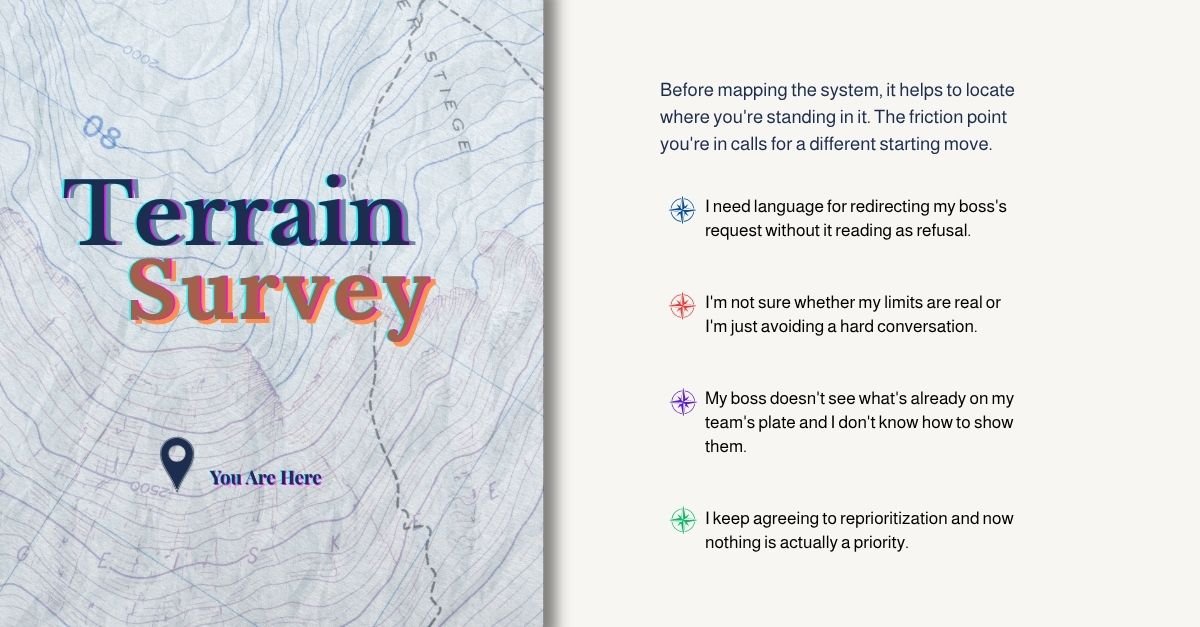
Before mapping the system, it helps to locate where you're standing in it. The friction point you're in calls for a different starting move.
How does a manager navigate upward pressure without losing their footing?
Most managers experience upward pressure as a personal failure.
It rarely is.
What feels like miscommunication, overcommitment, or unclear expectations is usually a breakdown in how work is being translated upward.
When key signals are missing, your boss cannot see what is actually happening. So they push, redirect, or override.
The issue is not effort.
The issue is signal.
The Managing Up Map uses a four-signal framework: Outcome, Evidence, Constraint, and Decision. These are the four elements that make a manager's situation legible to the people above them. When a redirect conversation fails, it's usually because one or more of those signals is missing. The ask lands on leadership without the constraint visible. Or the decision never gets returned to them because the manager absorbed it instead of surfacing it.
The full framework lives on the Managing Up Map. Where you start depends on which signal is most absent from your conversations right now.
Frequently asked questions about saying no to your boss
Is it actually possible to redirect a senior leader without it affecting how they see you?
In most organizations, yes, and the outcome depends more on how the redirect lands than on whether it lands at all. Managers who navigate this effectively almost always do it by making the senior leader part of the decision rather than positioning themselves as a gate. The no that reads as insubordination is usually a flat refusal with no alternative offered. The redirect that works usually names a constraint and surfaces a choice.
What if my organization genuinely doesn't tolerate any upward limit-setting?
That's a real condition and it deserves a direct answer: if the culture cannot absorb any form of upward negotiation, the friction you're feeling is not something a better script will fix. The Managing Up Map covers what's workable within the culture you're operating in, and what patterns signal that the issue runs deeper than a communication gap.
How do I know if I'm describing a real limit or avoiding a hard conversation?
This is usually the question managers are actually sitting with when they hesitate. The distinction is visible in the consequence: is this about what the team can realistically carry, or is it about discomfort with the ask itself? Both are worth examining. Only one calls for a redirect.
What's the first move when I've already said yes to too much?
Making capacity visible is almost always the starting point. Before anything can be renegotiated, the person above you needs to see what "yes" has been accumulating. That conversation isn't about blame or complaint. It's a navigation report: here's what the map currently looks like, and here's what I need you to help me prioritize.
What the saying-yes pattern reveals about management systems
The manager who can't say no is operating inside a system that never constructed a sanctioned pathway for upward negotiation. Requests flow downward because that's the direction the structure allows. They land without context because no shared language for capacity was ever developed. The manager absorbs because absorbing is what the system has trained them to do and what the culture has made legible as the safe response.
Leadership Cartography is built on the recognition that these patterns are terrain features. The friction a manager feels when a new request lands isn't a signal about their limits as a person. It's a signal about a gap in the system they're operating inside. When that gap gets made visible, the options for moving through it multiply.
The manager who learns to surface their team's capacity in language that travels upward, and to redirect with enough clarity that the conversation becomes collaborative rather than resistant, is not pushing back against leadership. They're navigating. And every time they do it with steadiness, they're building a different kind of relationship with the system around them.
Where that navigation starts depends on where you're standing. The Terrain Survey above is the starting point.
Related Reading
The Essential Guide to Managing Up to Your VP or CEO
Prioritization Matrix: 5 Ways to Stop Being Reactionary and Start Leading