
The Best Time Management Techniques for Busy Managers
Time management techniques for busy managers only work when they match the pattern shaping managerial time. Unlike individual contributor roles, manager time is driven by dependency, interruption, and decision gravity. The most effective approach is not adopting more discipline, but identifying whether your week is dominated by reactive mode, priority blur, project drift, or calendar saturation and choosing systems that fit that terrain.
You did not say anything.
The scope expanded and you absorbed it. The deadline moved and you adjusted. The priorities shifted and you reorganized your week without telling anyone what that cost you.
Not because you did not notice. Because you have learned, in ways that are hard to talk about, that speaking up about capacity has consequences. So you got quieter and more efficient and increasingly behind on work that actually matters.
By Tuesday afternoon, the calendar you built on Monday is already gone. You said yes to things you did not have room for, and no one in the room knew that except you.
The Answer That Rarely Gets Offered
Time management struggles for managers are rarely a discipline problem.
They are a pattern problem.
Most managers apply techniques designed for stable, predictable work to roles that are neither stable nor predictable. When the technique breaks, the manager absorbs the failure instead of questioning whether the technique ever fit the terrain.
When that happens repeatedly, time management stops feeling practical and starts feeling personal.
Why Manager Time Behaves Differently
Most time management advice is written for people who control most of their day.
Managers do not.
Managerial time is shaped by dependency. Other people’s work flows through you. Decisions land where clarity is missing. Authority attracts attention whether you invite it or not.
Several dynamics tend to converge:
Your time is shared, not owned.
Urgency arrives without context.
Reactive work crowds out thinking work.
Calendars reflect other people’s priorities before your own.
None of this means you are doing something wrong. It means you are operating inside a system that redistributes time in specific ways.
The Translation
When time management keeps breaking, it stops being an organization issue.
It becomes a signal that the system is pulling attention faster than it can be meaningfully organized.
A Different Way to Look at Time
Most conversations about time management assume the problem lives inside the person.
More discipline. Better habits. Tighter control.
But managerial time does not behave like personal time. It moves according to forces that are often outside the manager’s direct control. Authority pulls attention. Uncertainty attracts decisions. Urgency spreads faster than clarity.
Seen this way, time pressure is not a personal shortcoming. It is a visibility problem.
When you cannot see what is shaping your time, every technique feels fragile. When you can see it, even small adjustments start to hold.
This way of looking at time comes from the broader framework of Leadership Cartography. It treats recurring managerial friction not as evidence of personal weakness, but as terrain signals. The work is not to push harder against the calendar. It is to understand what kind of system you are standing inside so you can respond with clarity instead of self-blame.
The question shifts quietly.
Not how do I control my time,
but what is currently controlling the flow of attention around me.
Once that becomes visible, choice re-enters the picture.
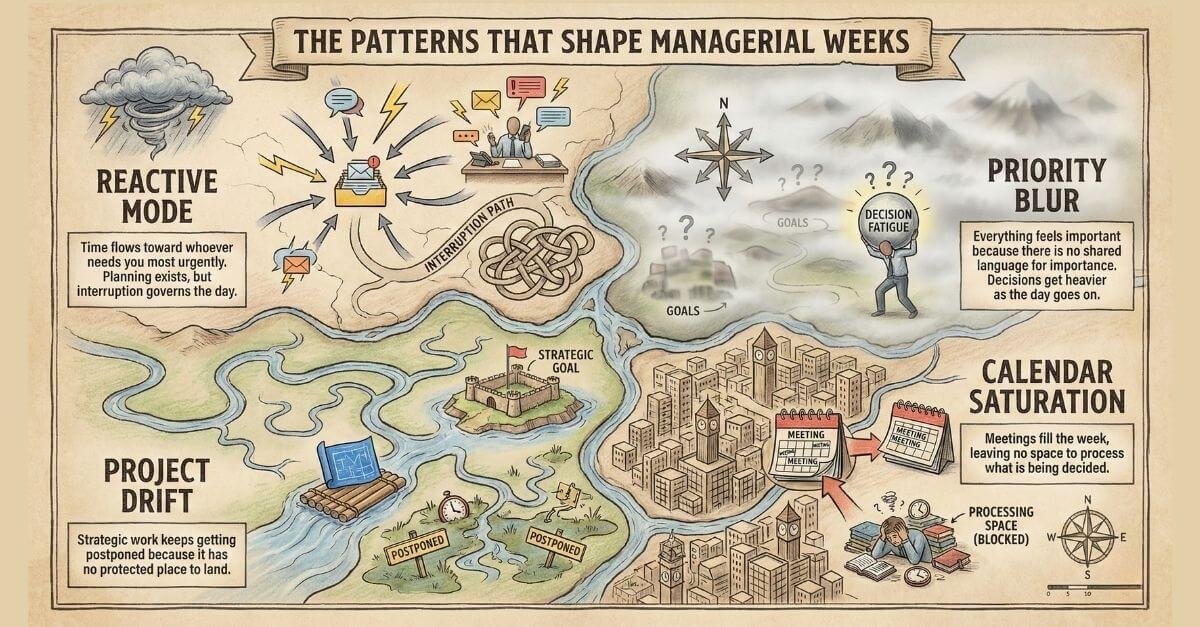
The Patterns That Shape Managerial Weeks
Across organizations, time pressure tends to cluster into a few recognizable patterns. These are not traits. They are conditions.
Reactive Mode
Time flows toward whoever needs you most urgently. Planning exists, but interruption governs the day.
Priority Blur
Everything feels important because there is no shared language for importance. Decisions get heavier as the day goes on.
Project Drift
Strategic work keeps getting postponed because it has no protected place to land.
Calendar Saturation
Meetings fill the week, leaving no space to process what is being decided. Each pattern distorts time differently. Each one makes certain techniques fail on contact.
The Time Tundra: Where Are You on the Map?
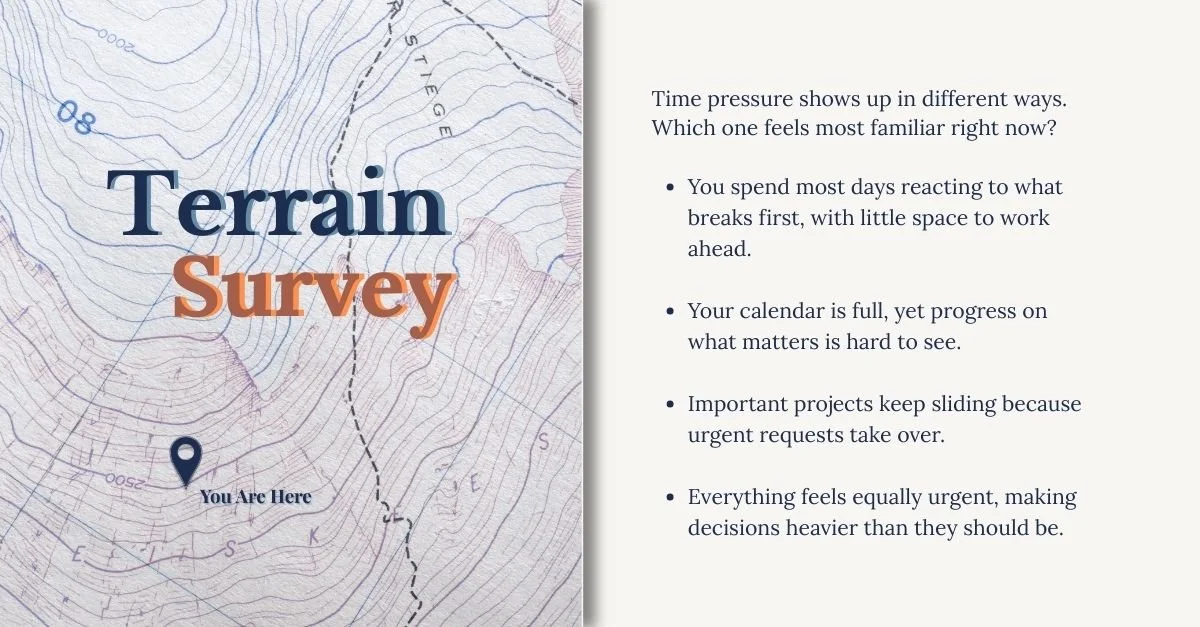
Choose the description that matches what you are standing in.
Why Techniques Fail Without Orientation
Time blocking fails when interruption is the dominant force.
Prioritization lists fail when urgency is undefined.
Focus rituals fail when processing time does not exist.
This is why time management advice often feels exhausting instead of helpful. It assumes the wrong conditions.
When the pattern is named first, techniques stop being prescriptions. They become options. Routes rather than rules.
The Cost of Misreading the Problem
When managers interpret time pressure as a personal failing, several things happen quietly:
Strategic work keeps getting delayed. Decision quality erodes. Burnout accelerates. The calendar becomes something to survive rather than shape. None of this improves by trying harder. It improves when the forces shaping time are seen clearly enough to work with rather than against.
Where This Becomes Useful
This perspective matters most during weeks that feel full but unproductive. In those moments, the question is not whether you are capable. The question is whether the system currently supports the kind of leadership you are being asked to provide, and whether you can remain steady long enough to see that honestly.
Seeing the pattern is already a shift.
Time management gets harder when it is treated like a character flaw.
It gets lighter when it is treated like a pattern that can be seen, named, and worked with.
You do not need more hours.
You need clearer sight lines.
When the terrain becomes legible, the calendar stops feeling hostile. It starts feeling navigable again. If this is your terrain, return to the Time Pattern Map to choose your route.