
The Hidden Behaviors That Turn You Into a Micromanager
Micromanaging is often misread as a personality flaw when it is more accurately a system response. When delegation has not fully transferred ownership, when decision rights remain unclear, and when mistakes are treated as the manager's personal failure, staying close to the work becomes the most rational available option. The system creates the conditions. The manager adapts to them. Without clear standards, shared ownership structures, and visible recovery paths, letting go does not feel like trust. It feels like risk without a net.

For a bit part of my management career, I believed my standards were the system.
I had a way I wanted things done. A particular sequence. A specific tone in customer communication. A threshold for what counted as acceptable. When my team didn't execute the way I envisioned, I would step in, redo the work, and move on without ever circling back to explain why.
What I told myself was that it was faster. What I didn't say out loud was that I had no idea how to give direction that actually transferred the picture in my head into someone else's hands. I didn't know how to build a standard someone else could follow. So rather than figure that out, I just stayed close to the work. If I was always nearby, the gap between what I meant and what landed never had to surface.
I thought I was protecting outcomes.
I was protecting myself from the discomfort of learning how to delegate.
That distinction took years to see. And I only saw it when I finally ran out of capacity to keep doing it alone.
If you've stayed late rewriting something your team already finished, or pulled work back midway through because you weren't sure it was going to land, or felt a specific quiet relief when you took something off someone else's plate — this terrain is probably familiar. It doesn't mean you're controlling by nature. It means the system handed you a gap and you filled it the only way that felt safe.
Micromanaging is often the first visible symptom of a deeper signal. Behind the worry is a simple truth: work quality is tied to your performance, so control starts to feel protective.
Micromanaging Is Often Not a Control Issue
This is why micromanaging rarely begins as a conscious choice.
It shows up when delegation has not fully transferred ownership. If the manager is still the person carrying the risk for outcomes, staying close to the work becomes the most rational way to reduce exposure. This is not about controlling people. It is about managing uncertainty.
When decision rights are unclear, standards remain implicit rather than shared, and mistakes trigger penalty instead of recovery, distance becomes dangerous. In that environment, constant oversight is not a preference. It is a protective response.
What appears as “control” is often a delegation structure that never stabilized enough to support distributed authority.
Over time, this creates a quiet distortion. Progress begins to depend on the manager’s presence rather than shared clarity. What looks like high standards is often unresolved delegation design.
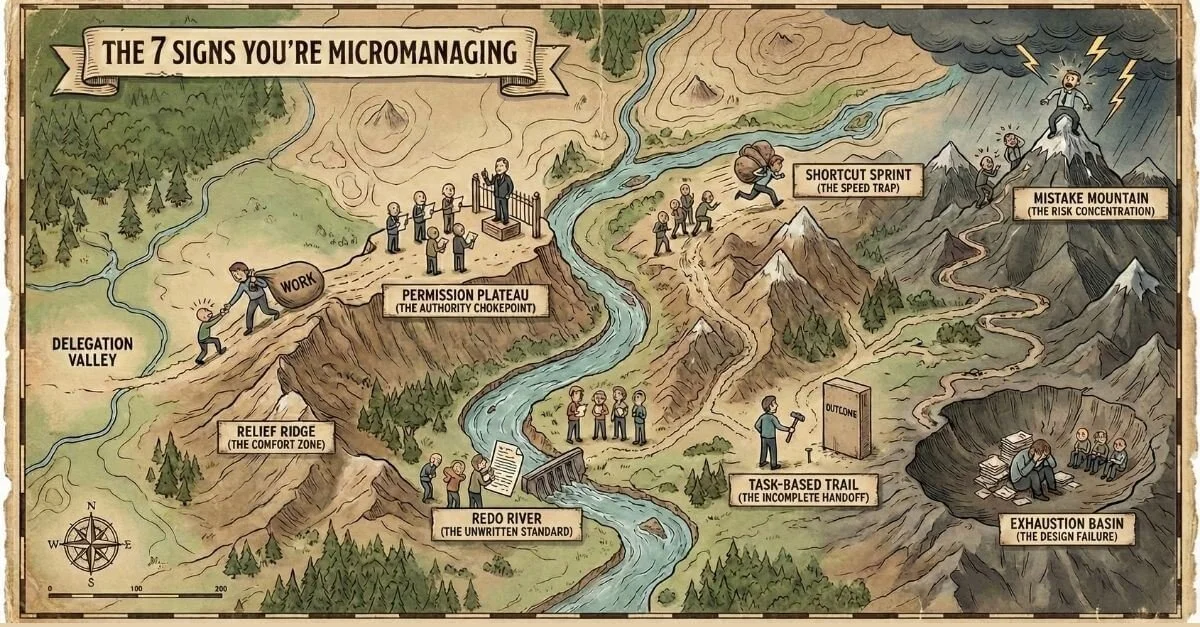
Why This Fails and What the System is Doing.
Micromanaging doesn't persist because managers lack self-awareness. It persists because the conditions that create it rarely get addressed.
Ownership never fully transferred. Most delegation hands off a task, not a result. When the manager is still carrying the accountability for whether the outcome lands, staying close to the work is not irrational. The delegation didn't actually move the risk. It just moved the doing.
Standards live in one person's head. When quality is defined by what the manager would have done, there is no shared reference point. The team can't hit a target they can't see. What looks like underperformance is often a visibility problem. The standard was never made legible.
Mistakes travel upward. In environments where a team member's error becomes the manager's performance problem, distance becomes dangerous. The cost of something going wrong lands on the manager regardless of who made the call. Tight oversight becomes a form of risk management, not preference.
Decision rights stay provisional. When there is no clear moment at which authority has been earned or transferred, team members keep checking in. Managers keep answering. The dependency holds because neither side has a map that says: this is yours to decide.
Recovery paths don't exist. When there is no shared process for what happens after something goes wrong, the only way to prevent the cost of a mistake is to prevent the mistake. Coaching becomes supervision. Learning becomes unlikely.
The cost of all of this is not just exhaustion on one side and underutilization on the other. It is a team that gradually stops developing independent judgment, and a manager who gradually becomes the ceiling on their own function's capacity.
These patterns do not form in isolation. They are shaped.None of these mean you are a bad manager. They mean the trust map is incomplete.
What the System Is Rewarding
Those patterns do not form in isolation. They are shaped by the environment around you.
A system can reward over control when the following conditions occur:
Mistakes made by team members are treated as the manager’s failure rather than a shared learning signal.
Manager performance is measured by error prevention instead of team capability development.
“Good management” is defined as knowing every detail rather than building independent judgment in others.
Leadership visibility comes from being in every room instead of having a team that can represent the function.
Authority is tied to being the most knowledgeable person rather than the person who grows knowledge across the system.
A system can also make autonomy feel risky when:
Delegation without perfect outcomes damages a manager’s credibility.
There is no clear moment when decision rights are earned, so authority remains provisional.
Quality standards live in people’s heads instead of being visible and transferable.
Mistakes are penalized rather than coached.
Managers carry accountability for results without authority to adjust capacity, scope, or standards.
When these conditions are active, tight control is not a flaw.
It is a protective adaptation.
The Delegation Desert: Where Are You on the Trust Map?
Note: Use the attached Terrain Survey image in this position. The image contains the four friction points with the "You Are Here" map visual and button options.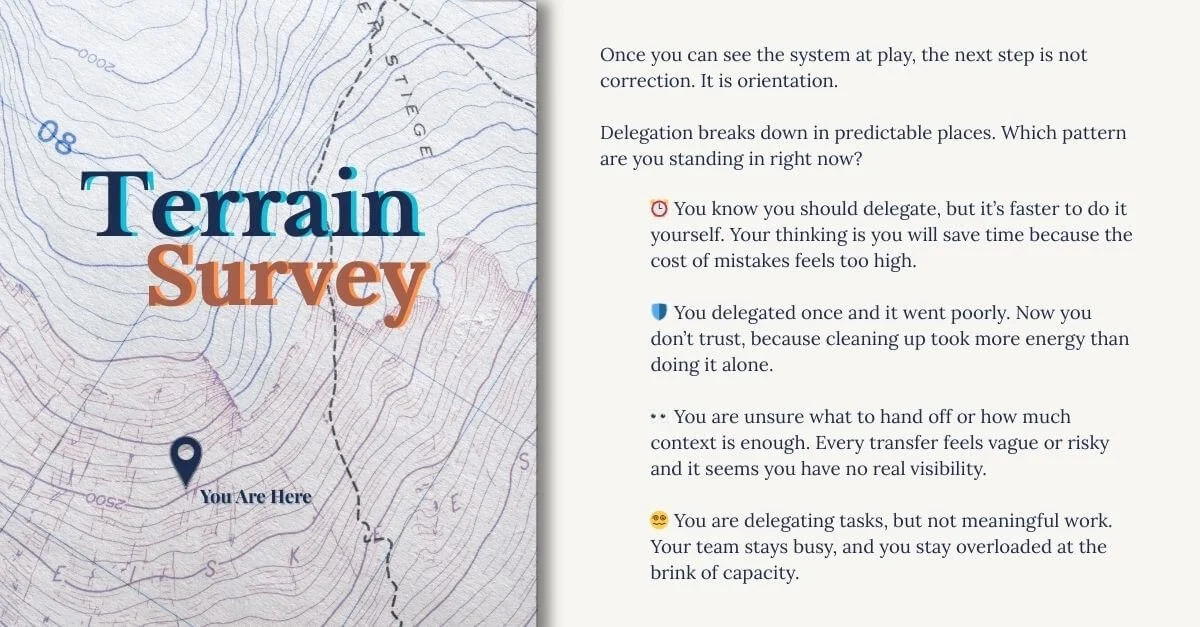
Choose the relief that matches your terrain.
The Map — Translating the Pattern Into Information
If you stopped reading right now and changed nothing, something has already shifted.
Micromanaging can be read as a system response rather than a character problem. The pattern is not happening because you are naturally controlling or incapable of trust. It is happening because the environment makes distributed authority unclear, unsafe, or unsupported.
That distinction matters. It changes what is available to you.
You are no longer trying to fix yourself. You are locating which conditions would need to shift for control to distribute safely — or recognizing that some of those conditions sit outside your authority to change.
That is not failure. That is terrain legibility.
What Does Micromanaging Actually Signal?
From here, a different kind of question becomes possible.
Instead of asking why you are like this, the more useful question is what conditions make this response feel necessary.
When micromanaging is read this way, it stops being about willpower or trust. It becomes a clue. It points to where responsibility, risk, and authority are misaligned. It tells you something about how quality is defined, how mistakes are handled, and who actually carries the consequences when work doesn't land.
This pattern is not something to eliminate by force. It is something to locate, so you can see what the system is asking you to protect.
For a deeper look at why delegation breaks down, read the Effective Delegation Guide.
Why Does "Just Let Go" Rarely Work?
Most advice misses the mark here.
Telling a manager to trust more or let go assumes the system can already hold the work. When it cannot, releasing feels reckless rather than responsible.
Trust is not a feeling. It is infrastructure.
Without clear ownership, visible standards, shared feedback loops, and safe recovery paths, release is not a real option. Control stays because it is the only available stabilizer. The advice to simply let go lands as one more thing you are failing to do, rather than a sign that the structure underneath you was never built to carry the weight.
What Does a Steadier Path Look Like?
This matters most when pressure is high and visibility is low.
In those moments, the question is not whether you should trust your team more — or how to stop micromanaging by sheer will. The question is whether the system makes trust possible without putting everything at risk.
If this is your terrain, the Delegation Block Map is where to continue. Not to fix the behavior but to read the signal it is sending.
And if you haven't mapped your leadership pathway yet, the Leadership Pathway Explorer is where the deeper terrain work begins — and where Field Notes finds you each week with what the map is showing.
FAQ
What is the difference between high standards and micromanaging? High standards exist in the system — in documented expectations, shared criteria, and feedback that builds toward those expectations. Micromanaging exists when the standard is only visible to the manager and correction happens through intervention rather than transfer.
How do I know if I'm micromanaging or just managing carefully? One useful signal: does your team's work improve when you're not in the room? If your presence is what holds quality together rather than a shared understanding of what quality means, the standard is still in your hands.
Why does "just trust your team more" rarely work? Because trust is not a disposition. It is an infrastructure. If the ownership structure is unclear, if there are no recovery paths, and if mistakes travel upward as personal failures, releasing control does not produce trust. It produces risk.
What should I do when I've already taken work back repeatedly? Before taking work back again, name the standard out loud. Not after the fact. Before the next assignment. If you cannot articulate the standard in a way someone else could follow independently, that is where the work is — not in the work itself.
Why This Matters
Leadership Cartography™ was built on the premise that most management problems are terrain problems.
The micromanagement pattern is one of the clearest examples. It is almost never about the manager's character. It is about a delegation structure that was never designed to hold distributed authority, and a system that rewards close oversight over capacity building.
Seeing that doesn't make it easier to change immediately. But it does change what you're actually looking at. You are not locating a flaw. You are reading a map. And once you can see the terrain, you can start to navigate it.
The Delegation Block Map at YourLeadershipMap.com is where this work continues.