
How to Set Boundaries as a Manager When You Can't Say No
Heart Managers become the team's safety net by leading with empathy and care—but often end up burnt out and resentful when they can't set boundaries. The 3-Step Boundary Check helps you reclaim your energy in ten minutes by identifying false dependencies (is this actually my problem?), setting coaching boundaries with care ("I can't, but I can"), and re-anchoring to your mission (how does this boundary help me lead sustainably?).
You're the manager everyone goes to.
When someone's struggling with a personal crisis, they come to you. When the project feels overwhelming, they knock on your door. When they just need someone to listen, you're the one who makes time. You genuinely care about your team's well-being, their weekend plans, and their personal struggles. You lead with Heart, making empathy, relationships, and care your primary navigational tool. Setting boundaries feels impossible when you lead with empathy and care.
And it's exhausting.
When relationship-building isn't moving your team forward, you might need Precision pathway tools - clear questions, defined roles, and structured decision-making.
I know this feeling intimately. Early in my management career, I prided myself on being the manager people could talk to. I was the one who stayed late to help someone untangle a work problem. I was the one who listened to an hour-long story about a difficult divorce, a sick parent, or a team conflict that didn't even involve me. I thought this was what good leadership looked like.
Until I realized I was three weeks behind on my own strategic work, and I couldn't remember the last time I'd left the office without feeling completely drained.

Lead with Heart
🎧 Prefer to listen? Episode 8 explores the full Lead with Heart™ pathway—your strengths as a "retention landmark," the hazards that drain your reserves, and tools like the 3:1 Coaching Compass and Two-Line Boundary Marker.
Or keep reading for the 3-Step Boundary Check—the specific tool you need when boundaries feel impossible.
Listen to Episode 8: Lead with Heart™ — Navigating Leadership with Care & Clarity
The Empathy Trap
If you've taken the Explorer Quiz and found yourself on the Heart Pathway, your gift is connection. You create psychological safety just by showing up. People trust you because you actually care, and that's not nothing—that's everything in a world where most managers treat people like resources on a spreadsheet.
But under pressure, that gift turns into its shadow. You absorb responsibility that isn't yours. You avoid conflict because you don't want to hurt feelings. You keep giving away your time and energy, but the problems never fully resolve, and your own clarity suffers.
I call this the Empathy Trap. You're standing in the middle of it, holding everyone else's problems, and slowly sinking
Being the safety net is great, but you can't be the safety net and the floor.
The panic point looks like this: you feel burnt out, resentful, and utterly stuck. You know you need boundaries, but every time you try to set one, you feel like you're letting someone down.
The Moment I Realized I Was the Problem
I had a direct report—let's call her Maya—who came to me every single week with a crisis. Her project was behind schedule. Her stakeholder was being difficult. Her team wasn't listening to her. And every week, I'd sit with her, work through the problem, and help her figure out what to do.
One day, my own manager pulled me aside and said, "You know Maya's project is three months overdue, right? And you've been 'helping' her the entire time."
It hit me like a brick. I wasn't helping Maya. I was enabling her. By constantly stepping in to solve her problems, I'd taught her that she didn't have to solve them herself. And I'd sacrificed my own strategic work to do it.
I wasn't being a good leader. I was being a crutch.
The 3-Step Boundary Check: Your 10-Minute Energy Reclaim Tool
This tool is designed for managers who lead with Heart. It restores sustainable energy by creating clear, empathetic boundaries in three vital areas. Use it when you're feeling drained and need to stop asking "How can I fix this for them?" and start asking "How can I coach them toward their own solution?"
1. Identify the Dependency (The "Why is this mine?")
Heart managers absorb responsibility that isn't theirs. Before you act, check if the problem truly belongs to you.
The Ownership Check
Question: Who is actually responsible for the success or failure of this task?
Example: Team Member is responsible. My role is to provide resources, not execution.
The Emotion vs. Task
Question: Am I responding to the problem, or am I responding to the high emotion attached to the problem?
Example: Responding to anxiety. Boundary needed: Acknowledge the feeling, then pivot to the facts.
The Time Cost
Question: How much time will fixing this for them cost me, and what priority task will I sacrifice?
Example: Cost is 1 hour. Sacrificing strategic planning. I cannot afford this cost.
2. Set the Coaching Line (The "Refusal with Care")
The Heart Manager must learn to refuse a dependency while preserving the relationship. This is the hardest part, because it feels like you're being cold. You're not. You're being clear.
Acknowledge the Pain
Question: What is the quickest way to validate their experience without taking the problem?
Example: "That sounds incredibly frustrating and stressful."
State the Boundary
Question: Use the "I can't, but I can" framework to decline the execution but offer support.
Example: "I can't jump in and finish the report (Boundary), but I can spend 15 minutes helping you outline the next steps (Support)."
Define the Next Action
Question: Force the team member to own the next step, rather than waiting for you.
Example: "What's the single next move you are going to take, and when should we check back in?"
3. Re-Anchor the Heart (The "Energy Reclaim")
Heart Managers feel guilt when setting boundaries. This final check transforms guilt into a renewed sense of purpose.
The Self-Check
Question: How does setting this boundary help me be a more sustainable leader for the whole team?
Example: It ensures I have the time and energy to focus on the team's top priorities, not just the loudest emergency.
The Confidence Affirmation
Question: What quality am I expressing right now by being clear?
Example: I am leading with clarity and care by teaching resilience, not enabling dependence.
The Mission Link
Question: Remind yourself why sustainable care links back to the larger company mission.
Example: By protecting my energy, I protect the team's ability to execute on the long-term vision.
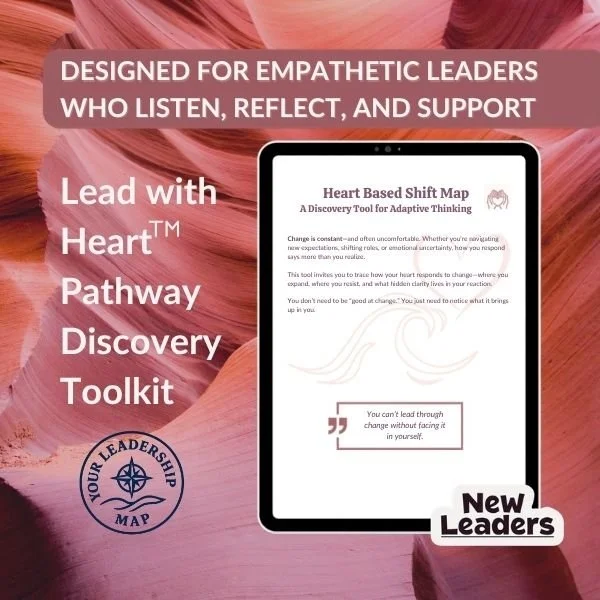
Lead with Heart™ helps new and newly-promoted managers lead with empathy without losing momentum.
What you’ll get:
Guided discovery sequence to clarify how you work best
Fillable prompts + reflection grids to map real conversations
Practical scripts for trust-building and boundary-setting
A one-page map to anchor weekly check-ins
Format: Fillable PDF (instant download).
Ideal for: New managers, team leads, and anyone rebuilding trust after change.
What Happened with Maya
After my manager's wake-up call, I sat down with Maya and had a different kind of conversation. I told her I'd been doing her a disservice by jumping in every time she hit a roadblock. I acknowledged that her project was hard, and that her stakeholder was legitimately difficult. And then I said, "What's the single next move you're going to take?"
She stared at me. She wasn't used to me not solving it for her.
"I don't know," she said finally. "That's why I came to you."
"I know," I said. "But I can't keep solving this for you, because it's teaching you that you can't solve it yourself. And I know you can."
It was uncomfortable. She left my office frustrated. But two days later, she came back with a plan. She'd scheduled a direct conversation with her stakeholder. She'd mapped out the next three critical milestones. She'd figured it out.
And three months later, her project launched. Not because I fixed it for her. Because I stopped fixing it for her.
Leading with Intention
Leading with Heart isn't about solving every problem for everyone. It's about building a strong foundation of trust and empowerment that lets your team grow. When you stop fearing boundaries and start clarifying the nine coordinates above, you transform burnout into sustainable empathy.
You show up as the leader your team needs: the one holding the map, not the one carrying everyone's luggage.
Have you ever realized you were enabling someone instead of empowering them?
What did it take for you to change the pattern?
Common Questions About Setting Boundaries
"What if setting boundaries damages my relationship with my team?"
Boundaries don't damage relationships—unclear expectations do. When you say yes to everything, your team never knows when they're asking too much, when you're overwhelmed, or when they should solve problems themselves. That creates anxiety, not trust. Clear boundaries ("I can't finish this for you, but I can help you outline next steps") actually strengthen relationships because people know where they stand.
"How do I say no without feeling guilty?"
Guilt comes from believing you're responsible for solving everyone's problems. You're not. You're responsible for helping people build the capability to solve their own problems. Reframe the boundary as development: "If I step in every time, I'm teaching you that you can't do this yourself. I know you can." The guilt fades when you remember that boundaries serve their growth, not just your energy.
"What if my team member really does need help and I refuse?"
There's a difference between helping and rescuing. Helping looks like: coaching them through the problem, providing resources, removing a legitimate blocker. Rescuing looks like: doing their work for them, absorbing responsibility that's theirs, protecting them from consequences they need to learn from. Use the "I can't, but I can" framework: acknowledge the need, refuse the rescue, offer appropriate support.
"What if I've been enabling someone for months—is it too late to change?"
No. It's uncomfortable, but it's not too late. Have the conversation: "I've been thinking about how I can better support your growth. I realize I've been stepping in to solve problems for you, and that's not serving either of us. Going forward, I'm going to coach you through challenges instead of fixing them. This might feel different, but I'm doing it because I believe you're capable." Expect pushback. Hold the boundary anyway.
"How do I set boundaries with my own manager who keeps dumping work on me?"
Same framework, different level. When your manager asks you to take something on: "I want to support this, and I'm currently at capacity with [list top 3 priorities]. If I take this on, which of these should I deprioritize or hand off?" You're not saying no—you're making the trade-off visible and asking them to make the call. Most managers don't realize they're overloading you until you show them the full picture.

Ready to explore how you naturally lead?
Take the Leadership Pathway Explorer to discover your instinctive management style.
If you're on the Lead with Heart™ pathway, learn more about the Leadership Cartography™ system and how all five pathways work together.

Want tools like this delivered monthly?
Join Map Drawer and get three practical management tools every month for $15.
Go Deeper Into the Heart Pathway
This post gave you the 3-Step Boundary Check for setting boundaries without guilt. But there's more to explore about leading with empathy sustainably.
Episode 8 covers:
Your strengths: retention landmark, conflict bridge, early warning beacon
Your hazards: rescue mode, boundary fade, stalled decisions
Additional tools: 3:1 Coaching Compass, Two-Line Boundary Marker, Time-Boxed Listening Post
A 7-day practice to balance care with clarity
Listen to Episode 8: Lead with Heart™ (10 min)