
What a Stalled Project Means, and How to Fix It
A stalled project is one that is still active but no longer moving: tasks sit in waiting states, the deadline holds, and no one says what's actually blocking it. The 3×3 Clarity Map gives managers nine specific questions to ask in ten minutes: three to define the destination (what must we deliver?), three to chart the route (what's the single next move?), and three to set standards (who owns this?). The tool works by forcing teams to say the real blocker out loud, the one they've been avoiding.
A project is stalled when work has effectively stopped even though the project remains active. The deadline may still exist, tasks may still be assigned, and meetings may still be happening, but meaningful progress has stopped.
What does a stalled project mean?
It's Tuesday morning, and you're staring at a stalled project on the dashboard. Everything is red. The deadline hasn't moved, but the task list has become a chaotic swamp of "waiting for approval" and "on hold." You can sense the low-grade frustration building across the team, and that familiar pit in your stomach tells you the project is officially stalling.
When I led operations, I had this moment at least once a quarter. The kind where you sit in a meeting and everyone's talking, but nobody's saying anything real. "We need better communication." "We're lacking buy-in." "Everyone's blocked." And you're thinking: just tell me what the actual problem is.
As someone who leads with Precision, your instinct in these moments is to restore order. When the world gets foggy, you reach for systems, clarity, and intentional execution. Your strength is mapping the road clearly enough that everyone knows where they are and why they're there.
But under pressure, that gift can turn into its shadow. You get rigid. You over-index on rules. You try to simplify human problems into systems problems, and sometimes that works, and sometimes it just makes people feel like you're not listening.
I've been that manager. The one who thought if I just made the process clearer, people would stop being confused. It took me years to understand that sometimes the process is clear, and the confusion is about something deeper.
Where Precision gets stuck
If you lead with Precision, you're the team's anchor when chaos hits. You keep the map steady when everyone else is spinning. And you still need a tool for the moments when even the map stops making sense.
If you're not sure Precision is your pathway, knowing how you default under pressure tells you why you reach for the tools you reach for. Find your source first.
The panic point looks like this: the project is stalled, but every conversation stays vague. Nobody wants to say the real blocker out loud. You need to get to the real blocker and restore the clear coordinates of execution. You need something simple and fast.
When everyone's talking but nobody's saying anything real, the fix is better questions.
Why do projects stall?
Most stalled projects are not stalled because people aren't working. They're stalled because something important has become ambiguous. The destination is unclear, the next move isn't agreed upon, a dependency has no owner, or two people are operating from different definitions of “done.”
The fastest way to restart the work is to find which coordinate has gone missing.
The 3×3 Clarity Map: your 10-minute re-alignment tool
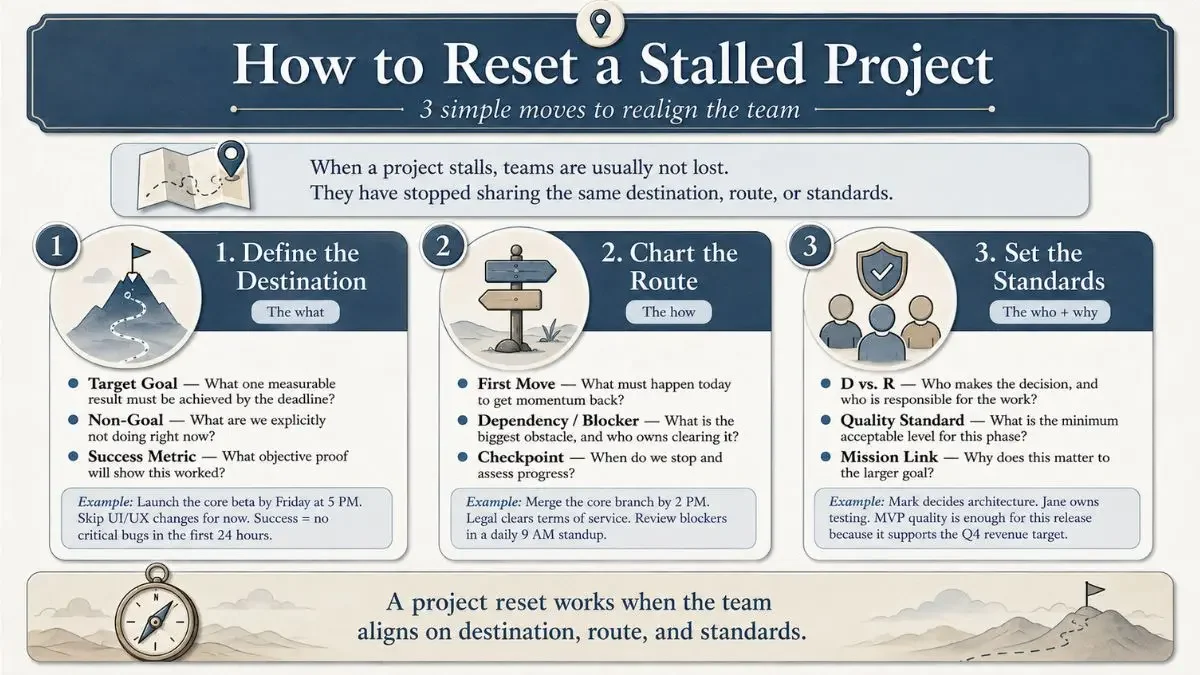
1. Define the destination (the "what")
When a project stalls, the team is usually headed to different places without realizing it. They're not lost. They've just stopped agreeing on where they're going.
Reset these three clear goals:
The Target Goal Question: What is the single, measurable outcome we MUST hit by the deadline? Example: Launch the core beta feature by Friday 5 PM with 99.9% uptime.
The Explicit Non-Goal Question: What are we explicitly choosing not to do right now? (This protects the perimeter.) Example: We are NOT integrating the new UI/UX feedback in this phase.
The Success Metric Question: What is the objective, undeniable measure of success? Example: Zero reported critical bugs in the first 24 hours.
2. Chart the route (the "how")
Managers often confuse a long task list with a map. A task list tells you what to do. A map tells you which direction to face first.
The route is only defined by the most critical steps and blockers:
The First Move Question: What is the immediate, non-negotiable next action that must be completed today? Example: Jane must merge the core engineering branch by 2 PM.
The Dependency Blocker Question: What is the single biggest external obstacle, and who owns removing it? Example: The Legal Team needs to approve the terms of service (Owner: Sarah).
The Checkpoint Question: When is the next time we formally stop to assess trajectory? Example: Daily 15-minute standup at 9:00 AM, focused solely on blockers.
3. Set the standards (the "who and why")
Confusion often hides in poor role definition and a forgotten mission. When people don't know whose job something is, it becomes nobody's job.
Role Clarity (D vs. R) Question: Who is the Decision Maker (D) and who is the Responsible Party (R) for this specific task? Example: Mark is the D for the technical architecture; Jane is the R for all testing.
Quality Standard Question: What is the minimum acceptable quality level right now? Example: Functional MVP is priority; detailed documentation is secondary for this release.
The Mission Link Question: Remind the team how this precision links back to the larger company mission. Example: We are launching this to meet the Q4 revenue target, which secures our budget for innovation next year.
Leading with intention
I learned this tool the hard way. I was three months into a new role, and we had a critical systems integration project that was fully stalled. Every status meeting was the same: people talking in circles, everyone agreeing we needed to "communicate better," and nobody admitting that we'd lost the thread entirely.
I finally called a 15-minute meeting and said, "We're not leaving until we answer nine questions." No slides. No agenda. Just the 3×3 Clarity Map written on a whiteboard.
Within ten minutes, we'd found the actual blocker: two departments disagreed on what "done" meant, and nobody wanted to admit it because it would mean one of them was wrong. Once it was out loud, we fixed it in a day.
Leading with Precision means giving your team a clear, reliable path to move on without second-guessing every step. When you stop guessing and clarify the nine coordinates above, a stalled project turns back into ordered execution.
You show up as the leader your team needs: the one with the map.
Have you ever watched a project stall because nobody would say the real blocker out loud? What did you do to cut through it?
Common questions about how to unstick a stalled project
“What's the difference between a stalled project and a delayed project?”
A delayed project is still moving, just later than planned. A stalled project has stopped making meaningful progress. The distinction matters because a delayed project may need a revised timeline, while a stalled project needs the blocker identified and removed.
"What if my team resists answering these direct questions?"
Resistance usually means fear. Fear of being blamed for the blocker, fear of admitting they don't know, or fear that whoever says the problem out loud will own fixing it. Open by telling them what this isn't: "This isn't about blame. I'm trying to cut through the noise so we can all see the same map. What's actually blocking us?" These are navigation questions. Ask them that way.
"Can this work with remote teams who can't all meet at once?"
Yes. Use a shared doc (Google Doc, Notion, Miro) and have people fill in answers asynchronously, then do a 15-minute sync call to discuss. The questions work the same way. The key is getting everyone looking at the same nine coordinates, whether that's in a room or in a document.
"What if we discover the blocker is a person, not a process?"
Good. Now you know what to address. If someone is the blocker (waiting on their approval, their decision, their input), don't route around it. Make the dependency visible and put a deadline on it: "Sarah is the Decision Maker here. Sarah, what do you need from us to unblock this by EOD Thursday?" If it's a pattern, that's a separate performance conversation.
"What if we answer all nine questions and we're still stuck?"
Then the problem probably isn't clarity. It's capacity, a priority conflict, or a resource constraint. That's valuable information. Escalate with your analysis: "We're clear on what, how, and who. The blocker is [resource/priority/dependency]. How should we proceed?" You've done your job as the Precision navigator. Now leadership needs to make the call.
"Won't this feel too rigid for creative or fast-moving teams?"
Precision gives a team a clear starting point. Creative teams still need to know what "done" looks like, who owns what, and what the actual blocker is. Clarifying what "done" means lets them create freely inside clear boundaries. Fast-moving teams waste less time when everyone knows where they're going.
Go deeper into the Precision pathway
The 3×3 Clarity Map handles one stalled project. The pattern underneath it, how you default to structure under pressure and where that steadies or stalls your team, is what discovery of your pattern shows you.