
How do you manage up when your boss micromanages?
Why constant check-ins are usually a visibility problem, and what changes when the work becomes easier to see.
A micromanager often watches people because they cannot read the work. A boss who hovers may be anxious, under-informed, or accountable for outcomes they cannot see, so they watch the person they can see instead. The work is unclear to them, and the checking becomes how they reach for it.
That read changes what you do with it. When the work becomes easier to see, your boss has something to look at other than you. The relief comes from structure: a steady, visible flow of updates, decisions, and risks that lowers the need for constant access. You can’t always change a micromanager. You can often reduce the friction by making the work clear enough that surveillance stops being their only instrument.

Is it me, or is my boss the problem?
I once had a boss who was the worst micromanager I have ever worked for. She was the director of operations. I was a district manager, and I oversaw between ten and twelve managers, as did each of my peers. We coordinated all of that work in a space we called the bullpen, and she was always in it. Always hovering.
At first, I read it as a trust problem. She did not seem to trust us. Then it seemed a bit like a personality issue. She would sometimes ask, are you guys talking about me, when we never were.
What I do know at the time is what eventually came out. She did not actually know how to do parts of her own job. There were specific requirements she was responsible for that she did not understand, and when that surfaced, it explained the hovering. If you have been with me for awhile…this was the same woman we handed the same report to over and over, because she never read it. (Read that story here) She never looked at the results we created. She never gave us feedback that meant anything.
At the time, my explanation for the hovering was simple. I did not believe she trusted us. That was the story I told myself about why she could never stay out of the bullpen.
What I didn’t expect was what it started to do to me. I began to question whether I could trust my own judgment. I would catch myself wondering, am I actually doing this wrong, is that why she keeps hovering? The belief that she did not trust us turned into a doubt about whether I could trust myself. It was an interesting dichotomy to stand inside.
Looking back now, what I see is someone who was watching the energy in the room because she could not work with us on strategic intent. The energy in our group declined every time we were not hitting the goals of the business plan, and the constant checking never once helped us get there.
Why does a boss start managing the person instead of the work?
Bosses watch and hover when there isn’t a system to give them a clear way to see the work product. The structure fails first. When a leader is accountable for results they can’t observe directly with no steady signal to pull evidence from the checking becomes their substitute for information.
This is why competent managers end up over-reporting and over-preparing. In this system, effort is visible and outcomes are not, so people start performing being busy for an audience of one. The check-in interrupts the work, the interrupted work slows down, and the slower work produces more checking. Each turn of that cycle adds more checking,
There is a documented pattern underneath this. Psychologists call it the Golem effect, a form of self-fulfilling prophecy. When a supervisor signals low trust or low expectations, the person receiving those signals can begin to perform inside that doubt. Confidence drops. Work gets more cautious. The person starts managing perception instead of doing the clearest work. Over time, the decline can begin to confirm the suspicion that created it.
The conditions created from this effect require a boss to be under-informed and over-accountable at the same time. That combination produces hovering in almost anyone. The pattern is structural before it is personal, which is why advice to simply be patient or communicate better rarely moves it.
Where is the friction in your upward terrain right now?
The Terrain Survey: The Managing Up Ascent
Managing up to a boss who needs to see everything is its own kind of climb. The friction is rarely general. It sits in one specific place. Find the spot that feels most true right now.
Read the friction you chose one more time before you decide what to do about it. The thing you are standing in is a condition the system around you produced. A boss reaches for surveillance when the structure around them does not make the work visible on its own. That gap is real, and you did not create it.
This matters because the next move depends on it. If you read the hovering as proof that you are failing, you will work harder at being watched. If you read it as a visibility gap in the system, you can work on the visibility instead. The pattern explains the pressure. The pressure was never evidence about you.
Which of these feels most treacherous in your terrain this week?
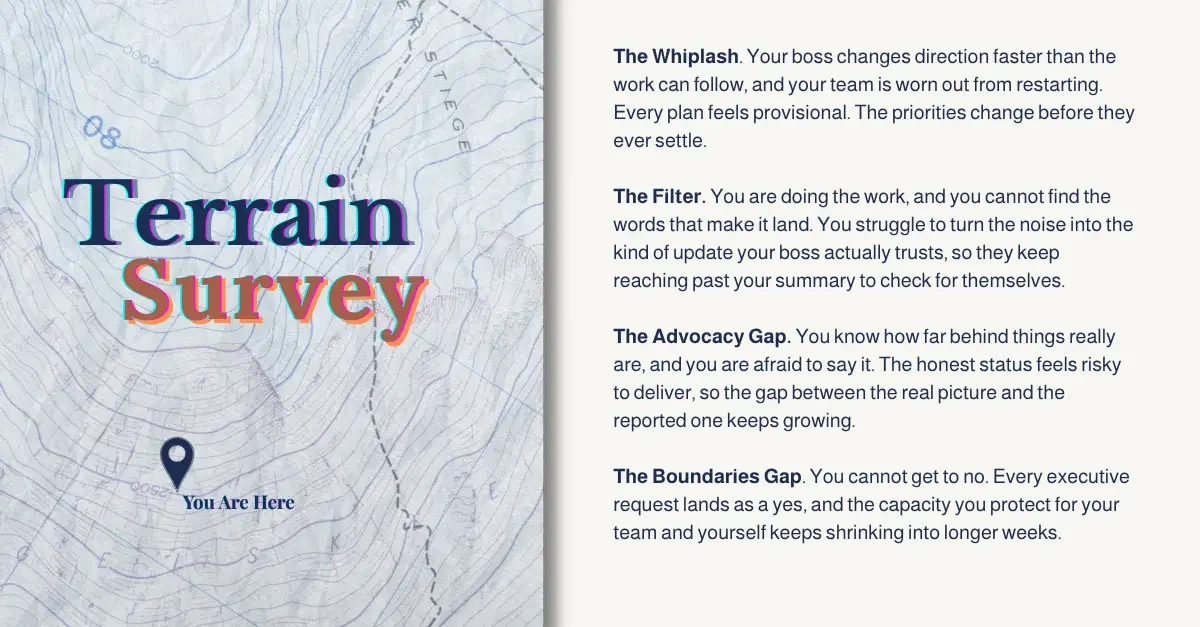
From here, the terrain has a shape. The friction you located is one point on a larger map of managing up to a boss who cannot yet see the work. The rest of this post walks the shape of that map.
What does it take to lower the checking?
The work of managing up to a micromanager is the work of making the job visible without making yourself more available. The map below lays out the phases. It does not walk each one in full, because the detail lives in the tool. For now, the orientation is enough.
You start by locating what your boss keeps checking, because the thing they return to is the pressure point. You look at what they may not be able to see, because that gap is what they are checking to fill. You separate the decisions they actually need to own from the ones they have drifted into, which gives the authority somewhere clean to sit. You build a rhythm of proactive updates, so they have the information before the interruption happens. You choose language that lowers threat without shrinking your own position. And you stay honest about what is still not working, because some of this pattern can be structured and some of it can only be survived.
What this points toward is a boss who can finally see the work. When they can, they have less reason to manage you through constant access to it.
Common questions about managing a micromanaging boss
Is micromanagement always about control? Not usually. It often comes from anxiety, low information, or accountability for outcomes the boss cannot see. The visibility gap is usually what sits underneath.
Should I just give my boss more access? More access tends to feed the loop. A steady rhythm of visible updates works better than constant availability, because it gives the boss the information without giving them your whole day.
What if the micromanagement does not improve no matter what I do? Some of the pattern is structural and can be lowered with visibility. Some of it sits in the person and cannot be fixed from your side. Knowing which one you are dealing with is the difference between adjusting and deciding to leave.
How do I push back without sounding defensive? Lead with the work itself. Show the decision, the status, and the risk in a form the boss can act on. Language that informs lowers threat faster than language that defends.
What is this pattern really about?
Underneath the hovering is a question about trust, and trust at work is mostly built on what a person can see. When a boss cannot see the work, the gap feels like risk to them, and that is what the hovering is about.
This is the terrain Leadership Cartography reads. The friction you are standing in is a feature of the system you are inside. It is not a measure of how good you are at the job. When you can locate the exact friction point, you stop carrying the whole vague weight of a difficult boss and start working on one specific, changeable thing.
The shift is from managing your boss's anxiety to managing the visibility their anxiety is reaching for. That is a smaller, more honest job, and it is one you can actually do.
If this is your terrain, return to the Managing Up Map to choose your route.
Related Reading
How to Say No to Your Boss Without Damaging Your Reputation
Difficult Conversations: 3 Scripts Managers Must Master
If you recognized your own terrain in this, the Source Assessment below shows you the pathway you lead from. Discover Your Pathway