
How to Delegate Without Dumping: The 4-Part Handoff Structure Managers Skip
When you hand work off without the structure to support it, the work comes back or fails.
The difference between delegation and dumping is often misread as a question of intent when it is a question of structure. Delegation transfers a task alongside the clarity and authority the person needs to complete it. Dumping transfers the task only. The gap that produces dumping is almost always a failure in the handoff process, not a failure in care. When the handoff carries no context, no decision rights, and no check-in rhythm, even well-intentioned managers default to offloading, and their teams carry the cost.
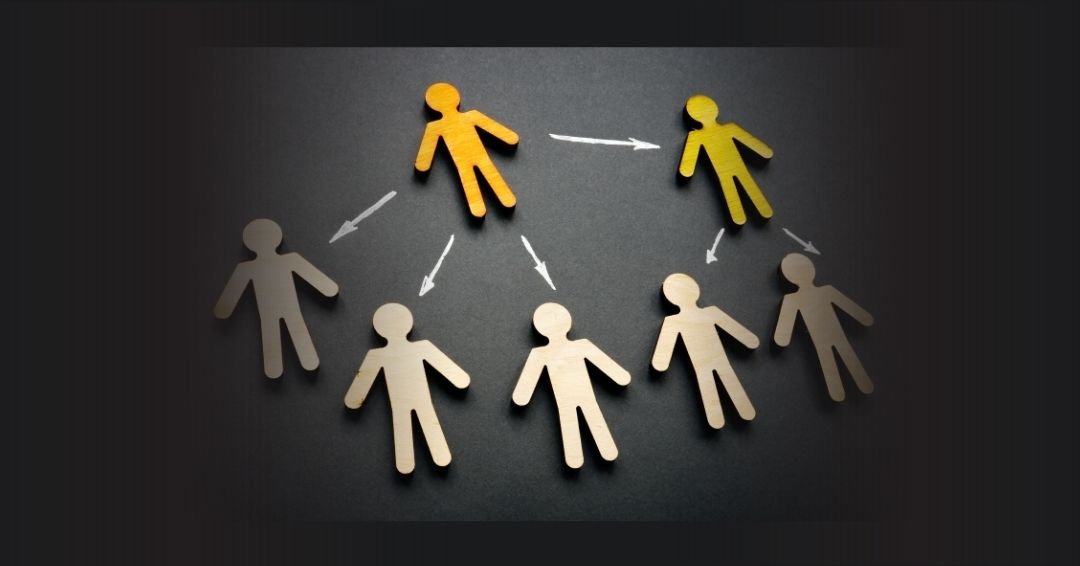
There was a running joke on our team. We kept a small file of project proposals we had already written, and when leadership came to us with a new initiative, we'd pull one out, update the cover page, and hand it back. Same project. Different week.
Nobody ever noticed.
Seven of us reported to the same executive. She never read anything we turned in. So we stopped writing new proposals. The ones we had already written were good enough, because good enough was never checked anyway. Problems stayed invisible. Work that needed attention didn't get it, because the structure only moved in one direction: leadership assigned, we received, and the gap between what they thought was happening and what was actually happening kept widening.
When I became a leader with people reporting to me, I did the one thing that had never been done for me. I told them the result I needed and asked them to figure out how to get there. No plan handed down. No format to fill. A conversation about what success looked like, and then room to think.
What came back was better than anything I would have assigned. Because they knew things I didn't. That's usually true.
Why does delegation break down even when managers mean well?
Delegation breaks down more often at the handoff level than at the assignment level. The conditions for a clean handoff do not exist in most organizations, and no one has made them explicit.
Clarity gap. The task moves but the context doesn’t. The receiving person doesn’t know the success criteria, the constraints, or why this work matters to the people above it. They produce something that answers the request but misses what it was actually for. The manager cannot explain the gap without sounding critical. The gap was in the handoff.
Authority without access. The task is assigned but the decision-making reach is not transferred. The person has to complete work that requires approvals, information, or resources they cannot get to. Every step toward completion runs into a wall they were not told about. They come back to the manager. The manager interprets this as an inability to work independently. Both are frustrated.
Accountability fog. The handoff happens but neither person is clear on who owns the outcome. The manager checks in and the team member reports progress. Ownership stays unclear. When the work hits a problem, neither person is sure whose decision it is to make. The manager steps in, and the delegation is effectively undone.
Missing support rhythm. There is no agreed moment for questions. The manager assumes the work is moving. The team member does not know whether surfacing a problem reads as incompetence or good communication. The ambiguity becomes paralysis. The work slows, or the team member makes a call that turns out to be wrong, and neither person had the structure to catch it before it mattered.
These patterns produce what gets called dumping. The work moved. The handoff structure stayed with the manager.
The Delegation Ditch: which friction point are you standing on?
What you are feeling is a gap in the structure. The handoff system between you and your team has no shared map for what a clean transfer looks like. The terrain has conditions. The conditions have names. And the first step is locating which one you are standing on.
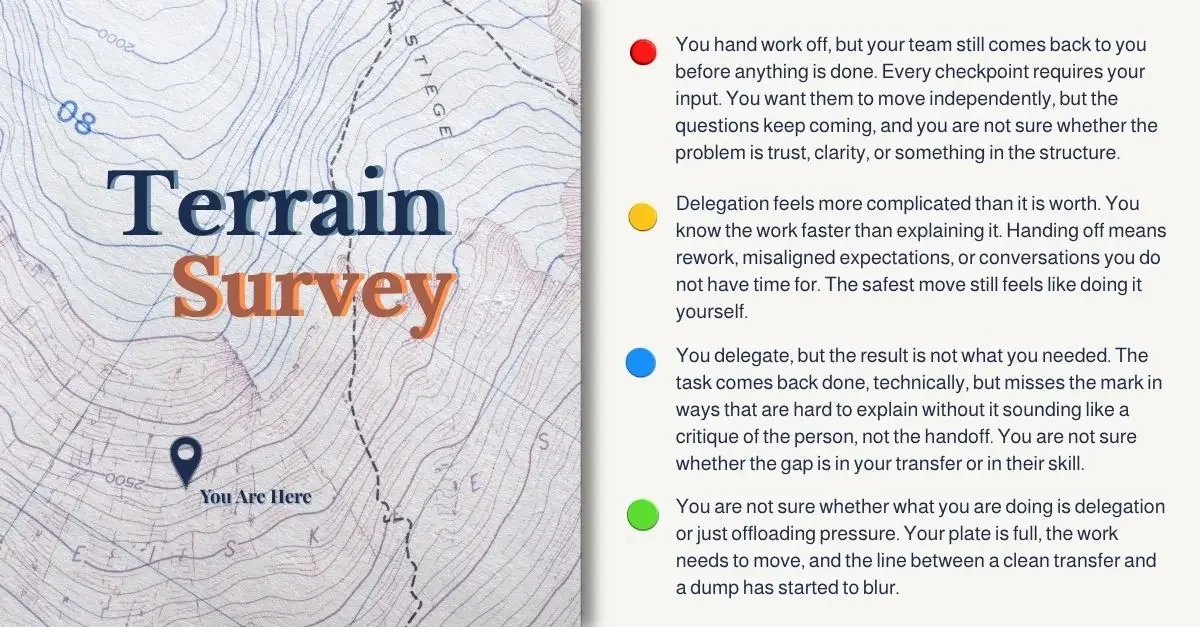
If the friction is showing up in more than one of those places, that is not unusual. A missing clarity structure produces questions. Questions pull the manager back in. The manager's involvement grows until doing the work feels easier than transferring it. The Delegation Transfer Map below traces the path back out.
The 4-Phase Delegation Handoff Structure
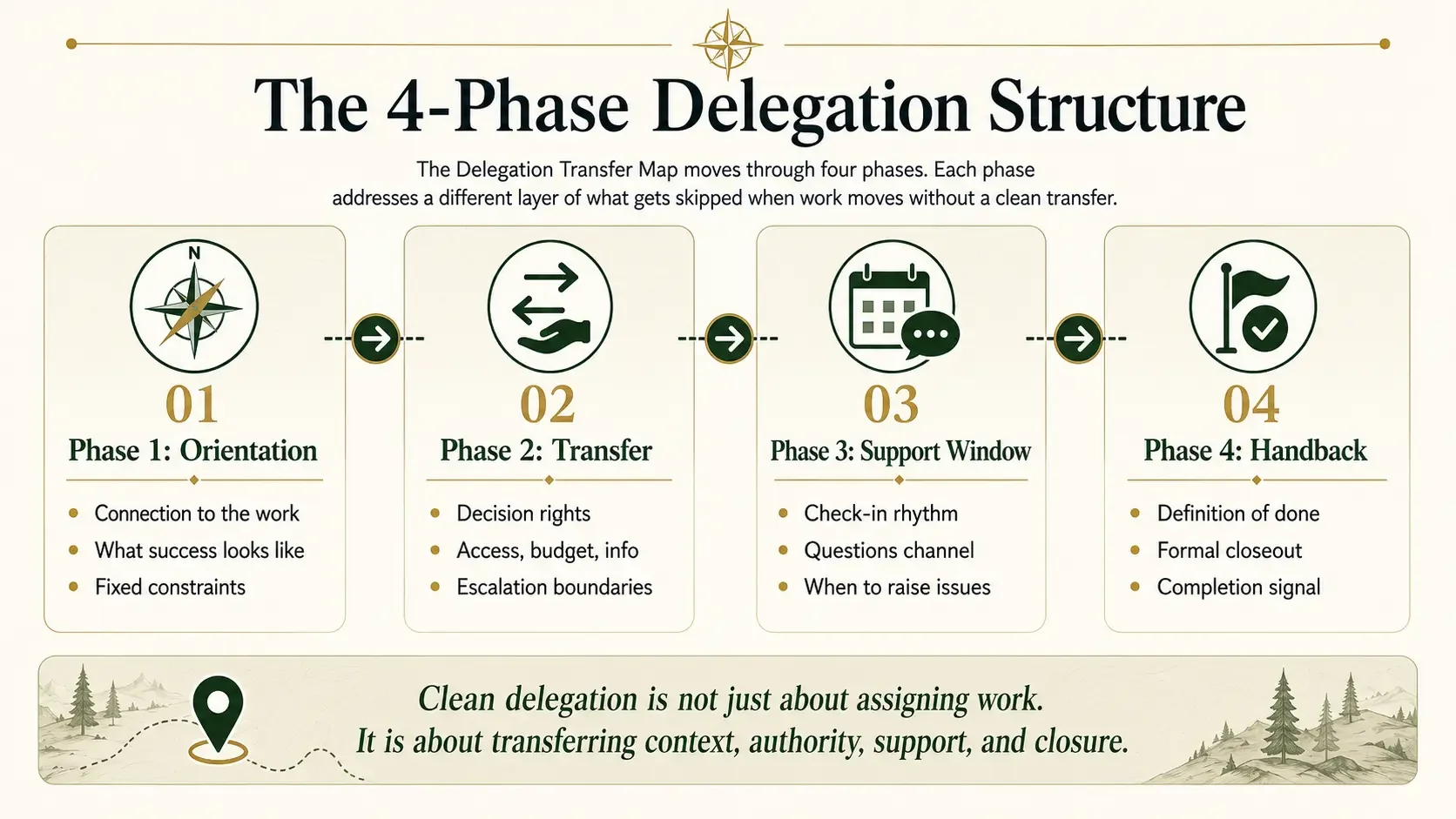
The Delegation Transfer Map moves in four phases. Every phase addresses a different layer of the handoff structure, the part that gets skipped when a task moves from one person to another without a clean transfer.
Phase 1: Orientation. Before the work changes hands, the person receiving it needs context that goes beyond the task itself. What the work is connected to. What success looks like from the perspective of the people above it. What constraints exist that they cannot change. This phase takes longer than most managers plan for.
Phase 2: Transfer. The work moves, and so does the authority to complete it. What decisions the person can make without coming back. What access, budget, or information they need to have ready on day one. Where the edges of their reach are, so they know exactly when to surface a problem versus solve it themselves.
Phase 3: Support Window. Before the handoff closes, an agreed rhythm for check-ins and questions. That rhythm tells the team member when to bring things forward and tells the manager when the work will surface. It removes the ambiguity that produces both paralysis and silence.
Phase 4: Handback. What done looks like. When accountability formally closes. How the manager will know the work is complete in a way that does not require them to reassume ownership. This phase is the one that makes the next delegation faster.
The path through the map depends on which friction point you selected above. Each Terrain Survey email sequence enters the map at a different phase.
Frequently asked questions about delegation and dumping
What is the difference between delegation and dumping?
Delegation transfers a task alongside the context, authority, and support the person needs to complete it. Dumping transfers the task only. The difference is structural. Most managers who dump work are not doing it deliberately but have not built a handoff structure that transfers what the task actually requires.
How do I know if I am delegating or dumping?
A clean delegation leaves the receiving person with four things: clarity on what the work is and why it matters, authority to make the decisions required to complete it, access to the resources and information they need, and a known window for surfacing questions. If any of those are missing, the handoff has a gap.
Why does delegation fail even when managers try?
Most delegation failures happen at the handoff, not at the assignment. The manager identifies the right task and the right person, then transfers the work without transferring the structure. The system produces the failure. There is no shared map for what a clean handoff looks like, and both people are left to work it out as they go.
What should a delegation conversation include?
A delegation conversation covers the task itself, the success criteria the manager is measuring against, the decision rights the person now carries, any constraints or dependencies they need to know about, and an agreed check-in rhythm. It does not need to be long. It does need to be explicit.
Why the delegation gap shows up across every leadership style
Delegation fails when the handoff structure is unclear. The manager knows how to hand work off. What is missing is the shared structure that makes the handoff land.
This is where Leadership Cartography becomes useful. The five pathways: Lead with Heart, Lead with Support, Lead with Purpose, Lead Together or Lead with Precision navigate delegation differently. A Heart-forward manager tends to over-involve because the relationship feels at risk when they step back. A Precision-forward manager often under-communicates the success criteria because the standard feels obvious from their vantage point. Neither is a flaw. Both are a product of how the pathway shows up under pressure.
Understanding your pathway tells you which part of the transfer you are most likely to skip, and where the gap in your team's experience is most likely to live. That is the starting point for a cleaner delegation.
Related Reading
The Definitive Guide to Effective Delegation
7 Signs You're Micromanaging (And How to Stop Today)
Locate your source. > Discover the inherent pathway that defines your leadership orientation.