
When Your Team Is Understaffed and Leadership Still Wants the Same Output

An understaffed team with unchanged expectations creates a structural pressure problem, and managers usually feel it first as personal strain. The work still has to move forward, the service levels still have to hold, and the accountability usually stays with the person in the middle translating the gap.
When leadership keeps reading output without reading the hidden labor required to maintain it, the condition can continue far longer than the team can sustain. That is where managers start confusing structural overload with a failure of leadership.
There is a point where a manager stops feeling busy and starts realizing the shape of the job has changed.
The team lost capacity, but the workload did not reduce with it. Priorities kept multiplying, deadlines stayed where they were, and new requests kept arriving with the same tone they had before the team was cut, before someone went out, before the vacancy froze, before a role disappeared and its work was absorbed by the people who remained.
What makes this hard to recognize is that the pressure never really emerges as one singular problem. It solidifies as a steady thumping managerial burden. You all of the sudden find yourself reordering work more than usual, deciding what can slip, what has to hold, and what has to be devoid of charged language before it goes upward because you already know how that conversation is likely to be received.
Why this pressure spreads so quickly
When a team loses capacity, the work continues as if no changes have occurred.
The same rigorous output is still expected at the same pace. The same commitments are still discussed as though the labor behind them is net zero. The same responsiveness is still assumed. What disappears on paper comes back as more managerial work.
You absorb the planning burden because someone has to keep deciding what moves first. You absorb the reprioritization burden because priorities are now colliding in real time. You absorb the communication burden because the team needs context and leadership needs assurance. You absorb the emotional burden because you can see the pace your people are keeping, and you know it will not hold.
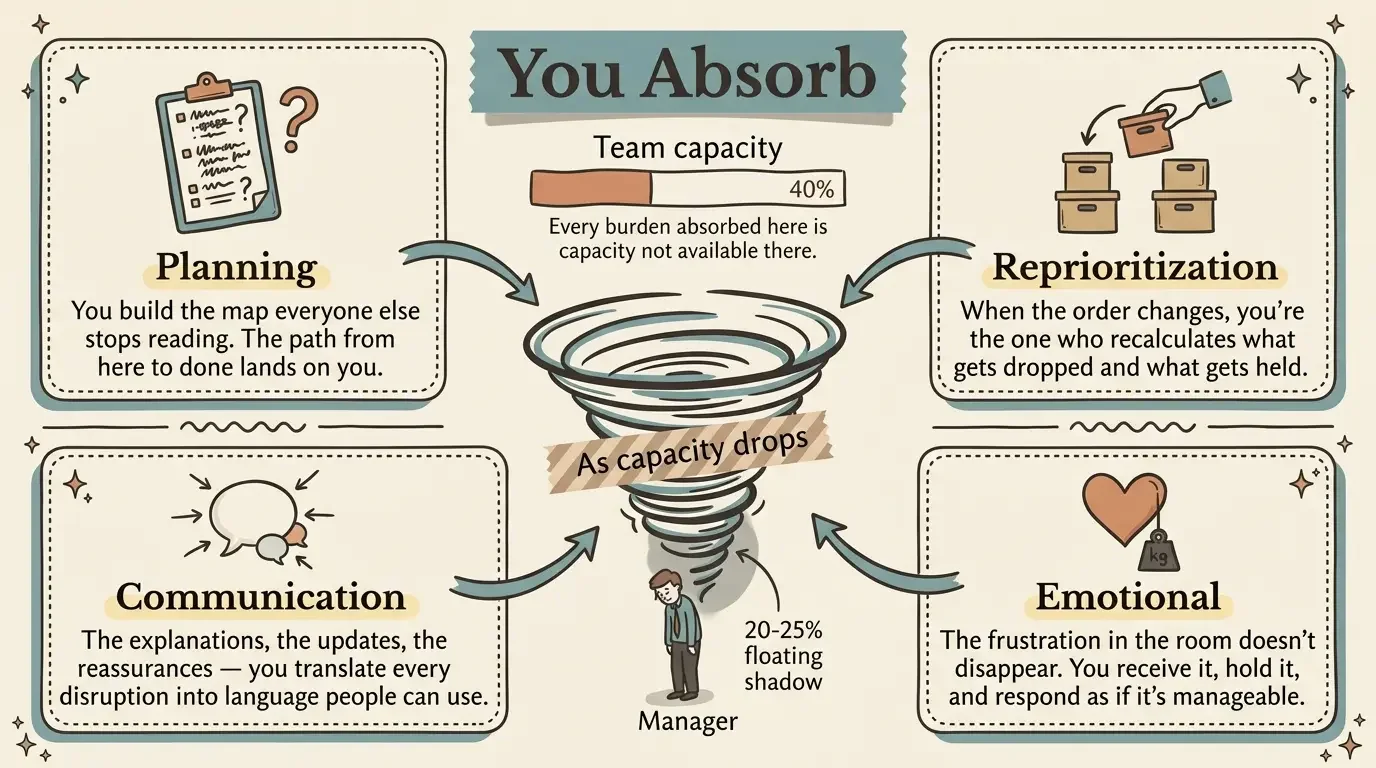
That is why these situations wear managers down in such a specific way. The first impact is interpretive. You become the person translating impossibility into language executives can hear without reacting against it.
That translation work is exhausting. It also hides the severity of the condition from the people who are farthest from the daily friction. When work keeps moving because your actions are smoothing, stepping in, and carrying the tension privately, leadership receives the wrong message. Continuation reads as stability. Delivery reads as proof that the structure still works with less people.
A team can remain functional long after it stops being sustainable.
The signs managers usually minimize
Managers usually know something is wrong before they are willing to say it plainly.
The team is still hitting deadlines, but the cost keeps rising. Quality and depth drops. Recovery time disappears. Basic steadiness gets traded away in small increments that are easy to excuse in the moment and hard to recover later.
A lot of your time now goes to sequencing work rather than moving the work. Strong people become the informal gap-fillers. Meetings about priorities keep happening because the priorities are still crashing into each other. Your updates upward start sounding more careful than accurate because you are trying to stay credible while also telling the truth.
Many managers don't communicate the current workload exceeds the team's capacity. They say the team is stretched. They say there is a lot on everyone's plate. They say timing may need to be revisited. They say everyone is doing their best to balance competing priorities.
Those phrases are familiar because they are survivable. They let you communicate strain without fully exposing the condition.
The more accurate version carries more risk. The work now exceeds what this team can carry. The gap is being absorbed through delay, compression, and overextension. If expectations stay where they are, something will give. Quality may slip. Retention may erode. Speed may break.
Managers often hold the line longer than they should. They keep buffering, translating, and hoping the strain will become obvious on its own.
It never does.
How understaffing changes the manager’s role
When a team loses capacity, the manager's role changes whether anyone names it or not.
You are no longer only leading the team. You are now carrying the spread between what leadership expects, what the team can actually carry, and what reality will allow. You are deciding which promises still hold, which standards can still be maintained, and which risks can no longer be contained through effort alone.
That is a different job from the one written on the job description.
It also creates a moral pressure that can get heavy very quickly. If the team struggles, it feels personal. If output slips, it can feel like poor planning. If morale drops, it can feel like a leadership failure. A lot of capable managers end up blaming themselves inside a condition they did not create and do not have the authority to resolve alone.
A manager can still know the work, care deeply about the team, and be fully committed to the job, while operating in a role that no longer has stability. When the gap between formal responsibility and structural reality gets wide enough, the job starts demanding something it can't keep asking for indefinitely.
What the team learns while this is happening
Teams are always learning from what the structure is rewarding.
In an understaffed environment with unchanged expectations, people learn quickly. They learn that urgency outranks judgment. They learn that the fastest person will keep picking up more. They learn that clear scope can disappear in an afternoon. They learn that recovery is private and that the manager will keep catching whatever falls through.
They also learn that plans are fragile. The week can be reorganized at any moment because new pressure can override the old plan without warning. Even strong teams get more reactive in those conditions. Attention narrows. Ownership gets fuzzier. Follow-through weakens. People stop thinking beyond the next ask because the pressure keeps pulling them back to the immediate.
At that point, behavior starts looking like the issue. Standards get uneven. Deadlines slip. The team can seem less disciplined, less thoughtful, less steady.
The condition is producing the behavior. When managers start correcting the behavior without addressing the structural pressure beneath it, they usually get more strain and less progress.
What upward leadership requires here
If you are in this position you have to make the condition legible if you intend to be a successful leader.
Name the facts in a way leadership cannot mistake for ordinary stress.
The useful specifics are usually plain.
What changed in capacity.
What stayed the same in demand.
What tradeoffs are already being made.
What risk has moved closer.
What decision now belongs above you rather than below.
This matters because executives are usually looking at output, summaries, and partial indicators. They are not standing inside the daily friction. They don't automatically see the hidden labor required to keep the whole thing moving, especially when you have become very good at absorbing it.
So the communication has to make that labor visible. Like this:
The current workload still reflects the former team structure.
The team is covering the gap through compressed timelines, reduced depth, and elevated manager intervention.
This level can continue for a limited period, but the tradeoffs are already visible.
A decision is needed on scope, sequencing, standards, or support.
That language stops the situation from staying vague. And vague conditions are the easiest ones for executives to leave in place.
How these conditions usually end
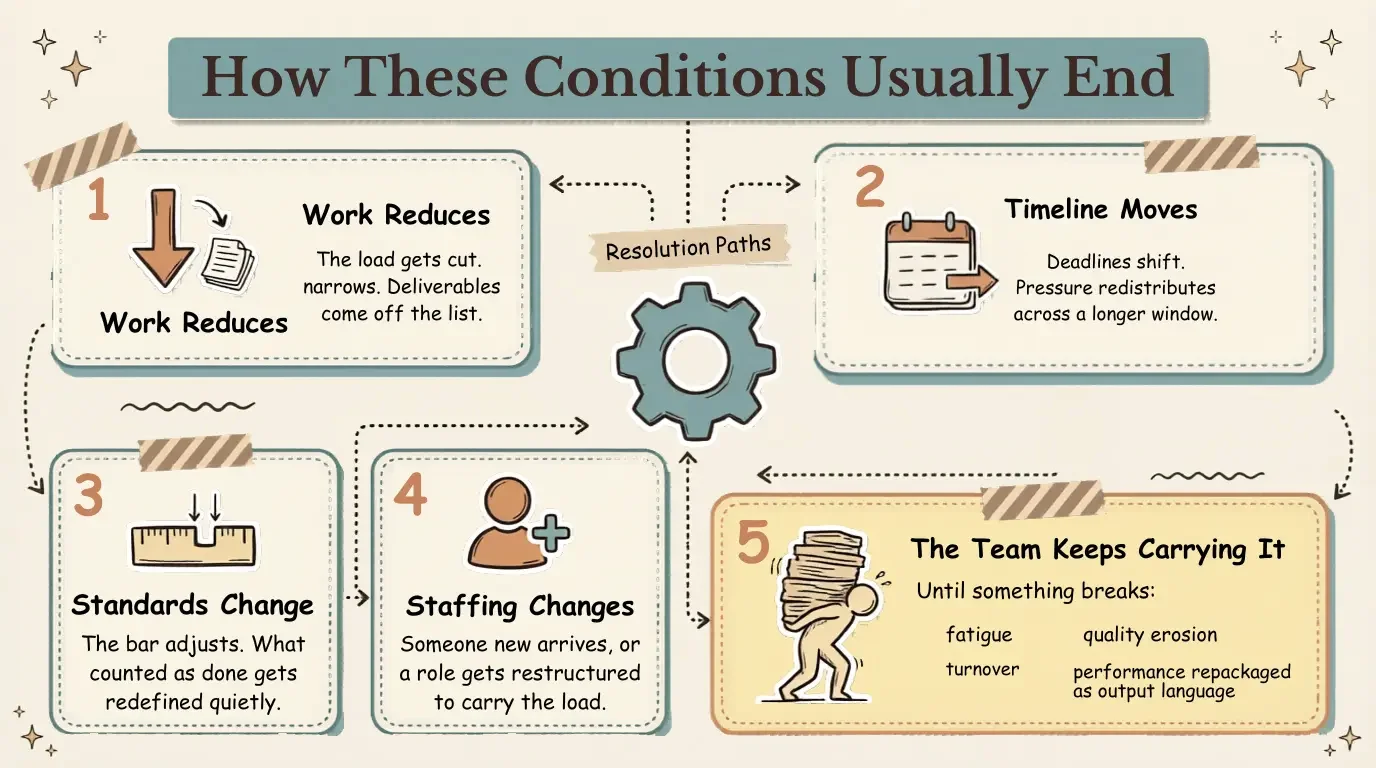
There are only a few ways this resolves.
The work reduces. The timeline moves. The standards change. Staffing changes. Or the manager and team continue carrying the difference until the strain starts showing up somewhere else.
A lot of organizations drift into that last outcome because it remains quiet for a while. By the time year-end conversations arrive, the original issue has often been repackaged into output language. Morale is down. Burnout is rising. Engagement is weaker. Communication is off. Performance is uneven.
Managers notice when an organization says capacity is tight at one level and makes very different spending choices at another. Kohl's offered its incoming CEO a large compensation package while also continuing layoffs and store closures during its turnaround, which is the kind of decision pattern that tells people the strain has not disappeared. It has been reassigned.
If you never name the condition while it is happening, there is a real chance it comes back to you later as feedback about your performance. The problem gets read where it became visible, not where it started.
That is usually the manager.
Where does this leave you?
If you are in this position, read the condition for what it is before the strain gets turned into feedback about your performance. A role becomes unsustainable when leadership is no longer being used to direct the work, but to absorb the damage created around it.
If this is your terrain, return to the Overwhelm Map to choose your route.