
Why Performance Reviews Feel Like a Verdict on Your Worth
Why feedback gets heard as a judgment of worth, and the structure that keeps a review on the work

A performance review is built to evaluate work, and it is often heard as a judgment of worth. The misread does not come from a manager being unclear on purpose. It comes from feedback arriving without enough structure to separate the work from the person. When a review is vague, late, reactive, or hedged, the person fills the gaps with the worst available reading, which is that they are the problem. Without a structure that keeps the conversation on the work, even fair feedback lands as a verdict, and the most capable people defend themselves instead of using it.
Why does my feedback keep landing on the person instead of the work?
I know the worth verdict from the inside. For years I measured myself by what I produced, reading a strong result as proof I was fine and a weak one as proof I was not. So when I sit across from someone and put words to their work, I know what is actually in the room. They are hearing feedback on a task. Part of them is also listening for whether they are still wanted here.
You can see it land before they say anything. The slight stillness. The nod that comes a beat too quickly. The next sentence out of their mouth is a defense of themselves, not a question about the work.
You did not come in to deliver a verdict. You came in with a note about a missed deadline, or a pattern in the reports, or a habit that is costing the team. Clear, fair, the kind of thing a manager is supposed to say. And somewhere between your mouth and their ears, the work turned into a referendum on the person.
Now you are managing two conversations at once. The one about the work, and the one happening underneath it, where someone is deciding what your feedback means about their worth. The second conversation is louder. It is also the one no one taught you to handle.
What makes performance feedback turn into a verdict?
No shared language for separating work from worth. Most organizations never give you a reliable way to say "this is about the work, not about you" and have the structure back it up. So the separation rides on tone and goodwill in the moment, which is the weakest place to put it.
Feedback gets saved up instead of delivered in real time. When a note waits for the annual review or for a problem to grow, it carries the weight of accumulation. A single conversation is asked to summarize months, and a summary of months feels like a summary of the person.
The rating controls real things. Pay, advancement, and standing ride on the review, so you read it as a threat no matter how kindly it is delivered. The stakes are structural, and structure is felt before tone is heard.
You are handed the role without the training. You’ve learned to give feedback by receiving it, often badly. The expectation to deliver clearly was never matched by the skill to do it, so the gap shows up in the moment that matters most.
The cost is that feedback stops being usable. A person bracing for a verdict cannot take in a note about the work, and a manager who senses the bracing softens until the note disappears. Both leave the room with less clarity than they started with. Locating which pattern is producing that is the first move.
Which feedback pattern are you standing on?
The Feedback Pattern Ridge Terrain Survey
Feedback rarely fails for one reason. It fails along a pattern. Find the ridge you keep walking, and the relief gets specific.
Which one is yours right now?
What you are feeling is not a gap in your ability. It is a gap in the structure. No one handed you a reliable way to separate the work from the person, so the separation has been riding on your tone in the moment. The terrain has conditions. The conditions have names. And the first step is locating which one you are standing on.
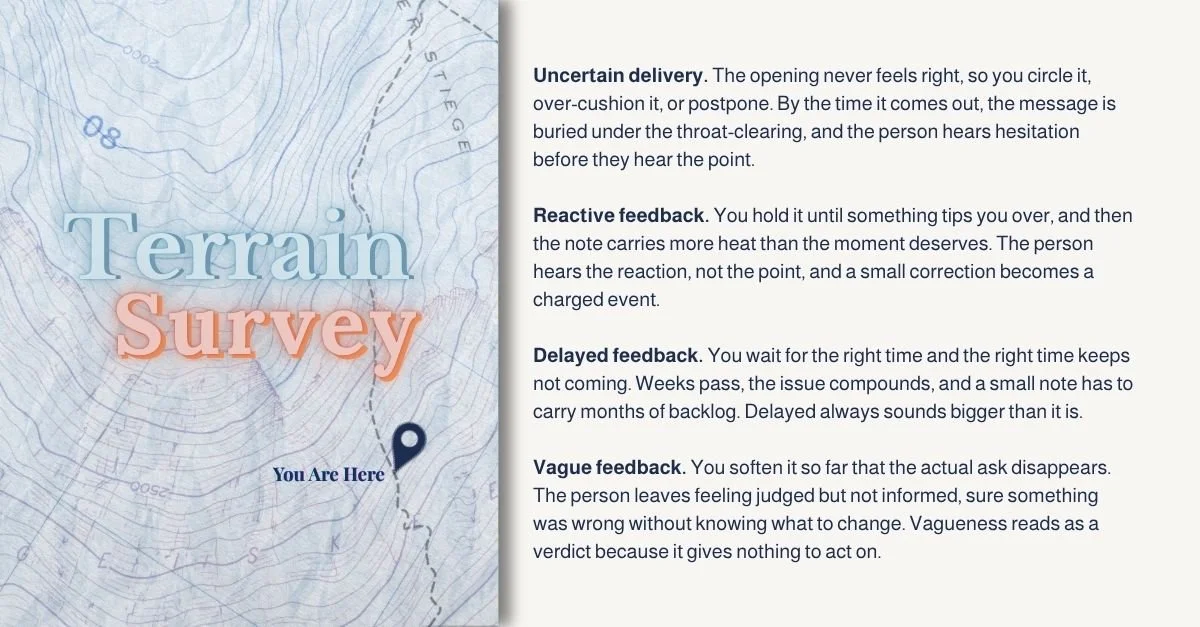
Once you know the ridge, the map makes sense.
How do you keep a review on the work?
There is a path that keeps feedback on the work, where it belongs, and off the person, where it does harm. Call it the Work-Line. It has four moves, and the survey above routes you to the one your pattern needs most.
Before the conversation: sort the two ledgers. Decide, on paper, what is about the work and what is a story you have built about the person. Only the first belongs in the room. What shifts is your own clarity, which the other person reads before you say a word.
At the open: name the frame out loud. Say what the conversation is and what it is not, so the person is not left filling the silence. What shifts is the bracing. A named frame gives the nervous system somewhere to stand.
During: keep returning to the work. When the conversation drifts toward the person, steer it back to the specific behavior, the specific result, the specific next move. What shifts is the second conversation, the one happening underneath, which quiets when the work stays in view.
After: close the loop on the work, not the worth. End on one clear next move and a real marker for when you will look at it again. What shifts is the meaning the person carries out the door. A loop closed on the work cannot become a verdict on the self.
That is the shape of it. The survey is where the specific relief lives, because the move you need depends on the ridge you keep walking.
What helps, and what makes it worse?
Do
✅ Name what the conversation is about before you give the feedback. A named frame keeps the person from filling the silence with the worst reading.
✅ Give it close to the moment. Small and current is easier to hear than large and accumulated.
✅ Point at the work. "The report missed three deadlines" gives someone something to do. "You're unreliable" gives them something to be.
✅ Leave them with one clear next move. A specific ask replaces fear with direction.
Don't
❌ Don't cushion until the ask disappears. Vague kindness reads as a verdict because it gives nothing to act on.
❌ Don't save it for the annual review. A year of notes delivered at once feels like a summary of the person.
❌ Don't deliver it hot. Reaction overwrites the point, and the person hears the heat instead of the work.
❌ Don't rely on softness to keep it safe. Clarity keeps the work in view, which is what lets the person stay in the room.
Why this is terrain, not a flaw in you
If your feedback keeps landing wrong, the likeliest reason is structural. You are doing a structural job with no structure, keeping work and worth apart with your tone alone because nothing else was built to do it.
Leadership Cartography reads that terrain before it reads the manager. It treats the feedback moment as a place with conditions, a ridge with known patterns. The moment stops being a test of whether you are good at this and becomes terrain you can read. A review that landed as a verdict becomes information about which move was missing, available to be corrected next time instead of carried as proof you are not cut out for it.
The manager who keeps a review on the work is not a more gifted communicator. They are working with a structure that does the separating, so their tone does not have to carry the whole weight.
Where to start this week
This week: pick the one ridge from the survey you walk most often, and opt in for that relief sequence. Before your next feedback conversation, write the two ledgers, work in one column, story in the other, and bring only the first.
This month: notice which ridge you return to under pressure. The pattern under pressure is the one worth building structure around first.
RELATED READING
Difficult Conversations: 3 Scripts Managers Must Master
When Your One-on-Ones Are Full of Connection and Empty of Development
Companion piece, Manager's Mind: The Worth Verdict
Discover your pathway. How a review lands depends on the terrain you lead from. Find your Source to see which pathway is yours, and how it shapes the way you give feedback