
Case Study: When Three Leaders Share the Same First Instinct
Mara already knows her people.
She knows Lena’s steadiness. She knows Theo’s long view. She knows how both of them show up for the young people, the work, and the mission.
The Team Terrain Report does not introduce Mara to her team.
It shows her what their leadership forms together.
That is where the report earns its keep.
Mara does not need a tool that tells her who her people are. She needs a way to see what their leadership becomes when they are carrying the same mission, the same pressure, and the same business reality together.
Background
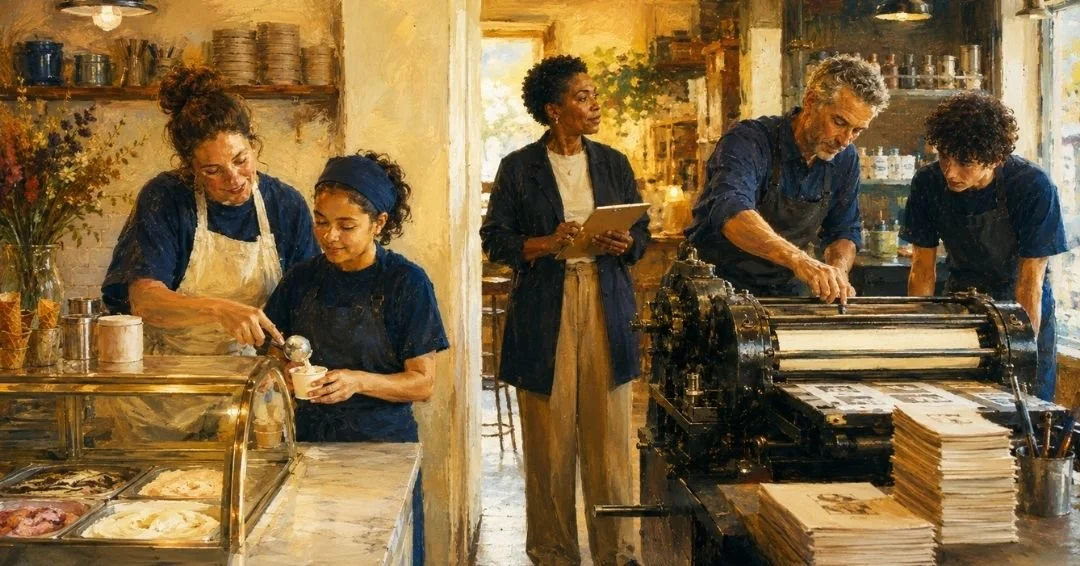
Mara oversees the business side of a social enterprise connected to a nonprofit serving young people navigating instability. The organization operates revenue-generating training businesses that help fund the mission while also creating first-work experiences for the young people it serves.
This is not a setting where the business can be separated from the human condition.
The enterprise must earn money. It also must teach young people how to work inside an environment where they are respected, supported, and expected to grow. It must hold standards without treating people like disposable labor. It must protect the mission without making the business optional.
Lena manages one enterprise site. Theo manages the other. Both report to Mara.
The individual readings
Each person receives an individual Pathway Snapshot.
Mara’s reading shows her as an Empathetic Scaffolder. Her support is more than warmth. It shows up as structure. She builds containers for people to succeed. She provides context, clarity, regular check-ins, and a larger sense of why the work matters. She leads by creating the conditions for meaningful work to happen.
Lena’s reading shows a different form of Support.
She is the Steady Anchor. Her support moves through reliability, follow-through, and operational steadiness. In her site, that matters in a concrete way. The work runs on staffing, customer expectations, production rhythms, training, daily decisions, and the thousand small moments where the operation either holds or does not.
Lena’s support lives in execution.
Theo’s reading shows another form again.
He is the Growth-Focused Guide. His support moves through development, long-term capacity, and the question of who people are becoming. In his site, the work is more than production. A task is also a learning opportunity. A customer interaction is also a place to build skill. The business produces outcomes, but it also develops people through the work.
Mara, Lena, and Theo are all Support-led.
But they are not the same.
Mara supports through scaffolding. Lena supports through steadiness. Theo supports through growth.
An individual reading can show the form each person’s care takes. It can show what kind of responsibility they naturally pick up and how they tend to protect the work when the work has weight.
The team pattern
But the larger insight comes when the three readings sit together.
All three leaders read the work first through Support.
That shared orientation gives the team something real. People are protected. The work has a human center. The young people in the program are treated like people learning how to belong inside work, not just labor filling a schedule.
In this context, that is not a secondary benefit.
It is part of the operating system.
A social enterprise serving young people in unstable circumstances cannot afford to build a work environment that is technically efficient and spiritually careless. The way people are held capable is part of the product. The young people are learning what a healthy workplace looks like through their experiences.
So a Support-led team makes sense here.
It fits the mission. It fits the population. It fits the moral center of the organization.
But when a whole leadership team shares the same primary orientation, that orientation can become the weather. It feels normal from the inside. The team may not experience it as a pattern. They may experience it as the way work is supposed to feel.
The same pathway runs through all three leaders. That means the same instincts are likely to show up in meetings, decisions, feedback, business conversations, and moments when care for people presses against the requirements of running viable operations.
The report does not say something is wrong with the team.
It shows Mara what kind of team she is leading.
The useful question becomes:
What happens when everyone in the room is trying to protect the work through the same lens?
That question has weight in Mara’s setting because the enterprise has to work as a business. The mission depends on the businesses running well, not only generating revenue, but also funding the training and development opportunities the enterprise provides to the young people it serves.
If the team protects people but the business becomes unsustainable, the mission suffers. If the team protects revenue but stops treating young people as whole humans, the mission also suffers.
Mara’s team has to hold both.
The map does not turn Support into a weakness. It does not say, “Support is the problem.” It says, “This is the orientation this team naturally shares. Lead with that knowledge.”
What changes for Mara
For Mara, that changes what becomes visible.
Before the map, Lena’s steadiness could look like a settled fact: the site runs well, Lena follows through, the work gets handled.
But the map shows that Lena’s steadiness is not just a personality trait. It is a leadership pattern. Lena is actively holding the operation steady through decisions, follow-up, standards, training, and daily problem solving.
But a Steady Anchor may not ask for support. Lena’s instinct is to keep things moving, not to stop the room and announce what is getting heavy. Once Mara can see Lena’s steadiness as active leadership, she does not have to wait for Lena to raise her hand. She can lead closer into the load before dependability becomes depletion or burnout.
One of the biggest insights I got in Lena's report was the risk I was running by not reaching out to her more regularly. The report provided the critical reminder that even though Lena is a dependable and top performer that there is serious risk of burnout if I don't create a solid scaffolding of insights and on-the-ground support.
—Mara, Director of Program Development
That support lands for Lena
Having an organization that really is working to understand who I am as a contributor has really made an impact. I know I can trust my supervisor to support my development as well as have my back when things aren't going to plan.
— Lena, site manager
Theo’s long view can also be read more clearly.
He sees growth, capacity, and long-term development. He notices who people are becoming. He sees how the work can build skill and confidence over time.
That orientation has value and has cost.
Development work still must live inside the production timelines, customer needs, and revenue pressure. A growth-focused leader can protect the becoming of people so strongly that the business rhythm starts to carry extra strain. Every instinct has weight when it becomes the primary way a leader reads the work.
Mara’s own pattern becomes clearer too.
She is building scaffolding around the work. She creates the structure, context, and care through the people. That is powerful leadership. It is also a place where a leader can carry too much without noticing, because the carrying looks like the work itself. Support leaders can mistake the system’s scaffolding as their own scaffolding and become part of the system itself. The instinct is to be useful and dependable, but the system should learn to operate without them. This is a major challenge for support leaders.
I realized through this process that it wasn't just enough for me to create the scaffolding for myself. In order to avoid burnout for myself AND to develop my team, I had to show them how to build their own scaffolding and at the very least to help me with mine. As I looped them more into my process, I noticed them taking on the creation of critical documentation and structure to help the business grow. I saw that my leadership style can sometimes leave people thinking that I have things totally handled and that's obviously not always the case. I have focused on being more transparent with my team about what I'm working on, what I'm challenged by and how they can help.
—Mara, Director of Program Development
What a terrain read asks
The team map shows the composition. It shows the team as a leadership system with a shared default, a shared way of reading pressure, and a shared instinct for what should be protected first.
That is the layer most leadership tools never reach.
A personality profile can tell you something about the person. A strengths profile can tell you what someone may naturally do well. A behavior profile can tell you how someone may show up. A 360 can tell you how someone is experienced by others.
A team terrain read asks a different question:
What does this leadership become when these people are responsible for the same work?
That question changes what a leader does next.
If Mara reads Lena only as a capable site manager, she may miss the amount of operational steadiness Lena is providing. If she reads Theo only as a thoughtful program leader, she may miss how much of his leadership is oriented toward long-term capacity. If she reads herself only as a supportive director, she may miss how much her own scaffolding sets the tone for the whole team.
But when Mara sees the composition, the work changes.
She can recognize what each person is carrying. She can stop assuming that shared care means shared burden. She can make the business conversation part of the mission conversation and she can notice when support has become invisible labor.
She can ask different questions in one-on-ones.
Questions like:
What are you carrying that I do not see?
Where is the work depending on your steadiness?
Where are we protecting people well?
Where are we protecting people in a way that hides the business reality?
Where are we building capacity?
Where do we need clearer operating ground?
Where has the mission become the reason we avoid a harder business conversation?
Those are leadership terrain questions.
They become available once the team stops looking like a stack of separate profiles and starts becoming visible as a team operating within a system.
For Mara, support is not just an individual trait inside this team. It is a shared leadership orientation shaping how the team holds work, pressure, decisions, standards, and responsibility.
A support-led team can be misread by systems that only know how to value speed, force, and visible control. But in this nonprofit’s context, support is necessary. The work involves young people entering employment, many of them learning tasks, trust, expectations, repair, responsibility, and belonging for the first time.
A team that protects people is doing the work.
The leader’s task is to understand how that protection shapes the work, then lead the full terrain with that knowledge in view.
That is what Mara can see once the individual readings become one team map.
She knows the people.
The map shows her what their patterns form together.
I have brought my direct team and even some of our more senior youth interns into conversations about what they see as needing to happen for the businesses to grow. Me slowing down to be more inclusive has provided me with some very critical information AND support that I have really appreciated. Getting a 360 perspective from everyone in our social enterprise ecosystem can only make our businesses more effective.
—Mara, Director of Program Development
The value of the Team Terrain Report is not that it tells Mara her team cares. She already knows that. The value is that it shows how care is functioning inside the team. In Lena, care shows up as steadiness. Mara has to notice the load before Lena asks. In Theo, care shows up as development. Mara has to help him protect growth without letting every business constraint become secondary. In Mara, care shows up as scaffolding. She has to see where her own support is strengthening the system and where it is making the system dependent on her.
That is the practical value of the map.
It does not give Mara a label for each person.
It gives her a better read on where to lead next.
The Team Terrain Report
The Team Terrain Report is built for leaders who need to understand the team they are actually leading.
Each team member receives an individual Pathway Snapshot. The team leader receives the larger overview: how those individual readings form one team composition.
It does not diagnose the team. It does not reduce people to types.
It shows the terrain.




Most team friction gets read as a people problem. The Team Terrain Report checks the terrain first.
This is a Leadership Cartography reading of your team's collective pattern — how your team's leadership defaults shape the way decisions get made, communication lands, feedback moves, and follow-through holds. Before you make it about individuals, you see what the map actually says.
What you get:
Each team member receives an Individual Pathway Snapshot — a one-page read of their primary leadership style and how it shows up under pressure. The leader receives the Team Terrain Report: a full interpretation of how those pathways interact, where the team is built to see clearly, what it consistently misses, and where strain is most likely to surface.
The reading includes a Team Constellation page — a visual map of your team's full pathway distribution — designed to be shared with the team.
How it works:
After purchase, you'll complete a short intake form. Each team member takes the Leadership Cartography assessment from a custom to you link (I will provide). Once all assessments are in, I build the reading and deliver it within 2 business days.
Select your team size above. Teams larger than 15 are typically better served by a cohort summary. Contact me: Hello@YourLeadershipMap.com or using the /contact me to figure out the right fit before you buy.
What this reading is and isn't:
The Team Terrain Report reads the pattern. It does not fix the team, predict performance, resolve conflict, or replace a development plan. Visibility is the offer. What you do with the terrain is yours to decide.
The reading reflects your team as it stands on the date of the assessment. A roster change, a restructure, or roughly a year of significant shifts is usually enough to warrant a fresh read.