
Hybrid Work: 5 Strategies for High Team Connection
Why connection breaks on hybrid teams, and how to read the terrain before you try to fix it

On a hybrid team, low connection usually comes down to visibility. Distance does not break the connection you already have. It reveals how much of it is outdated, and how much you have been assuming about who knew what and who was ready for what. The shared context a co-located team builds without trying doesn’t always transfer to a distributed team on its own, and when it is missing, managers find out under pressure, at the moment they need it connection and/or relationship turns more vulnerable than it looked.
What hybrid distance actually feels like
I learned what hybrid distance costs during a finance collapse. We had lost almost the entire finance team, and the only person left was remote. She had worked in the corporate office before her family moved to the Chicago area, so I knew her. We had history. We had once shared the same building, the same meetings, the same daily context.
But when the department fell apart, I realized how much of that connection was outdated and old.
I was living the crisis in real time. She was receiving it from a distance, one call and one request at a time. I had urgency because I was standing inside the consequences. She had questions because she had been outside the daily reality of what was happening.
Both things were true. And that was the problem.
I needed her to step into a much larger role quickly. I needed judgment, ownership, and speed. What I found was someone whose development had been assumed more than verified. Her title suggested one level of readiness. The actual work showed another.
When I asked for a breakdown of what she owned, the answer told me what the org chart had hidden. The work had been held too tightly by the person above her, who was no longer with us. She had been near the finance function, but she had not been brought deeply enough into how it actually ran.
So I was trying to stabilize a department with someone who should have been ready to operate as an assistant controller, but who had not been prepared for that level of ownership. That made everything harder.
The operational problem was urgent. The relationship needed repair. The capability gap needed diagnosis. The remote distance made every part of that slower, because we did not have the shared context that a crisis demands.
That is where hybrid connection becomes real. It is easy to talk about connection when the work is steady. It is harder when the team is under pressure, the shared context is thin, and the person you need most has not been close enough to carry the same sense of urgency.
The distance did not create the whole problem. It showed me how much we had been assuming.
Mine came all at once. A department in free fall, a deadline that couldn’t wait, and a clear view of everything the distance had been covering. Yours may never look like a crisis. The team is steady, the work gets done, and you only notice how thin the shared context has gotten when something finally tests it.
Either way the lesson is the same. From a distance, you assume the connection and the readiness are still there, right up until the very moment you need to draw on it.
That is the terrain of hybrid work. Not the schedule. The gap between the connection you think you have and the connection that is actually there when the work gets hard.
Why does hybrid work hide problems until they surface under pressure?
The gaps stay out of sight because the tasks keep moving. The surface looks fine while the shared context underneath all of it is thin. Four conditions typically sit underneath that.
Shared context stops transferring. In a shared office, people pick up how the work runs and how the team is doing just by being near it. None of that context moves to a distributed team on its own. Proximity used to deliver it for free, and once that stops, each person works from a partial, private picture, and no one notices the pictures have stopped matching until a decision needs all of them.
Readiness gets assumed instead of verified. Titles and org charts suggest who is ready for what. At a distance, the manager rarely sees the daily work that would confirm or correct that. Development gets taken on faith, and the gap between what a title implies and what someone can actually do stays out of view until the work demands the higher level.
Distance flattens the early signals. When someone is struggling or pulling back in a shared room, you see it. The slumped posture, the skipped lunch, the shorter answers. Across a screen and a schedule, those signals flatten. The system gives the manager attendance and deliverables, not the small daily cues that used to show who needed a word, so by the time a problem reaches awareness, it has been forming for weeks where no one could see it.
The gaps only surface under pressure. When the work is steady, thin connection costs nothing. Everyone manages from their own partial picture and the work still moves. The system only reveals what was missing when something finally tests it. Like an unexpected deadline that cannot wait or a sudden departure, and that is the worst moment to realize that the shared understanding you were counting on is thinner than it looks.
The cost is a manager facing a crisis with people whose readiness and shared context were assumed rather than confirmed. Before any of that can change, it helps to locate which part of the terrain you are standing on.
The Hybrid Distance Crossing
Disconnection on a hybrid team is not one problem. It shows up in four different places, and the right move depends on which one you are standing in.
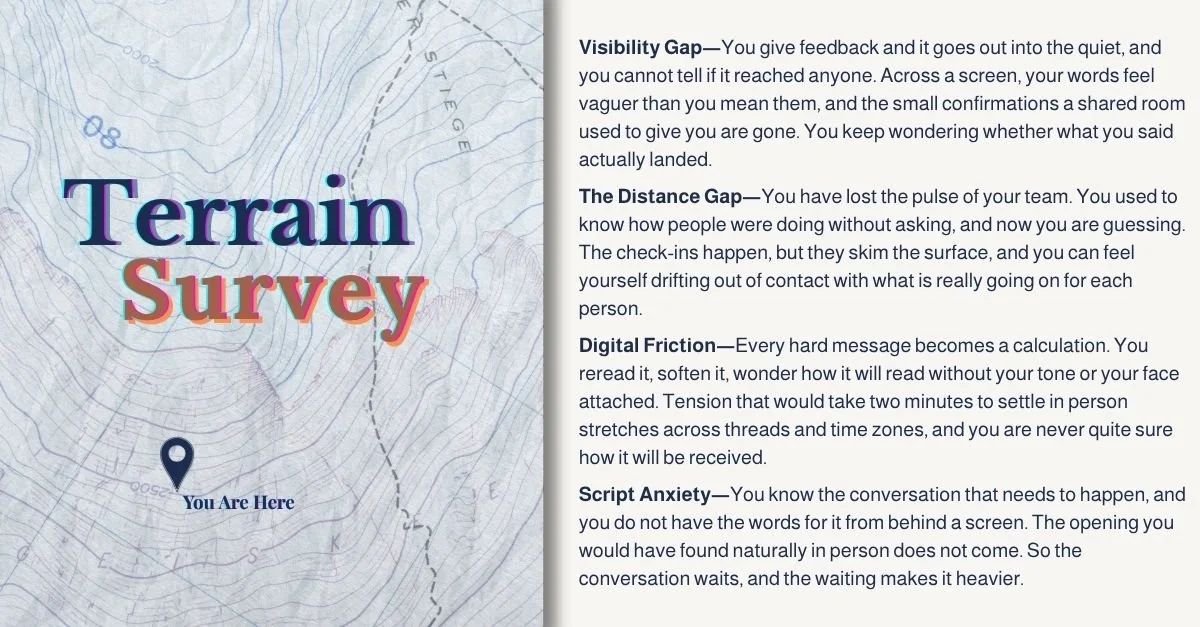
So which crossing are you standing in right now?
What you are feeling is not a gap in your warmth or your effort as a manager. It is a gap in the structure. The conditions that used to build connection without any work from you are gone, and nothing has been put in their place. The terrain has conditions. The conditions have names. The first step is locating which one you are standing on.
Each crossing points toward a different region of the same map. Here is how that map is laid out.
How do you rebuild real connection across hybrid distance?
Closing hybrid distance takes more than one ritual. It is five regions of the same terrain, each one making visible on purpose something proximity used to handle for free. You do not have to cross them in order. The Terrain Survey above points you to the region you are standing in now. Here is the whole map, so you can see where you are.
The Connected Distance Map has five regions.
1. Context Transfer (weeks 1 to 2). Move the shared context that proximity used to deliver into something deliberate. The move is to make how the work runs and where it stands visible in one place everyone can see, instead of leaving it in hallways and individual heads. What shifts: people stop working from separate, private pictures. The team starts from the same map, so fewer gaps hide until a decision exposes them.
2. Readiness Check (weeks 2 to 4). Replace assumed development with a real read on what each person actually owns and can do. The move is to look at the work itself, not the title, and find where readiness was taken on faith. What shifts: you stop discovering capability gaps under pressure. The distance between what a role implies and what someone can do becomes something you can see and close before a crisis forces it.
3. Signal Recovery (weeks 3 to 6). Rebuild your ability to read how people are doing when you cannot see them. The move is to create a few reliable places where the real answer surfaces, past fine. What shifts: the early signs of strain become visible again, through structure instead of proximity, so you catch them while they are still small.
4. Shared Urgency (weeks 4 to 8). Close the gap between the urgency you feel inside the work and what reaches someone at a distance. The move is to bring people close enough to the daily reality that the stakes are as visible to them as the tasks. What shifts: the team stops splitting into people standing inside the consequences and people receiving them secondhand. When pressure comes, more of the team feels it at the same time.
5. Even Ground (ongoing). Keep the in-person and remote members of the team on equal footing, so distance does not decide who is included. The move is to watch where proximity is buying access, and set the defaults so it does not. What shifts: remote members stop working twice as hard to stay in the conversation, and the shared context you are building reaches the whole team, wherever they sit.
That is the map. The detail for the region you are standing in lives in the Terrain Survey and the short email sequence behind it.
Common questions about hybrid team connection
Why does connection drop on hybrid teams even when everyone is performing well?
Because most connection at work was never produced by the work itself. It came from being in the same place, the unplanned contact that builds familiarity over time. Hybrid work removes that contact and leaves the tasks intact, so performance stays steady while the relationships underneath it slowly thin out.
Are more video calls the answer to low connection?
Rarely. More calls add visibility and fatigue without adding closeness. People can be in meetings together all day and still not know each other. What rebuilds connection is consistent, lower-stakes contact and a real way to read how people are doing.
How do I keep remote team members from being left out?
Watch where being in the building is buying access, like decisions that happen in hallways or information that travels by proximity. The fix is in the defaults. When the standard way of sharing information and making decisions does not require being in the room, distance stops deciding who is included.
Is low team connection a sign I am failing as a manager?
Usually not. It is a sign that the conditions that used to build connection are gone and nothing has replaced them yet. That is a structural gap. The work now is to build on purpose what the office used to build on its own.
What this says about the terrain you are leading in
What makes hybrid work so disorienting is that nothing about you changed. You lead the way you always have. The room you were leading in is what changed, and it took with it the shared context you never had to think about. The shortfall you feel is the distance between what you assume you know about your team and what you can actually see from here.
Leadership Cartography is built to make that terrain visible. It helps you see where you are actually standing, so the friction reads as a condition with a name rather than a quiet verdict on your worth as a manager. A team that surprises you under pressure is not proof you missed something obvious. It is information about what the distance had been hiding.
Once you can see that, the work changes. You stop trying to close the gap through force of will and start building the few structures that surface what distance keeps out of view. The terrain is hard. It is not a referendum on you.
Where to start this week
This week, notice the one place casual contact used to happen most on your team, and where its absence is felt now. You are locating the condition, not fixing it yet.
This month, locate which of the four crossings your team keeps returning to, and let the matching region of the map guide where you build first. The relief is targeted. Start where you actually are.
Related Reading
When Your One-on-Ones Are Full of Connection and Empty of Development
Difficult Conversations: 3 Scripts Managers Must Master
When distance makes your team hard to read, the clearest place to start is how you lead. Discover your pathway.