
What Is Your Real Role in Team Conflict?
How to tell whether the conflict lives between your people or outside of them, and which role does anything about it.

What is your real role in team conflict?
Team conflict often looks like two people who cannot get along. Sometimes that is true. But just as often, the conflict is a system signal.
The team is receiving mixed messages about priorities, roles, standards, or decisions. People are not only reacting to each other. They are reacting to different interpretations of the same terrain.
That is why surface-level intervention often fails. You can calm the conversation, but the friction returns when the structure that produced it stays unchanged.
Mediation and coaching both have a place. Your job is to locate the source of the friction. Does the conflict live between the people, or is it being produced by the system around them?
Why does the same team conflict keep coming back?
One year in my operations role, I had developed an extensive business plan. We would focus on four distinct priorities that year. One of them was removing barriers for managers, the kind of work that compounds when a team moves on it together instead of individually.
We also had business coaches. They worked with my department heads one-on-one, and they were good at what they did. The trouble was the direction. They were coaching my staff toward something else entirely: more leadership development and more culture work, none of which connected to the plan we had committed to deliver that year.
So every team meeting went something like this. I would open by pulling everyone back. Here is what we are here for. Here is what we agreed to. Let’s talk about the barriers we are committed to removing this quarter. What have you heard from our managers?
Week after week, I reminded the team of the plan, but they kept drifting from it, and I could not understand why the drift never stopped.
I thought the problem was my focus. Maybe I needed to be clearer, say it more often, or be more disciplined about keeping us on track.
Turns out, it was not my focus at all. The coaches and I were sending two different definitions of success into the same people, and no one on the coaching side had any coordinated action regarding my plan. My team was not scattered. They were standing between two authorities who wanted different things, doing their honest best to serve both at once.
If you manage a team, you know this meeting. You say the same thing three different ways and it still does not land. You leave wondering why a capable group of people keeps coming apart at the same seam.
What actually creates team conflict that is not about personalities?
The system can sometimes create conditions that show up as conflict between people. The following is usually happening underneath.
Competing definitions of success. When more than one authority sets direction, you, a senior leader, an outside coach, a cross-functional partner, the team receives more than one definition of what good looks like. The people closest to the work carry that contradiction, and it surfaces as friction with each other over priorities none of them chose. Because the competing signals come from outside the team, they stay invisible inside the room.
No clear authority over the decision. The structure has not made it clear who decides when priorities collide. The team works it out informally, and the informal negotiation turns into tension. From the outside, it reads as a personality clash. The friction sits in how the roles overlap. Two people were handed competing claims on the same decision, with no rule for who wins.
Conflict gets treated as a feelings problem. When tension shows up, the reflex is to smooth it. Get people talking, repair the relationship, restore the calm. That can settle a single moment. If the conflict is structural, it returns, because relationship repair does nothing to the conditions producing it. The recurrence is then interpreted as attachment or having to be right.
The person gets blamed for the pattern the structure keeps recreating.
I have been in this exact spot. I once gave a manager feedback about how they were showing up in a meeting. They had come across as combative. That was the visible behavior, so that was where I started.
But their response was not defensiveness in the ordinary sense. It was frustration. Full-body frustration. The kind that tells you the person is not simply rejecting the feedback. They are trying to tell you something about the conditions around the behavior.
That response became the signal.
The issue was not only how they were acting in the meeting. The issue was what the meeting structure was asking them to carry, defend, clarify, or absorb. Their behavior was still real. It still needed to be addressed. But it was no longer enough to treat it as a personal style problem.
That is where your role changes.
You still name the behavior. You still hold the standard. But you also ask what the behavior is pointing toward. What condition is making this reaction more likely? What contradiction is this person standing inside? What part of the system is being expressed through the person?
Every collision lands on you. When the structure offers nowhere else for the conflict to go, they all route to you to settle. That keeps you busy with symptoms and far from the misalignment upstream. You end up believing no matter what you do, nothing sticks. Being the person everyone comes to feels like leadership, so the impact on you stays hidden.
Each of these keeps you occupied working to settle conflict that will just happen again. Before deciding whether to step in or step back, it helps to locate which kind of friction you are actually standing in.
The Team Conflict Crossing
Team conflict feels like one thing when you are inside it. From the map, it splits into four kinds of friction, each with a different source. Find the one you are standing in.
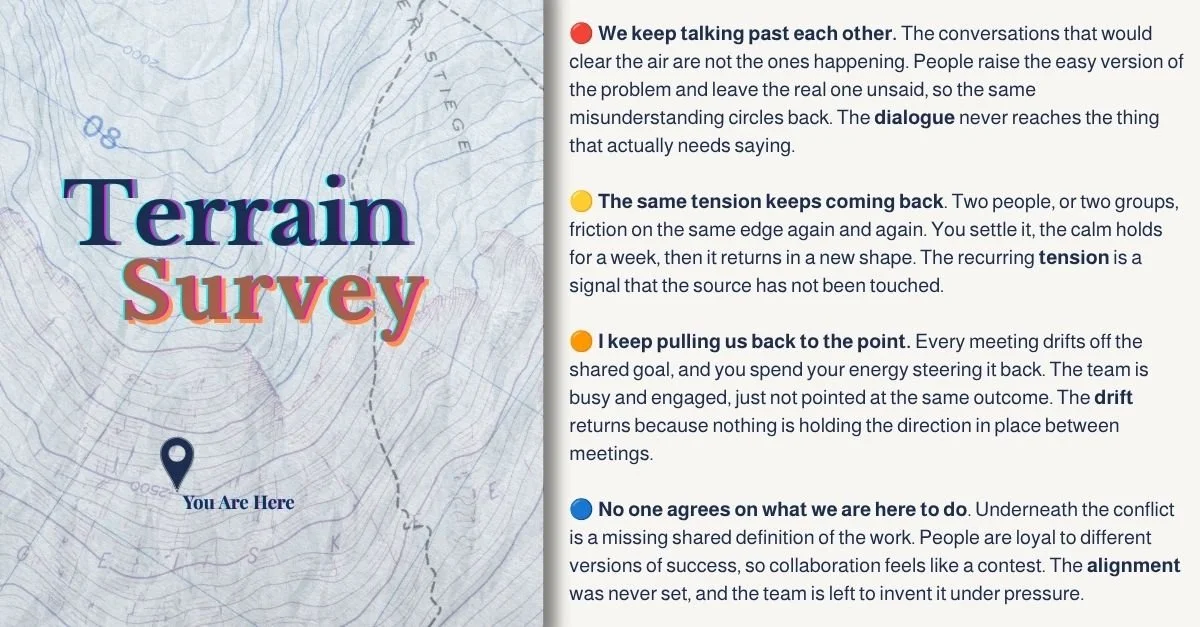
So which of these is actually happening on your team?
What you are feeling is not a gap in your ability to lead a team. It is a gap in the structure. The team has not been given one clear definition of what it is working toward, or one clear place where collisions get decided. The terrain has conditions. The conditions have names. The first step is locating which one you are standing on.
Once you know which friction you are in, the map shows what the role asks of you next.
How do you decide whether to mediate or coach?
Reading Team Conflict helps you locate the source before you choose a response. It does not settle the conflict for you. It shows you whether the friction lives between the people, inside one person’s development, or above the team in the structure around them, so you can stop spending energy on a response that cannot reach the source.
Phase 1: Locate the source. The purpose is to tell whether the conflict sits between the people or above them. You trace the tension back to where the competing signal first enters the team. What shifts is the read itself. Recurring friction stops looking like a relationship that needs repair and starts looking like two definitions of success colliding in the same room.
Phase 2: Name the missing structure. The purpose is to identify what the system has not provided. You ask which decision has no clear owner, which priority has no agreed rank, or which expectation has not been made visible. What shifts is where the problem lives. The gap becomes a structural one you can describe, instead of a personal one you carry.
Phase 3: Choose the role the source calls for. The purpose is to match your response to where the conflict actually lives. If it lives between the people, the work may call for mediation. If it lives in one person’s skill, behavior, or interpretation, the work may call for coaching. If it lives above them, the work is realigning the structure rather than refereeing the room. What shifts is your effort. You stop pouring it into the role that cannot reach the source.
Phase 4: Coordinate upstream. The purpose is to address the misalignment where it is produced. You take the collision to the level that can actually reconcile it. What shifts is the pattern. The conflict stops regenerating because the competing signal is settled before it reaches the team.
The map orients you. The Terrain Survey above is where each kind of friction gets worked through in depth.
Common questions about your role in team conflict
Should you mediate or coach team conflict?
It depends on the source. When the conflict lives between two people, mediation may help them work through what is happening between them. When the conflict lives in one person’s skill, behavior, or interpretation, coaching may help. When the conflict comes from competing direction or an unowned decision, neither mediating nor coaching the people will resolve it, because the source sits above them. Locate the source first, then choose the role.
Why does the same team conflict keep coming back?
Recurrence is the clearest sign that the conflict may be structural. If smoothing the relationship settles it for a week and then it returns, the conditions producing it are still in place. The repair may have been real, but it was applied to the symptom rather than the source.
What causes team conflict that is not about personalities?
Competing definitions of success, unclear authority over decisions, and missing shared direction. When the structure sends more than one signal about what matters, the people closest to the work end up in friction over priorities they did not set. The clash looks personal because the structural cause is invisible from inside the team.
When should you escalate team conflict instead of handling it yourself?
When the source sits above the team. If the conflict comes from two authorities asking for different things, you cannot resolve it inside the room, no matter how skilled the mediation. The work then is to coordinate upstream with the people who set the competing direction, so the team stops being asked to reconcile a contradiction that was never theirs.
Why this matters
In my case weekly drift was something i thought I was failing to manage. The truth was simpler and harder. I was standing in a structural conflict and treating it as a focus problem, which is why every meeting felt like starting over.
The conflict was real. It was just not located where I kept looking for it.
This is what Leadership Cartography is built to do. It treats conflict as terrain with conditions, not as a verdict on the manager standing in it. When you can see whether the friction lives between your people, inside one person’s development, or above the team, you stop the personal frustration that comes with being in this territory.
You read the ground first, then move.
The shift is from settling conflict to reading it. A mediator calms the room. A coach develops the person. Both matter. Neither helps when the conflict is a signal coming from somewhere the team cannot see.
The work is to find where it starts and meet it there.
Related reading
Effective Team Norms: A Guide to Setting Ground Rules for Success
Coaching Star Performers: Building the Next Level Pipeline
Difficult Conversations: 3 Scripts Managers Must Master
Before you can tell where a team's conflict lives, it helps to know how you read terrain yourself. The Source Assessment shows you your pathway, so you know where your instinct steps in and where it should step back. Discover Your Pathway.