
Coaching Star Performers: Building the Next Level Pipeline
Why your best people struggle after promotion and what development actually needs to include

Coaching star performers is often misread as a talent identification problem when it is a development architecture problem. Most managers can recognize who is ready for the next level. Fewer have a method for preparing them for conditions they have never operated in. The gap between operating inside a well-built system and building one from scratch rarely enters the development conversation. When development transfers performance expectations without transferring the diagnostic skills that produce results, star performers walk into their first independent role carrying everything they learned and missing the one thing they were never taught.
What does it actually feel like to develop someone you believe in?
There was a manager I worked with for a year, maybe two, who I genuinely believed was ready for anything. He enrolled people in his vision the way some leaders only hope to. He made the work feel meaningful to the people around him without appearing to try. When he needed to teach something I had spent years struggling to explain, he did it in a hallway conversation in ten minutes, and it landed.
When he was ready for his own operation, I did something I had never done before. I reversed roles. He made the decisions. I became his number one. Break what you are not sure about, I told him. We will debrief the learning.
A promotion for him would leave a measurable hole in my restaurant. That is what development is all about.
He was promoted. I was genuinely beaming, because his accomplishment felt like mine too. That is how it goes when development actually works. You feel it in both directions.
Then, in his first week in the new role, I received a call.
He was overwhelmed. The restaurant he had inherited was in rough shape. The systems were thin. The support structures we had built together did not exist in this new place. In that conversation, I understood what I had actually given him, and what I had not.
I had taught him how to operate inside a well-built system. Mine. I had never taught him how to build one. I didn't think of what I did as a method. I would observe what was actually happening. I would look at each element, assign a standard, and go to work on the actions needed to reach it. I would measure, adjust, measure again. That process was invisible to me as a method. I just did it. So it never occurred to me to hand it over.
The struggle he walked into that first week came from a gap I created. I had given him everything I knew how to do. I had never handed over the method behind it, because the method was invisible to me. That part I cannot stop thinking about.
You may recognize this feeling. The realization, usually after the fact, that your star performer learned to work beautifully inside your system. Building one from scratch was a different skill, and you never handed it over.
Why does developing a star performer feel so different from developing anyone else?
The system creates specific conditions around high performers that make their development harder to see clearly, and harder to structure well.
The invisible method problem. Managers develop star performers through proximity and observation. The performer learns how things are done, what standards look like, how problems get solved. The underlying method stays invisible. The manager never named it, so the performer never received it.
The conditions transfer gap. Development happens inside a specific context: the manager's system, their relationships, their standards, their culture. The star performer learns to succeed in those conditions. When the conditions change — a different team, a different organization with different legacy problems — the gap between what they learned and what the new role requires becomes visible for the first time.
The readiness misread. Organizations promote based on demonstrated performance in the current role. Star performers look ready because they are excellent at operating in a well-run environment. The measurement is accurate. The environment it is measuring is not the one they are walking into.
The pipeline without architecture. Managers often think about building a next-level pipeline as a talent identification exercise: who is ready, who is almost ready, who needs more time. The identification is often correct. The preparation architecture underneath it is thin. A pipeline of identified candidates is not the same as a pipeline of prepared ones.
The cost. When development stops at preparation for current conditions, the star performer's first struggle in a new role gets read as a performance problem. It is a development gap, and it was created before the promotion happened.
Where exactly this shows up for you is worth locating before you build a plan.
The Next Level Pass
Developing a star performer into a next-level leader is one of the most demanding things a manager takes on. It is also one of the least structured. The friction points below map to four distinct places where that development tends to stall. In most cases, the system has not provided the tools to prepare a performer for what they are walking into.
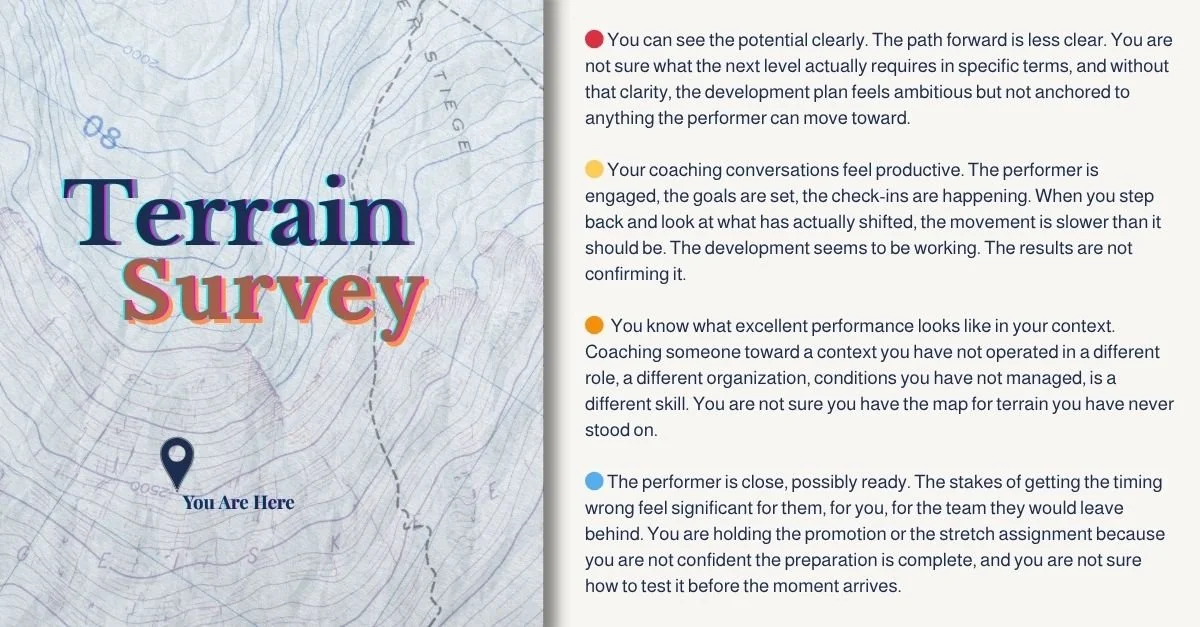
Where does development most often stall for you?
Which of these is closest to where you are standing right now?
What you are feeling is not a gap in your ability as a developer. It is a gap in the structure. Most development frameworks were built for managing performance in the current role, not for preparing someone for conditions that do not yet exist. The terrain has conditions. The conditions have names. And the first step is locating which one you are standing on.
The friction points above map to a four-phase development system. Each friction point has a different entry and a different set of moves. The framework below gives you enough orientation to locate where you are.
What does a next-level pipeline actually require?
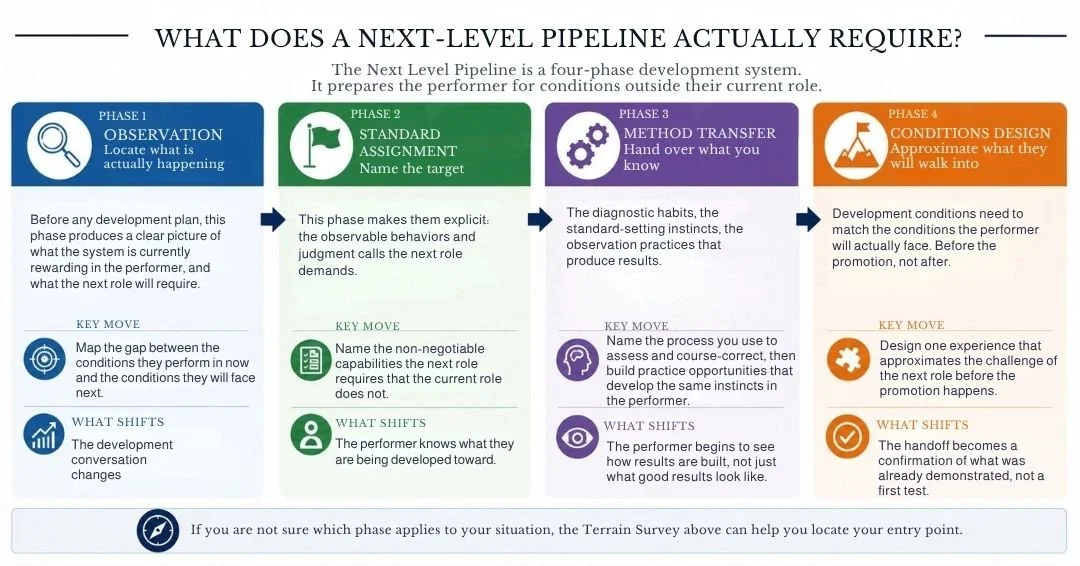
The Next Level Pipeline is a four-phase development system. It prepares the performer for conditions outside their current role.
Phase 1: Observation — Locate what is actually happening
Before any development plan, this phase produces a clear picture of what the system is currently rewarding in the performer, and what the next role will require that the current environment is not developing. Most development skips this step.
Key move: Map the gap between the conditions they perform in now and the conditions they will face next.
What shifts: The development conversation changes from how do we improve what you are already doing to what does the next environment actually require.
Phase 2: Standard Assignment — Name the target
The next level has specific requirements. This phase makes them explicit: the observable behaviors and judgment calls the next role demands. This is where most managers discover they have been developing toward a general idea of readiness rather than a specific target.
Key move: Name the non-negotiable capabilities the next role requires that the current role does not.
What shifts: The performer knows what they are being developed toward. The plan has a target.
Phase 3: Method Transfer — Hand over what you know
The diagnostic habits, the standard-setting instincts, the observation practices that produce results — these need to become explicit and transferable. The performer who learns only outcomes cannot reproduce them in a different context. This is the phase most managers skip because the method never felt like a method.
Key move: Name the process you use to assess and course-correct, then build practice opportunities that develop the same instincts in the performer.
What shifts: The performer begins to see how results are built, not just what good results look like.
Phase 4: Conditions Design — Approximate what they will walk into
Development conditions need to match the conditions the performer will actually face. A role reversal, or a stretch assignment in a context where they are not already excellent. This phase tests preparation before the promotion, not after.
Key move: Design one experience that approximates the challenge of the next role before the promotion happens.
What shifts: The handoff becomes a confirmation of what was already demonstrated, not a first test.
If you are not sure which phase applies to your situation, the Terrain Survey above can help you locate your entry point.
Questions managers ask about coaching star performers
What is the difference between coaching a struggling employee and coaching a star performer? A struggling employee needs support to reach the standard. A star performer has already met it. Coaching a star performer requires a different orientation. The goal is building capacity for conditions the performer has not yet encountered. The conversations are different, the timeline is different, and the success signals are different.
How do I know when a star performer is actually ready for the next level? The clearest signal is adaptability. A performer who succeeds consistently in a well-run environment may or may not be ready for an environment they have to build themselves. The useful test is what they can do when the system does not exist yet.
How do I develop someone for a role I have never done myself? You develop the capacity, not the content. You may not know what their next role requires in detail. You can still develop their diagnostic instincts and their capacity to build a standard and measure toward it. Those skills transfer. The specific content of the next role does not need to be yours to teach.
What do I do when the promotion leaves a gap I cannot fill? Plan for the gap before the promotion happens. A promotion that leaves a hole is part of what development costs. When the gap is recognized early, it can be managed through succession planning, team redistribution, or a transition timeline that does not leave the operation exposed. The gap that surprises you is the one that was not planned for.
Why does this gap show up so often in leadership development?
Most managers are trained in performance management. They are not trained in development architecture. The two are related but they are not the same skill set.
Performance management measures results in the current role. Development architecture builds capacity for future conditions. When managers apply performance management logic to a development conversation, they produce performers who are excellent in one context and underprepared for the next.
Leadership Cartography was built in response to exactly this gap. The five pathways — the ways different leaders naturally show up in their work — each carry their own development pattern. A Support leader develops differently than a Precision leader. A Purpose leader's star performers surface differently and need different preparation. The pipeline needs to account for who the person actually is, not just what they can do in this role.
The gap that surfaced in my manager's first week was about structure. The system he walked into was different from the one he had learned inside. That is a structure problem. And structure problems have structural solutions.
If Phase 3 is where you are standing — the work of making your diagnostic process explicit and transferable — the Reality-Based Employee Development Toolkit gives you the structure to do it. Observation templates, development plan builders, feedback frameworks, and conversation scripts for the moments when vague encouragement stops working and the truth needs to land.
Stop Performance Review Theater. Start Honest Growth Conversations.
Most development plans fail because they protect feelings instead of building capability. Managers leave conversations relieved, employees leave confused, and no one gets better.
This toolkit changes that.
Designed for managers who care enough to tell the truth — and skilled enough to make it land — the Reality-Based Employee Development Toolkit gives you the frameworks, scripts, and templates you need to have honest growth conversations that create measurable change.
What’s Inside
The Reality-Based Framework → Diagnose real gaps, not vague traits.
Honest Feedback Conversation Guide → Step-by-step flow and ready-to-use scripts.
Development Plan Builder → Fillable PDF template for measurable goals.
Scenario Library → Four real-world profiles with feedback + focus areas.
Tracking System → Monthly check-in sheets and observation log.
Resource Library → Books, coaching cues, and internal development options.
When to Use It
Before performance reviews, to name real development needs.
After a missed promotion, when your employee deserves clarity.
When coaching someone who’s “stuck” and generic advice isn’t working.
Anytime you want to replace vague encouragement with actionable growth.
Why It Works
Anchors development to business reality (not personality traits).
Builds trust through specificity and clarity.
Saves time — ready-to-use scripts, templates, and tracking forms.
Moves employees forward with confidence, not guesswork.
Format & Access
Instant digital download (fillable PDF)
Use on desktop, tablet, or print for in-person sessions
For individual professional use
Your Next Step
Clarity is care. If you’ve been waiting for a way to move past vague development conversations, this toolkit gives you the words, structure, and confidence to make it happen.
Add to Cart today and transform your next development conversation.
Related Reading
When Your One-on-Ones Are Full of Connection and Empty of Development
How to Delegate Without Dumping: The 4-Part Handoff Structure Managers Skip
The next-level pipeline looks different depending on how you lead. Discover your source pathway first.