
The Invention of the Employee Manual
When the unwritten rules finally became a cage
The employee manual emerged in the early 20th century as a tool for institutional protection rather than employee clarity. It shifted the burden of knowing the rules from the manager to the individual, creating a permanent record of expectations. This post explores how these manuals evolved from helpful guides into systems of administrative control.
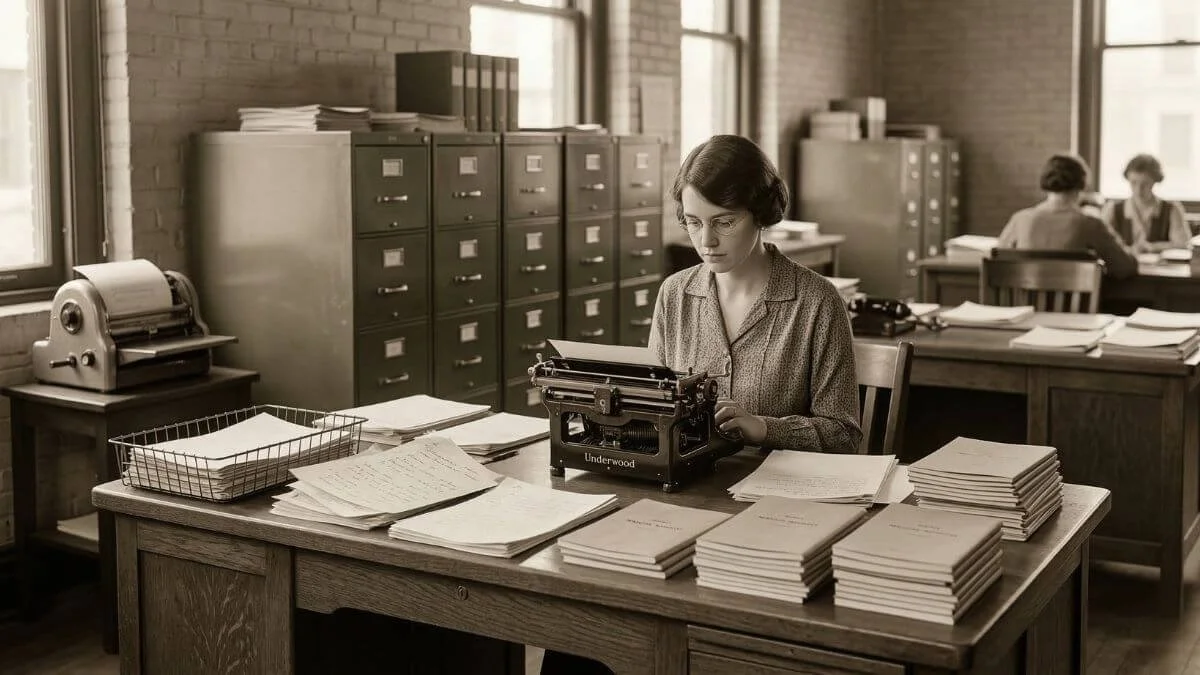
The Manual Clerk at work (c. 1920s). This role was created to gather policy fragments and weave them into a single, cohesive voice of authority, turning messy collaboration into a cold, binding script
The moment a company puts its culture into a three-ring binder, the culture is already dead.
Before the early 1900s, joining a company was an oral tradition. You learned the way we do things by standing next to a master or listening to a foreman. This was inefficient for the exploding scale of the Industrial Revolution. Companies were hiring hundreds of people a week, and they could no longer rely on human conversation to pass down instructions. Necessity birthed the first formal employee manuals. These were not designed to make you feel welcome. They were designed to ensure that the worker was the one held liable for any deviation from the process. By the 1920s, the Company Way was no longer a vibe, it was a legal document.
The Job: The Manual Compiler
In the burgeoning personnel departments of the 1920s, the Manual Compiler was the architect of expectation. Their job was to walk the factory floors and office rows to capture every unwritten rule and turn it into a sterile command. They were the original policy writers.
The Manual Compiler carried a clipboard and a heavy sense of bureaucratic duty. They interviewed managers to find out what people were doing wrong, then wrote a new rule to prevent it from ever happening again. They did not care about employee engagement. They cared about uniformity of output. If a worker failed, the manager did not have to explain why. They simply pointed to the page and the paragraph number. The Manual Compiler turned the manager into a referee and the employee into a rule-follower.
The Modern Correlation
Many modern managers are exhausted because they are acting as the living embodiment of the employee manual. You spend your one-on-ones reciting policies and clarifying the way we do things rather than developing the human in front of you. We have replaced the master-apprentice relationship with a PDF that no one reads. If you feel like your leadership is buried under a mountain of standard operating procedures, it is because you are maintaining a 100-year-old system designed to prioritize the rule over the person.
In the Leadership Cartography™ system, we recognize this as the Lead with Support™ pathway. We often think of onboarding and handbooks as a way to support the new hire. In reality, we have inherited a system of administrative scaffolding designed for institutional protection.
If your entire leadership style were removed and replaced by your company’s employee manual, would your team actually notice a difference in how they are treated?

Audit the Rules
The 1920s manual was designed to remove the need for a manager to think. Today, that same desire for uniformity is what keeps you stuck in the administrative weeds.
Not sure if your onboarding process is actually welcoming people or just inducting them into a system of control? Take the Leadership Style Quiz to see how your map is currently drawn.
If you feel stuck in the overwhelm of policy enforcement and rigid procedures, explore how the Development Approach Map can help you move from being a rule-enforcer to a growth-facilitator.
We help you identify where the mechanism of the Manual Compiler is still running your calendar.