
The Company Town and the Architecture of Total Provision
When "we are a family" was an engineering requirement (1880)
Chicago History Museum, Public domain, via Wikimedia Commons
The Company Town and the Architecture of Total Provision
In 1880, George Pullman built an entire town outside Chicago for the workers who manufactured his luxury railroad cars. Pullman, Illinois had company-owned housing, a company store, a company library, and company schools. Workers paid rent to Pullman, bought groceries from Pullman, and sent their children to Pullman’s schools. It looked like corporate benevolence. It looked like a caring employer providing everything people needed.
But the town was not built to make workers comfortable. It was built to make them stay. A worker could not quit without becoming homeless. They could not shop elsewhere without violating lease terms. They could not organize a union without risking eviction from the only housing they could access. The company town offered stability, but it came with a condition. Your life belonged to the same system that owned your paycheck.
The Job: The Welfare Superintendent
This structure created a new kind of management role. Not a foreman. Not a supervisor. Someone whose job was to manage life outside the factory. The Welfare Superintendent.
The Welfare Superintendent did not oversee production metrics. They oversaw the person as a whole. They inspected company housing and enforced cleanliness standards. They ran the company store. They organized recreation, education, and “community.” They appeared to be providing care and opportunity. They were actually running surveillance.
In Pullman’s model, the line between support and control disappeared. Good workers received better housing assignments. Troublemakers were moved to smaller units closer to factory noise. Workers who attended company social events were noted as loyal. Those who did not were quietly flagged as potential union sympathizers. The Welfare Superintendent performed a version of empathetic infrastructure while administering a system designed to make leaving economically impossible. Everything was provided. Independence was not.
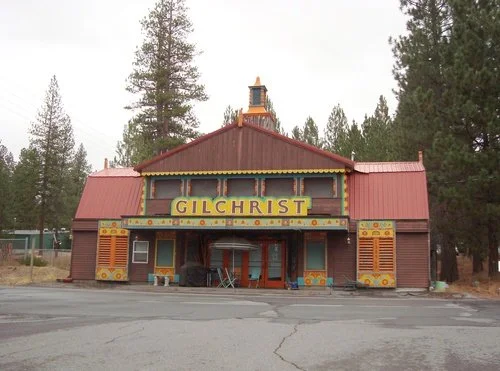
The Legacy of Gilchrist, Oregon
The practice of total provision did not end in the Victorian era. Gilchrist, Oregon, was founded in 1938 and operated as a family-owned company town for over fifty years. In Gilchrist, the timber company remained the landlord and the grocer. Even the entertainment was part of the infrastructure. The Gilchrist Theatre (pictured) wasn't just a place to see a movie; it was a company-owned social anchor for the families and students who grew up in the timber town's closed loop.
For generations of students who graduated from Gilchrist High School, the company town was the only center of gravity. Independence was not part of the architecture until the town was finally sold and incorporated in 1991. It remains a stark reminder that the "total care" model persisted long after the industrial revolution ended.
Entering Gilchrist High School for me, as a senior transfer student was less of a traditional high school change and more of a surreal observation in systems. While the community was tightly knit, seeing it for the first time as an outsider revealed the invisible architecture of the company town that those born into it could no longer see. It was a lived study of what happens when a community is engineered rather than evolved. This perspective afforded me a different point of view on what community actually entails—and how easily total provision can be mistaken for total belonging. No one will remember me as a student there. I was only there one year. But I will remember it.
The Modern Correlation
Today, companies do not own towns. They do not own the grocery store or the housing block. But the same management logic lives inside teams. In the Leadership Cartography™ system, we recognize this as the Lead with Heart™ pathway.
A modern company town is built when a manager provides everything. You handle your team’s conflicts with other departments. You shield them from difficult stakeholders. You intervene before they have to negotiate for themselves. You build a team culture so tight that your people’s social network, identity, and sense of belonging all live inside the company. You tell yourself you are creating a supportive environment. You might actually be creating dependency.
The Development Approach pain point is not that you care too much. It is that your care can prevent your team from building capability that exists outside your protection. When you handle every difficult conversation, they do not learn to navigate conflict. When professional development is entirely internal, they do not build external networks. They may love the environment you created, but that does not mean they are growing. It may simply mean you built a very comfortable enclosure.
If George Pullman provided everything his workers needed except the ability to leave, and you are proud of creating a team that cannot imagine working anywhere else, what exactly are you building?

This pattern did not disappear. It evolved.
If you recognize yourself in the Development Approach tension, the map will show you where support becomes enclosure.
Take the Leadership Cartography™ Quiz and identify your dominant pathway.