
Ford's Assembly Line: When Efficiency Meant You Never Saw the Finished Product
When efficiency meant you never saw the finished product
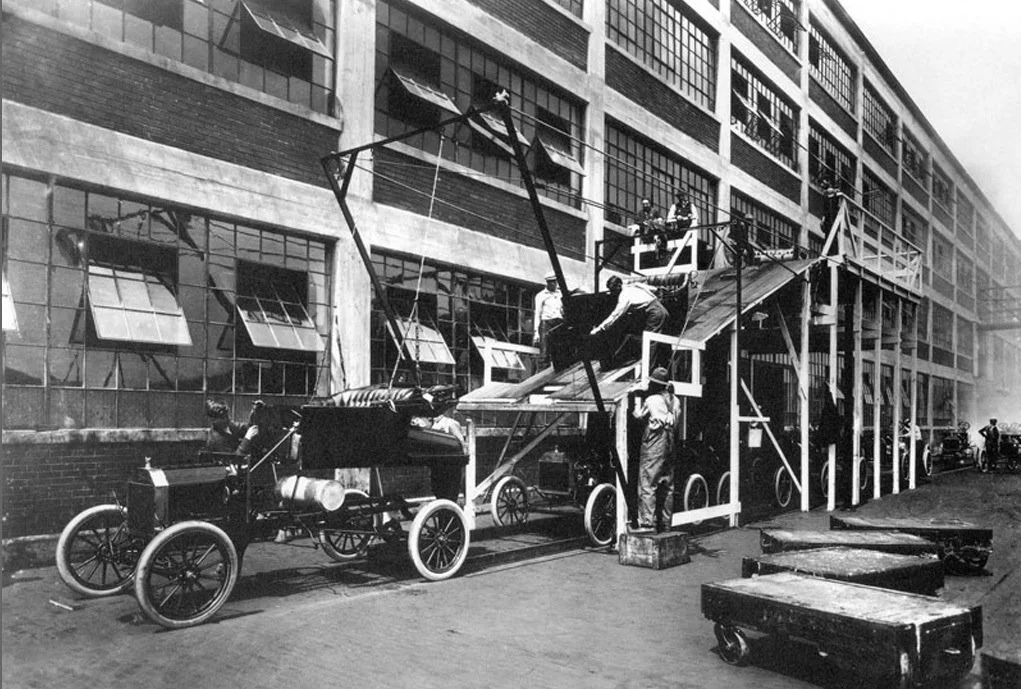
Ford company, Public domain, via Wikimedia Commons
In 1913, it took 12 hours to build a single Model T Ford. (Nevins & Hill, Ford: The Times, the Man, the Company, 1954)
Skilled mechanics moved around the factory floor, gathering parts and assembling entire sections of the car. Each worker needed to understand engines, transmissions, steering mechanisms. Building a car required craft. Then Henry Ford installed a moving assembly line at his Highland Park plant. The work came to the workers instead of the other way around. Assembly time dropped from 12 hours to 93 minutes. (Ford Motor Company Archives, cited in Hounshell, From the American System to Mass Production, 1984)
The Job: The Assembly Line Worker
Before the assembly line, Ford employed mechanics. Workers who understood how a car functioned as a whole, who could diagnose problems and take pride in what they helped build. After the assembly line, Ford employed assemblers. Worker #47 installed the left front wheel. Not wheels. Not the front axle assembly. Just the left front wheel. Eight bolts. Tightened in sequence. Every 60 seconds. For ten hours a day. Six days a week. (Hounshell, 1984)
Ford could hire anyone, train them in minutes, and replace them just as fast. The job required extreme Precision. But precision of motion, not precision of thought. Do the task exactly the same way, at exactly the same speed, in exactly the same sequence, forever. The worker couldn't see the car before their station or after it. They couldn't see the finished product roll off the line. They just saw an endless parade of identical moments, each requiring the same eight bolts.
Ford celebrated this as scientific management. Maximum efficiency. Minimum waste. What he actually built was a system where no single worker understood the whole, where expertise was unnecessary, and where workers became interchangeable parts in a machine they would never comprehend.
The Modern Correlation
Most managers today aren't running assembly lines. But if you lead with Lead with Precision™ in the Leadership Cartography™ system, you've inherited Ford's workflow logic. You break projects into discrete tasks. You assign each person a specific component. You optimize handoffs. You create documentation so anyone can do anyone else's job. And you call it good team design.
But when you optimize a workflow by breaking it into specialized tasks, you don't just increase efficiency. You eliminate each person's understanding of the whole. Person A handles intake. Person B does analysis. Person C writes the report. Person D presents to stakeholders. No one sees the full picture. When something breaks, no one can diagnose it because no one understands the system.
You've designed your team into specialized stations where Ford's eight-bolt logic still governs. Lead with Precision™ leaders are especially vulnerable here. Clear swim lanes feel responsible. Documented processes feel consistent. But what you've built is a team of assemblers who can't see the car, who can't understand why their eight bolts matter, and who leave each day without comprehending what they're building or why it matters.
If Henry Ford increased efficiency by ensuring no worker understood the whole car, and you've increased efficiency by ensuring no team member understands the whole project, are you building a high-performing team, or are you running an assembly line with better job titles?
Related Reading
The Carbon Copy Clerk: Why We Still Use 1806 Management Logic — Another Precision-era system designed for efficiency that quietly stripped workers of judgment and understanding.
Frederick Taylor's Principles of Scientific Management — The intellectual foundation Ford built his assembly line on. Taylor's stopwatch logic came first. Ford just industrialized it.

Identify Your Terrain: Are you a Precision™ pathway leader who's optimized your team into isolated stations? Take the Leadership Style Quiz to see if your efficiency instincts have turned your team into 1913 assembly line workers who never see the finished product.