
The $5 Day and the Price of Your Personal Life
When Your Wage Came with a Home Inspection
Credit
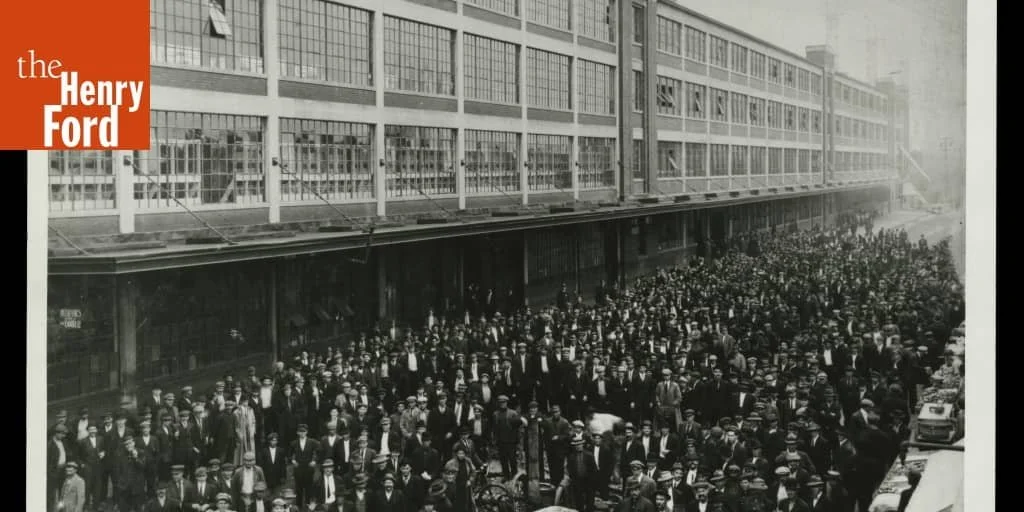
From the Collections of The Henry Ford. Gift of Ford Motor Company. Ford workers disliked the new assembly line methods so much that by late 1913, labor turnover was 380 percent. The company's announcement to pay five dollars for an eight-hour day compared to the previous rate of $2.34 for a nine-hour day made many workers willing to submit to the relentless discipline of the line in return for such high wages.
Henry Ford paid his workers double. In exchange, he sent someone to inspect their homes.
In January 1914, Ford announced a $5-per-day wage for assembly line workers at the Highland Park plant. The prior rate was $2.34 for a nine-hour day. Newspapers called it unprecedented generosity. Workers flooded the plant gates before dawn. Competitors accused Ford of socialism.
The fine print didn't make the headlines. The $5 Day was a profit-sharing plan, and workers still earned the base $2.34 wage. The additional $2.66 required qualifying, and Ford created the Sociological Department specifically to determine who did. Investigators arrived unannounced. They checked the cleanliness of the house, the state of the marriage, the presence of alcohol. If your wife worked outside the home, you were disqualified. If you sent money to family abroad, you were suspect. If you didn't speak English, you attended Ford's Americanization classes before you saw a cent of profit share.
The Job: The $5 Day Qualified Worker
The $5 Day Qualified Worker held two jobs simultaneously. On the line, they performed the assembly work Ford paid them for. At home, they performed Ford's definition of an American life. They believed in the $5 a day and what it meant for survival, at a time when a week's groceries ran roughly $3.50 and rent consumed the rest. The wage came attached to a purpose narrative, but the purpose was Ford's to define, and a worker's private life was the collateral. Ford called it generosity. His workers called it a second job they couldn't quit.
The Modern Correlation
You are running the same inspection. You have just given it a better name.
You call it mission-driven work. You call it values alignment. You call it cultural fit. You celebrate the people who seem to embody the mission, flag the ones who don't perform enough enthusiasm or devotion, and quietly filter out anyone whose authentic relationship to work doesn't match the company-approved template. You probably believe every word of it. Ford believed every word of his too.
When compensation, advancement, or belonging is tied to performing a company-defined sense of purpose, the reward structure filters for identity performance, not quality of work. Your Sociological Department runs through performance reviews and all-hands meetings and the hallway conversation where someone gets described as "not aligned" The inspection has moved rooms. The mechanism is identical.
Your team figured this out faster than you think. They know which stories get nods in meetings. Which language signals alignment. Which version of caring gets rewarded and which version gets a person quietly sidelined. They have replaced whatever their authentic relationship to work actually was with the version you've signaled you want to see. The people who seem most themselves at work are the ones whose real selves happened to match the template. Everyone else is managing a second shift, and you've decided to call it engagement.
Ford genuinely thought he was helping workers become better Americans. You genuinely think you're helping your team connect to meaningful work. That sincerity is not a defense. It is the point. The most entrenched inspection systems are the ones built by people who were absolutely certain they were doing good. Certainty closes the feedback loop. It stops you from asking whether the people inside the system are actually okay, because you already know the answer: they should be grateful.
When purpose becomes a condition of advancement, it stops producing meaning and starts producing compliance. Your team has learned the script. The question is whether you've noticed they're reading from one.
If Ford paid workers double to live according to his moral standards in their private lives, are you creating purpose-driven work, or running the Sociological Department with a better mission statement?
Related Reading
The Company Town and the Architecture of Total Provision — The $5 Day and the company town are the same mechanism. One controlled your home. The other sent someone to inspect it.
Ford's Assembly Line: When Efficiency Meant You Never Saw the Finished Product — Ford built a system where no single worker understood the whole. The $5 Day made sure they were too financially bound to ask why.

Sources
Nevins, A., & Hill, F. E. (1954). Ford: The Times, the Man, the Company. Scribner. Meyer, S. (1981). The Five Dollar Day: Labor Management and Social Control in the Ford Motor Company, 1908-1921. SUNY Press. U.S. Bureau of Labor Statistics. (1914). Cost of Living Studies.