
The Sociological Department and the Surveillance of Care
When supporting your workers meant inspecting their bedrooms. Today we know the inspector as the Chief Cultural Officer.
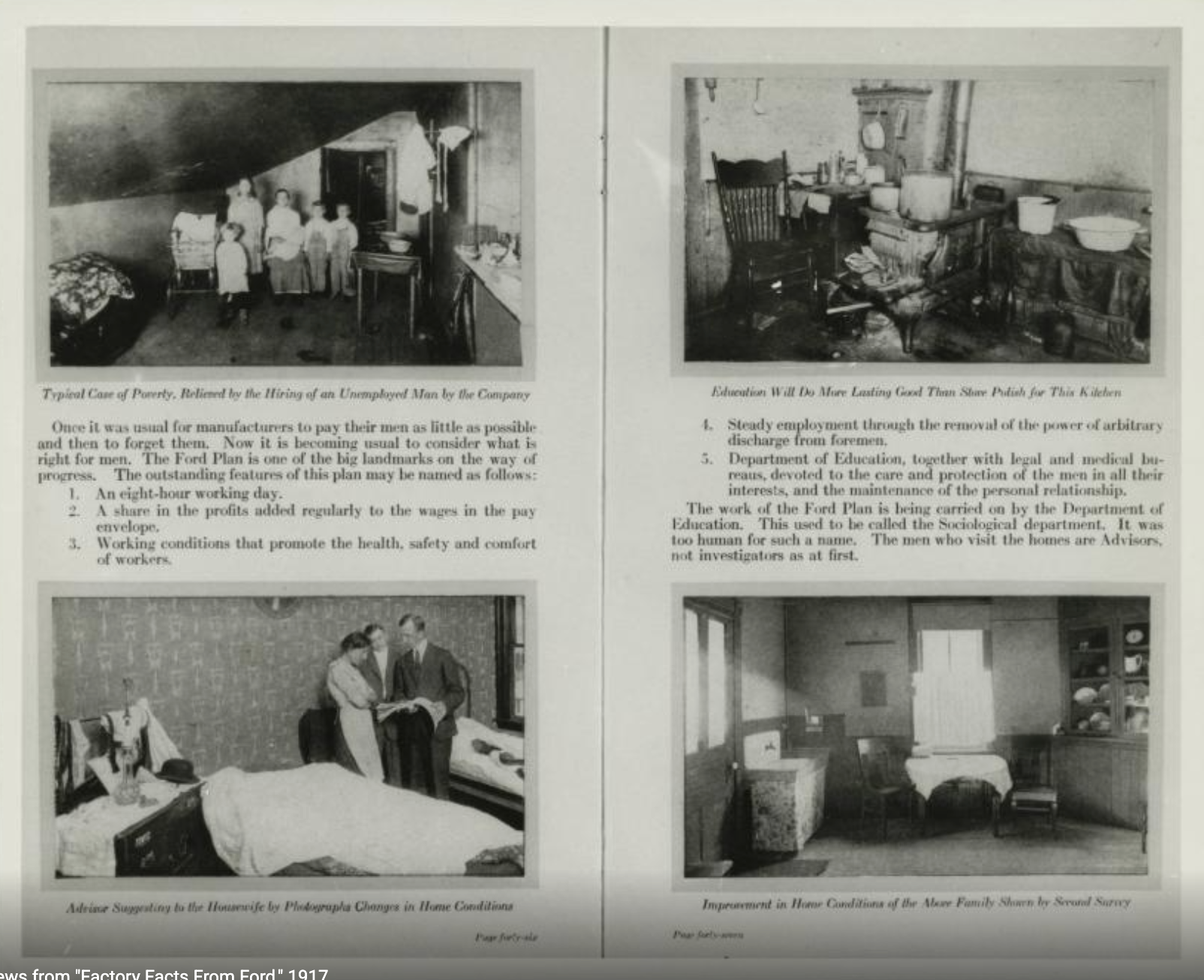
Beyond revolutionizing America's industrial production, Henry Ford and other managers at Ford Motor Company instituted a wide-reaching corporate welfare program that opened up the most intimate and personal details of employee's personal, family, and financial life to investigators from the Sociological Department Photo Credit: From the Collections of The Henry Ford. Gift of Ford Motor Company.
In 1914, Henry Ford didn't just announce the $5 Day. He built an entire department to decide who deserved it.
Not based on work performance. Based on behavior at home.
The Sociological Department employed 50 investigators whose job was to visit workers' houses unannounced, interview their neighbors, and determine if they were living according to Ford's standards. If you wanted the profit-sharing portion of the $5 wage, you submitted to the inspection. Ford called this character building. What he actually built was the first corporate surveillance system designed to monitor workers' private lives as a condition of economic security.
The Job: The Sociological Department Investigator
The Investigator arrived at your door without warning, carrying a clipboard with 150 questions. They wanted to see every room. They checked if your floors were swept, if you had boarders to supplement income. They asked your neighbors if you drank or gambled. They wanted to know if your wife worked outside the home. If you sent money to family abroad. If your children attended school.
The Investigator wasn't evaluating your work. They were evaluating your worthiness for full wages based on Ford's definition of proper American life. They filed reports using a four-tier classification system: Poor, Fair, Good, or Excellent. Only Good or better qualified for profit-sharing. The rest lost the wage increase that made survival possible.
And they performed this work through a posture of care. They asked about your family, your health, your struggles. They offered advice on household management, English classes, budgeting. They called it support. Every piece of information they collected was used to determine if you deserved full compensation. The care was real. The surveillance was also real. Workers could not separate the two.
The Modern Correlation
Today, managers don't send investigators to their team's homes. But if you lead through the Lead with Heart™ pathway, you may be running a version of the Sociological Department without recognizing it.
You ask how they're really doing. You notice when someone seems off. You check in about work-life balance, stress levels, family situations. And every answer quietly becomes data that shapes your read on their readiness, their potential, their ability to handle more.
Your team learns what's safe to share. A sick parent can explain a performance dip. Chronic depression cannot be mentioned without risking a quiet recalibration of their trajectory. They perform disclosure carefully, offering just enough to seem authentic while protecting the details that might mark them as unable to handle more.
The mechanism looks nothing like Ford's home inspections. The structural logic is identical. Both systems make support contingent on visibility. Both systems require disclosure to receive investment. Both systems call it care.
Ford's Investigators genuinely wanted workers to thrive. They were not monsters. They were people who believed that knowing everything about workers' lives was necessary to help them succeed. The development approach for Heart™ leaders runs deeper than intention. Your caring requires information people shouldn't have to share as a condition of development.
If Ford's Sociological Department investigated workers' homes to determine if they deserved support, and you require access to personal information to determine development readiness, are you leading with Heart™, or are you running the inspection with better questions?
Related Reading
The First Question: A Map for the Human Element — The 1930s Houser Survey turned "How are you?" into a data collection system, the same structural logic as Ford's inspection but wearing a friendlier face.
Personnel Departments Weren't Built To Help You — The first HR departments were also built around control disguised as support, making this a direct predecessor to the Sociological Department story.
Where does this land for you? If the system you have been managing inside is starting to feel more familiar than you would like, the Leadership Map quiz can help you see what you are working with.

Sources
Watts, S. (2005). The People's Tycoon: Henry Ford and the American Century. Knopf.
Meyer, S. (1981). The Five Dollar Day: Labor Management and Social Control in the Ford Motor Company, 1908-1921. SUNY Press.
Hooker, C. (1997). Ford: The Men and the Machine. Little, Brown and Company.