
47 Tons of Iron and a Stopwatch
Frederick Taylor’s Principles of Scientific Management (1911) introduced the theory of "Scientific Management," which posits that labor productivity can be maximized by breaking work into standardized, timed motions. Often called Taylorism, this method shifts control from the worker’s craft to the manager’s scientific process. In modern leadership, Taylorism is the historical root of the "Delegation Block," where a focus on Precision™ becomes a rigid system of micro-control rather than a supportive framework for team clarity.
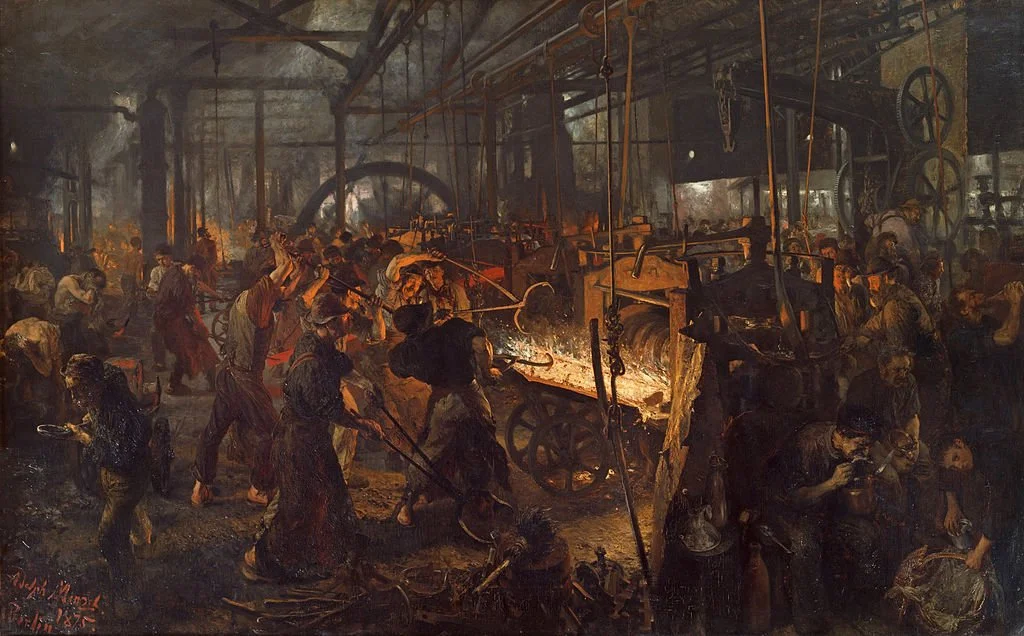
Adolph von Menzel, Public domain, via Wikimedia Commons
In 1911, a man named Frederick Winslow Taylor published a book that turned the human body into a machine part. The Principles of Scientific Management was the first true management blockbuster. It was a provocative claim that the system must come first. Before this book, work was a matter of craft and personal knack. After it, work became a matter of math. Taylor believed that there was exactly one best way to perform any task. He also believed the worker was too uneducated to find it. This book was necessary because the industrial age was moving too fast for traditional apprenticeships. The owners needed a way to make humans as predictable as the steam engines they operated.
The Job Description: The Scientific Operative (1911)
The job description for a Taylorist worker was not a list of responsibilities but an instruction card for a biological machine. The primary task required the worker to execute a specific sequence of physical motions as dictated by the planning department. The scope of work was limited to a singular and repetitive motion. For example, a pig iron handler was told exactly where to place their feet and at what angle to bend their knees to move 47 tons of iron a day. The reporting structure consisted of direct and constant supervision by a Functional Foreman who did not mentor the worker but timed them with a stopwatch instead. This division created a strict brain and body split where the job description explicitly prohibited thinking. The operative provided the muscle while the manager provided the science. Success was defined by strict adherence to the clock and hitting the 100 percent efficiency mark without any deviation from the manual.
Efficiency became the new religion of the 20th century. As factories grew, the soldiering of workers became a financial threat. Soldiering was the practice of working at a slow and human pace to protect one's energy. Taylor’s book provided the intellectual cover to strip the worker of their agency. If the manager held all the science, the worker only needed to provide the movement. It was an attempt to solve the chaos of rapid growth by imposing a rigid and mechanical order on the human spirit.
The Modern Correlation
Today we see the ghost of Taylor every time a manager asks for a status update on a task that was assigned ten minutes ago. We have moved from the stopwatch on the factory floor to the green active dot on a chat app. The absurdity lies in the fact that we are trying to apply the mechanics of the assembly line to creative and complex thinking. You cannot Taylorize a strategy session or a difficult conversation. Yet our modern management systems still treat the workday like a series of predictable and mechanical movements. We are still obsessed with the one best way in a world that requires constant adaptation. We track keystrokes and time in seat as if we are still moving pig iron in 1911.
In Leadership Cartography, we recognize that this historical era was the birth of the Precision™ Pathway. In its healthiest form, Precision™ provides the clarity and systems that allow a team to feel safe and steady. However, when the terrain becomes unpredictable, even the best systems can create a Delegation Block. This happens when the desire for a perfect outcome turns into an urge to control the specific movements of others.
When you feel the need to correct every minor detail of a teammate's work, you aren't failing. You are simply leaning into a historical impulse to protect the system. By recognizing this 1911 mindset, you can shift your focus back to the why and the what. True precision in modern leadership is about clear boundaries rather than microscopic instructions. It is about using your gift for systems to build a path rather than a cage.
How much of your current exhaustion comes from trying to maintain a 1911 level of control in a 2026 world?

Tier 1: Discovery
Not sure why your focus on the details is leaving you or your team feeling stuck? Take the Leadership Style Quiz to see how your map is currently drawn and how your Precision™ can better serve your goals.
Tier 2: Tactical
If you find yourself unable to let go of the how, you are likely navigating a Delegation Block. Explore how this historical pattern of control becomes modern overwhelm.
Tier 3: Subscription
Need a permanent place to store your insights and refine your leadership maps? Join The Map Drawer for a standing library of tools to help you navigate the system with clarity and steadiness.