
The Open Office 1.0 and the Illusion of Together
What was office landscaping designed to do?
In the 1900s, German efficiency experts removed office walls to create "Bürolandschaft" or office landscaping. The open floor plan was designed to increase collaboration and supervision. The system promised connection but delivered constant surveillance and distraction under the guise of teamwork.
How removing walls in 1900s Germany became the blueprint for collaborative chaos
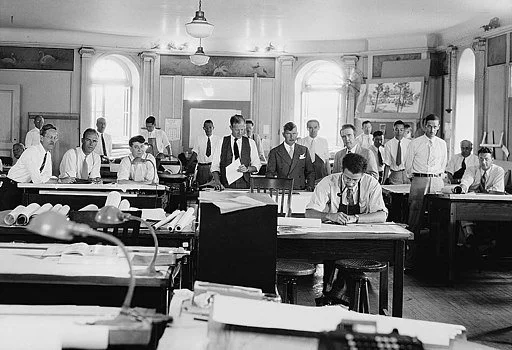
An Open Office Environment, Public domain, via Wikimedia Commons
The walls came down in the name of togetherness.
In the early 1900s, German management theorists faced a visibility crisis. Enclosed offices made it impossible to see workflow bottlenecks, communication breakdowns, or workers who weren't producing at full capacity. So they invented "Bürolandschaft," which translates to office landscaping. The concept was simple. Remove every wall. Place desks in organic clusters based on workflow proximity. Let information flow freely across the open floor. It wasn't presented as surveillance. It was presented as liberation. No more hierarchical barriers. No more isolated silos. Just one big collaborative ecosystem where everyone could see everyone else working.
The Job: The Floor Manager
Before office landscaping, the Floor Manager had a straightforward role. They walked a circuit between enclosed offices, checking in on teams, gathering reports, and moving information from one closed door to the next. Their job was defined by knocking. They were the human router in a system of sealed nodes. Each office had its own climate, its own rules, its own small kingdom. The Floor Manager was the bridge.
When the walls came down, the Floor Manager's role shifted from connector to conductor. They no longer needed to knock because there were no doors. But they also couldn't leave. The open floor required a constant physical presence to maintain the illusion of order. They became the visible enforcer of "collaborative" behavior. If someone put on headphones, the Floor Manager needed to visibly notice. If a cluster of desks got too loud, they had to intervene. The job stopped being about moving information and became about managing the social performance of teamwork. They weren't managing workflow anymore. They were managing the theater of productivity.
Modern Correlation
Today, we still build open offices in the name of collaboration. We remove the cubicles, install long tables, and call it innovation. In the Leadership Cartography™ framework, this is a Together™ pathway failure. The Together pathway is about creating structures that enable genuine collective action, not systems that force the appearance of it. Office landscaping was never about bringing people together. It was about making people visible. And we've inherited that confusion.
If your team has complained about noise, distraction, or the inability to focus in your open workspace, they aren't complaining about collaboration. They're naming the friction that happens when you design for surveillance and call it teamwork. The 1900s system promised connection but optimized for control. Modern open offices promise innovation but deliver exhaustion. We've kept the layout but lost the honesty about what it actually does. It doesn't make teams work better together. It makes them perform togetherness while working alone with noise-canceling headphones.
If the system was designed to make people visible rather than effective, are we building spaces for collaboration or stages for performance?

Discovery: Map Your Natural Terrain
Not sure why your open office culture feels more like surveillance than support? Your leadership style determines whether you see physical proximity as collaboration or as performance theater. If you lead from the Together pathway, you may be unintentionally reinforcing 1900s visibility metrics while calling it teamwork. Take the Leadership Style Quiz to see how your map is currently drawn. Understanding your natural orientation helps you distinguish between systems that actually enable collective work and systems that just make people visible.
Tactical: Lower the Pressure on Forced Collaboration
If your team is stuck performing togetherness instead of actually collaborating, you are experiencing Collaboration Theater. This happens when the physical or digital workspace is designed for visibility rather than for the actual dynamics of how your team works. The Team Dynamics Map helps you see the difference between real collaboration patterns and inherited systems that force proximity without enabling connection. It shows you where your team actually needs walls and where they need genuine openness.
Subscription: Join The Map Drawer
Need a permanent place to store your leadership insights? The terrain of management changes with the seasons. Join The Map Drawer for a standing library of leadership maps that update every month to match the specific pressure of the current season. Instead of hunting for a solution when the terrain gets steep, you will already have three new tools waiting.