
Why Do I Feel Like a Fraud as a Manager?
You made the call. You sent the message. You moved the work forward. Then the doubt showed up right behind it.
Maybe you should have asked more people first. Maybe you missed something obvious. Maybe this is the decision that finally proves you are not as capable as people think. The work keeps moving, but inside, every choice feels heavier than it should.
That is what this can feel like as a manager. You are doing the job while privately questioning whether you should be the one doing it.
The friction moment
Your team asks a reasonable question and your body reads it like a challenge. A senior leader pushes back and the whole meeting stays with you for hours. A decision goes sideways and your first thought is not about what to adjust next. It is about whether you were ever qualified to make the call.
This is the part people do not talk about enough. Manager self-doubt can stay active even when your judgment is sound and your work is solid.
The role may be real on paper. It still may not feel settled inside you.
What this may be showing
This pattern often shows up when role legitimacy is still unstable. You may know how to do the work, understand the context, and still feel exposed every time a decision becomes visible.
When legitimacy depends too heavily on outcomes, every result starts carrying extra meaning. A good outcome brings temporary relief. A messy one feels personal. Feedback gets harder to sort because it does not land as information alone. It lands as a comment on whether you belong.
That changes the way you lead. You may over-prepare, over-explain, delay simple calls, or keep looking for more certainty than the situation can actually provide. You may also perform confidence in public while privately replaying every decision after the fact.
What this costs when it stays unclear
This kind of doubt slows decision-making. It makes ordinary leadership tasks feel emotionally expensive. You burn energy trying to protect yourself from being wrong instead of using that energy to read the situation and respond cleanly.
It also affects how others experience you. You may defer too often, hesitate when clarity is needed, or soften your authority because being direct feels risky. Over time, the role gets harder to inhabit because you are carrying the job and the self-protection at the same time.
That is exhausting. It also makes competence harder to feel, even when it is already there.
What changes when the problem is read clearly
Once the pattern is easier to read, the work changes. A decision can go badly without turning into a verdict on your worth. A hard question can stay a hard question. It does not need to become evidence against you.
That shift usually comes from stronger internal evidence. You need a way to track judgment, learning, and competence that does not collapse every time a result is imperfect. When that evidence gets clearer, your authority becomes steadier because it is less dependent on constant external proof.
The doubt may still show up. It just stops running the room.
The Manager Imposter Syndrome Map
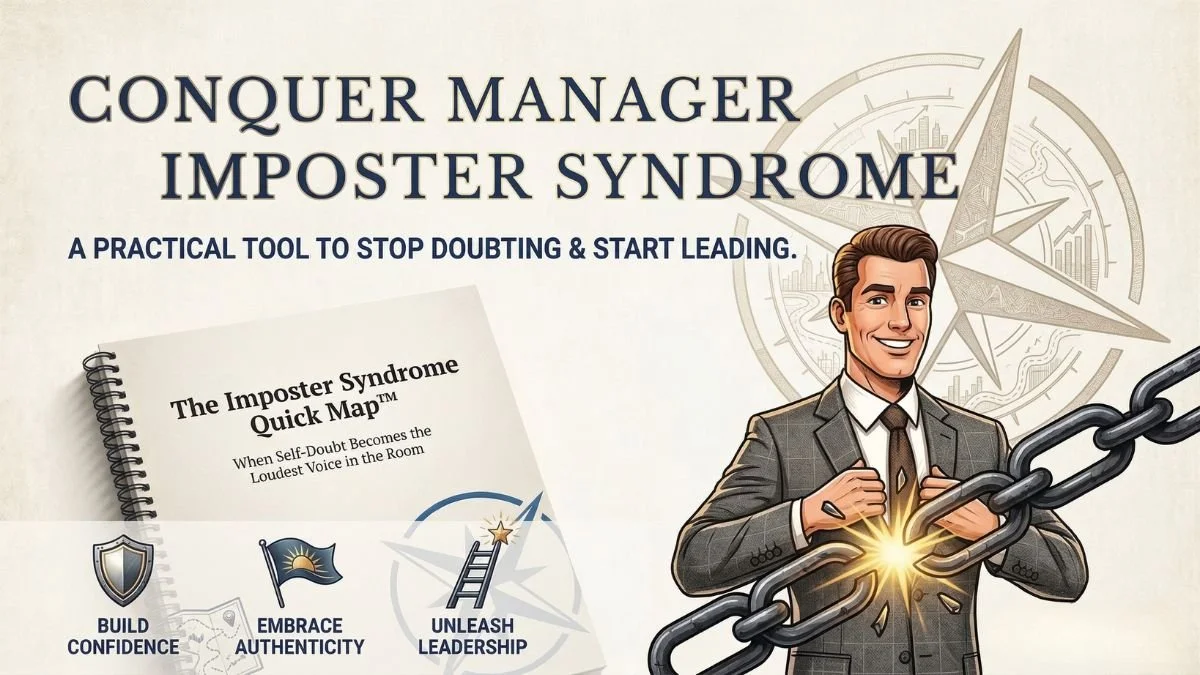
A structured self-doubt reset tool for managers who feel competent one moment and exposed the next. It helps you separate role legitimacy from outcome anxiety so decisions stop feeling so existential.
What it helps you do
This tool helps you build a steadier read on your own competence. It gives you a practical way to document what you know, what informed the decision, what happened after, and what the result actually means. That matters because vague self-doubt grows fast when there is no evidence structure to interrupt it.
What is included / how it works
Evidence-tracking pages to document competence, judgment, and growth over time
Decision debrief prompts to separate outcome review from self-attack
Printable and fillable worksheets for tracking what you knew at the time of the decision
Reflection pages to sort feedback, mistakes, and learning without collapsing into fraud feelings
A repeatable process for building steadier internal legitimacy after hard calls
Is this tool for you?
This tool is for managers who know the work but still feel shaky in their authority. It fits people who replay decisions, over-prepare to avoid being exposed, or feel that every mistake says too much about them.
Use it when self-doubt is affecting decision speed, follow-through, visibility, or your willingness to lead cleanly. It is especially useful when the doubt gets louder after visibility, feedback, mistakes, or high-stakes calls.
This tool is not a substitute for therapy, mental health support, or formal help for anxiety when the distress is broader than the role itself. It also does not replace skill-building if there is a real capability gap that needs direct support. Its job is to help you read self-doubt more accurately and stabilize legitimacy inside the role.
Choose your next route
A tool only works if it fits the hand using it.
You have the tactical fix for the friction. Now, make sure you know how to wield it. Get Your Map to see how your inherent orientation interacts with this terrain.

If the issue runs deeper, go to the Leadership Identity Map.
If an adjacent pattern is also present, use the Feedback Pattern Map.
For the full library, visit The Supply Post