
How Do I Support Growth Without Becoming Responsible for It?
You finish the development conversation and the employee leaves encouraged.
You talked about strengths. You talked about goals. You talked about what could be possible over the next year. On the surface, it felt like a good conversation. Then you leave with a second reaction underneath it. A sense that the employee heard more certainty than you meant to give.
That is the problem this tool is built for. It helps managers support growth without turning encouragement into an implied promise.
Why development conversations get misread
A lot of managers are trying to do the right thing in these conversations.
They want to recognize potential. They want to keep the employee motivated. They want to be honest without shutting the person down. So the conversation starts leaning toward possibility. The manager says, “we can work toward that,” or “I can see that for you,” or “let’s keep building in that direction.”
The problem is that those phrases can carry more certainty than the manager actually owns. The employee hears support and reads commitment into it. They assume the path is clearer than it is. The manager assumes they were being encouraging, not definitive. Both people walk out with a different read of what just happened.
That is the sharpest part of your source draft. The room was unclear, and the employee responded to the conversation as it sounded.
What this costs when it stays vague
The damage usually shows up later.
A timeline passes. The role does not open. A promotion goes elsewhere. The next step that felt close turns out not to be close at all. The employee now has to reconcile the hopeful read they took from the conversation with the reality that followed it.
That often lands as broken trust, even when nothing explicit was promised.
The manager pays for it too. These conversations start to feel risky. They begin to dread them because they know how easy it is for support to get misheard as sponsorship, or for possibility to get heard as a plan. The conversation becomes harder to hold because the aftermath is already sitting in the room with you.
Your original draft said this well: vague optimism creates an expectation problem that neither person sorted clearly at the time.
What changes when the conversation has structure
A better development conversation gives both people something specific to orient to.
The manager can point to actual strengths, actual growth goals, actual readiness markers, and actual limits on what support looks like. The employee can see what is real now, what is possible later, and what part of the process belongs to them.
That changes the temperature of the conversation. It stays encouraging, but it gets clearer. Hope does not disappear. It gets tied to specifics. The manager no longer has to rely on tone alone to balance honesty and care. The structure does that work on the page.
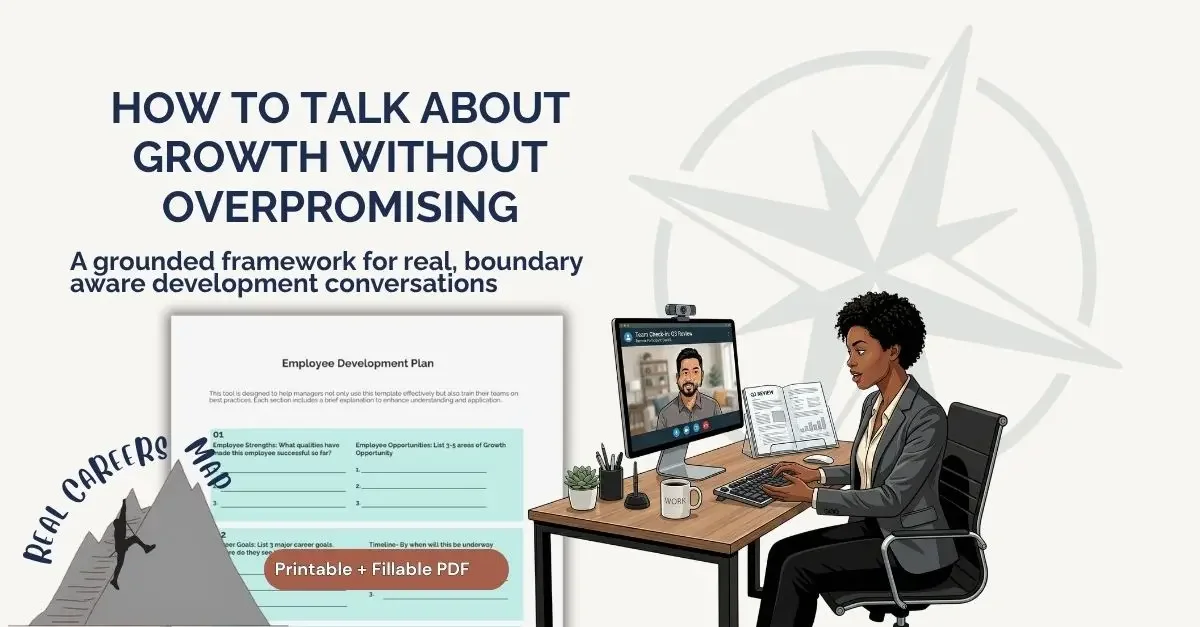
The Employee Development Plan
A fillable PDF for managers who want clearer growth conversations with employees.
What it helps you do
It helps you support development without drifting into vague encouragement, fuzzy timelines, or expectations you do not fully control. It turns the conversation into a shared working document instead of a loosely hopeful discussion.
What is included / how it works
An Employee Strengths Reflection section for identifying specific strengths and what those strengths make possible
Space for 1 to 3 Core Growth Goals tied to realistic development priorities
A Timeline and Readiness Assessment so both people can discuss timing and what “ready” means
A Support and Resource Planning section for clarifying what the manager can provide and what is outside their control
A Shared Definition of Success so the employee is not working toward a vague target
A Follow-Up and Accountability section to keep the plan active over time
A printable and fillable PDF format that works in a 1:1, in person, or as a document shared ahead of the meeting
That is the value of the tool. It gives the conversation a visible boundary, so support stays support and does not quietly turn into a promise.
Is this tool for you?
This tool is for managers who are having real development conversations and want to be honest about growth without creating commitments they cannot guarantee.
It fits best when the employee is motivated, the conversation is future-focused, and the manager wants a way to support that growth without overspeaking their authority. It is useful when development talks tend to drift toward encouragement that feels good in the moment and confusing later.
It is not a substitute for HR process, promotion decisions made above your level, or performance management. It is also not the right tool when the core issue is current-role underperformance or a formal improvement plan.
This tool helps when the problem is not whether you care. The problem is whether the conversation is clear enough to protect trust.
Choose Your Next Route
A tool only works if it fits the hand using it.
You have the tactical fix for the friction. Now, make sure you know how to wield it. Get Your Map to see how your inherent orientation interacts with this terrain.

If the issue runs deeper, go to Development Approach Map.
For the full library, visit The Supply Post