
Why Do My Difficult Conversations Go Sideways?
You prepared for the conversation. You thought through what needed to be said. You picked the time carefully and walked in with a clear intention.
Then the exchange drifted. The person got defensive. Or shut down. Or pulled the conversation into something next to the actual issue. You left with less clarity than you had going in, and the pattern you needed to address was still sitting there untouched.
That is the kind of conversation this guide is built for. It helps managers stay clear when a difficult conversation starts to come apart.
Why difficult conversations derail
Managers usually blame themselves first.
They assume they said something wrong, were not clear enough, or picked the wrong moment. Sometimes that is true. A lot of the time, the problem starts earlier than the sentence itself.
A difficult conversation puts several pressures into the room at once. There is the relationship history between you and the other person. There is the power difference. There is the culture around direct feedback. There is the fact that most people walk into these conversations with no shared understanding of what the exchange is supposed to do.
When that structure is missing, the conversation follows the strongest reaction in the room. If the other person gets defensive, the conversation bends around defensiveness. If they shut down, everything slows around shutdown. If they redirect, the issue gets pulled off course. The manager then gets left carrying the blame for a conversation that never had enough structure to stay on track. That is the sharpest point in your source draft, and it is the point worth keeping.
What this costs when it keeps happening
After a conversation like this, most managers delay the next one.
They tell themselves they will come back when they have better words, better timing, or a calmer room. The issue keeps moving while the manager is still recovering from the last attempt. The team notices what does not get addressed. The person involved learns how far the conversation will go before it loses force. The manager carries both the unfinished issue and the residue of the failed attempt.
That delay gets expensive. One missed conversation becomes a pattern. Team standards get weaker. Performance problems last longer. Relationship strain spreads. By the time the issue comes forward again, it has usually picked up more history and more emotion than it had the first time.
Your original draft said this well: the real cost is not one hard conversation that went badly. The real cost is the avoidance pattern it creates afterward.
What changes when the conversation has structure
A good structure does not control the other person.
It gives the manager a way to stay oriented when the exchange gets reactive. You know what you are there to address. You know what belongs in the conversation. You know where to return when the thread starts to drift.
That changes the manager’s footing. They do not have to improvise in the most charged part of the exchange. They can let emotion show up without losing the point. They can stay steady enough to bring the conversation back to the issue, the evidence, and the next step.
That is the shift this tool supports. Clearer footing. Less drift. Better follow-through.
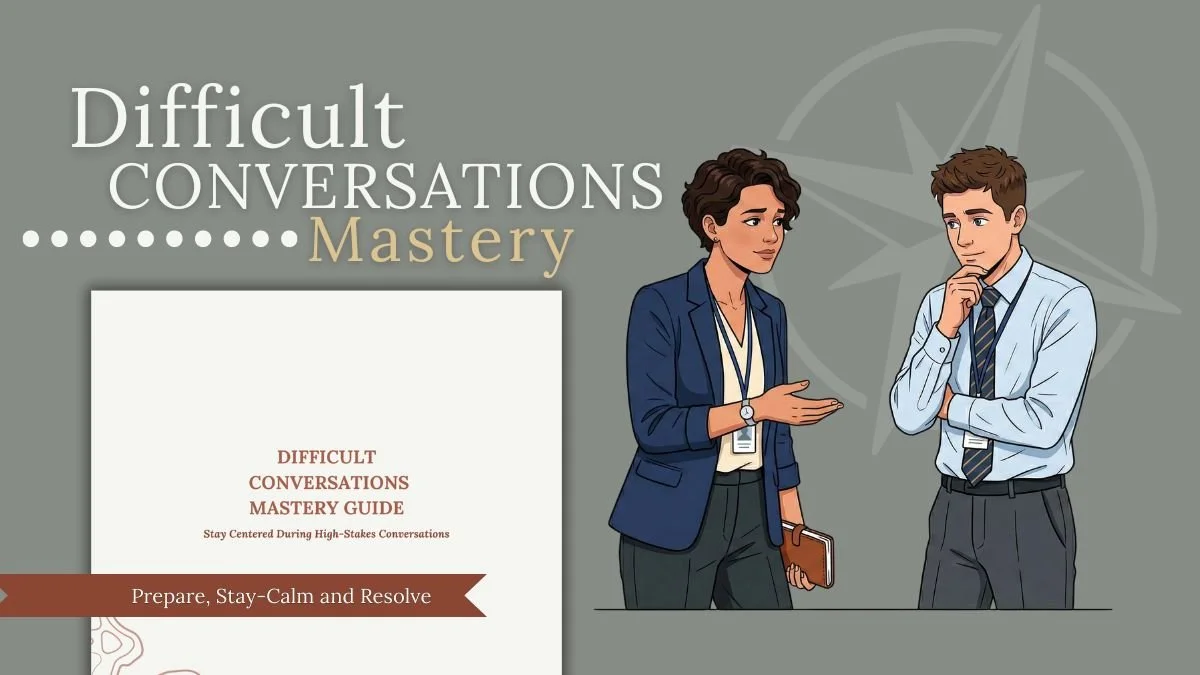
The Difficult Conversations Mastery Guide
An 18-page PDF built for managers who cannot afford a high-stakes conversation going off the rails. It covers the full arc of a difficult exchange: mental and emotional preparation before the conversation, a 4-part structure for clarity inside it, grounded scripts for opening, discussing, and closing, and a follow-up framework that supports real change rather than a one-time discharge.
What it helps you do
It helps you prepare for the conversation without spiraling, stay focused when the other person reacts, and leave the room with a next step that does not disappear the next day.
What is included / how it works
Pre-conversation preparation for mental framing and emotional steadiness
A 4-part conversation structure for naming the issue, presenting evidence, inviting response, and defining next steps
Opening, discussion, and closing scripts for common difficult conversation types
A reaction map for defensiveness, shutdown, blame, and tears
A follow-up framework that turns the conversation into accountable next steps
A self-assessment tool to build steadiness over time
Those are the useful parts of the guide. It does not stay at the level of generic advice. It covers the full exchange, from preparation before the meeting to follow-up after it.
Is this tool for you?
This guide is for managers who have already watched a conversation go sideways and do not want to repeat that pattern.
It fits when the stakes are high, the issue is real, and the cost of drift is too high to leave to improvisation. It also fits managers who know the conversation needs to happen and want a structure strong enough to carry them through it.
This guide is not a substitute for HR process, formal documentation, or legal guidance. It is not for avoiding the conversation. It is for going in with a cleaner structure once you have decided the conversation needs to happen. That fit boundary is already present in your source draft and should stay.
Choose Your Next Route
A tool only works if it fits the hand using it.
You have the tactical fix for the friction. Now, make sure you know how to wield it. Get Your Map to see how your inherent orientation interacts with this terrain.

If the issue runs deeper, go to Feedback Pattern Map.
For the full library, visit The Supply Post