
How to Tell an Employee What Is Holding Them Back
You know an employee is not ready yet, but you cannot say why in a way that feels clean, honest, and useful. So the conversation gets softer than it should. You say they need to work on communication, strategic thinking, or executive presence. They leave with a list of broad phrases that sound important but do not tell them what to practice. You leave knowing you still did not explain the gap clearly.
That is the moment this toolkit is built for. It helps managers explain what is holding someone back without drifting into vague feedback or unnecessary damage.
Why employee development feedback gets vague
Managers usually know more than they are saying.
They can see the pattern. They have watched the employee miss the room, struggle to influence across functions, stay too tactical, over-explain, shut down under pressure, or fail to connect their work to the business. The problem starts when that pattern has to be translated into a development conversation.
A lot of managers soften the truth at exactly that point. They are trying to be supportive. They are trying to avoid shame. They are trying to keep the conversation constructive. So observable behavior gets turned into abstract language. A real capability gap turns into a trait label. The employee gets a polite summary instead of a clear read.
Your original draft had the right diagnosis here: the manager is describing symptoms instead of the gap itself. That is why the conversation feels helpful on the surface and useless in practice.
What this costs when the gap stays unclear
The employee cannot work on what they do not understand.
They may think they are being developed when they are actually being managed through ambiguity. They hear encouragement, but they do not get orientation. They try harder, but in a scattered way. Nothing gets measured cleanly because nothing was defined cleanly.
The manager pays for it too. They keep revisiting the same conversation in softer language. Promotion decisions get harder to explain. Development plans look active without creating visible change. Trust gets weaker because the honesty never fully made it into the room.
That cost is already in your source draft, and it is one of the strongest parts of the piece. Vague development talk wastes time, weakens trust, and keeps both people stuck.
What changes when the problem is read clearly
A useful development conversation starts with what can be seen.
The manager can point to a pattern, explain the consequence of that pattern, identify the capability gap under it, and connect that gap to the current role or the next level. That gives the employee something real to work on. It also gives the manager a structure for tracking whether change is actually happening.
Clarity changes the quality of the conversation. The feedback gets easier to hear because it is concrete. The development plan gets easier to build because it is tied to behavior and business reality. The manager stops circling around the truth and starts saying it in a way that can be used.
The Reality-Based Employee Development Toolkit
A structured tool for managers who need to explain a capability gap clearly and build a development plan around it.
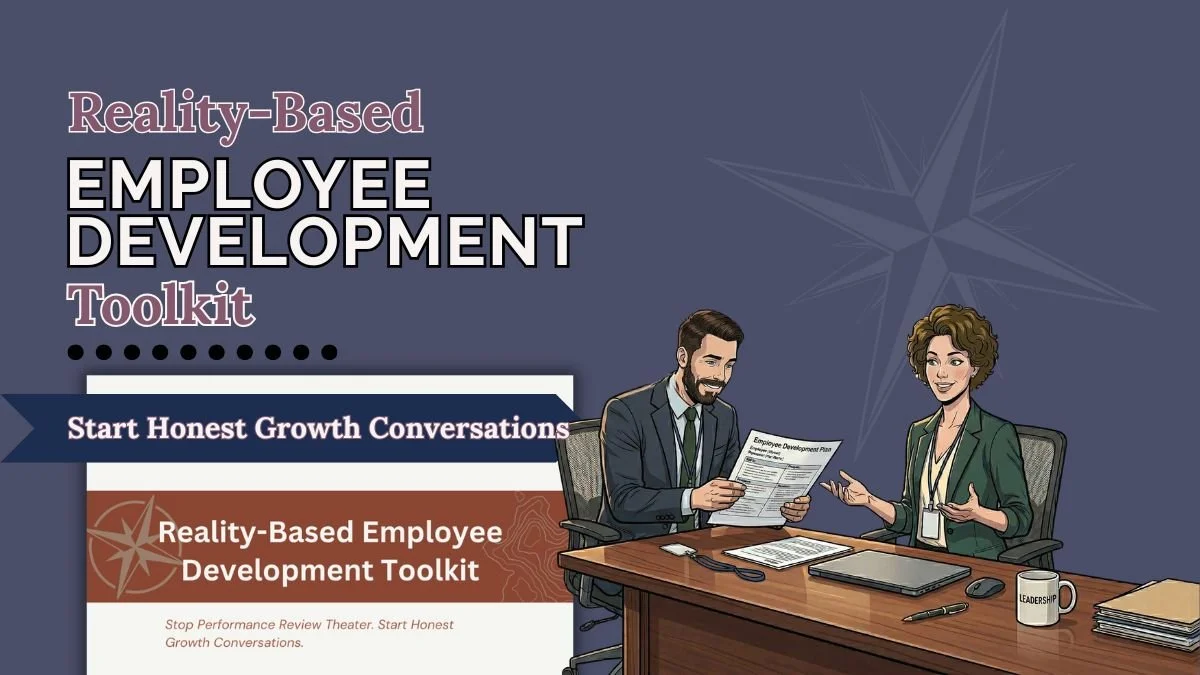
What it helps you do
It helps you prepare for a hard development conversation without hiding behind broad HR language. It gives you a way to sort what you are seeing, connect it to role expectations, and turn the conversation into a plan with actual follow-through.
What is included / how it works
An Observation Template to capture the pattern, the impact, and the capability gap
A Business Case Template to connect the gap to role expectations, next-level requirements, and business consequence
A Development Goal Template to turn vague goals into visible practice and measurable progress
A 6-step conversation flow for honest development discussions
A Development Plan Builder and monthly tracker to see whether anything is actually changing
A Scenario Library for common cases, including the almost-ready promotion candidate and the high-potential employee with low self-awareness
Guidance for when the issue has moved out of development and into performance management
Those are the practical strengths of the toolkit. It does not stop at helping the manager say the hard thing. It also gives them a way to document the gap, build the plan, and track whether the employee is closing it over time.
Is this tool for you?
This tool is for managers who need to tell the truth about development without turning the conversation vague, personal, or harsh.
Use it when an employee asks what they need to do to advance. Use it when someone was passed over for promotion and broad feedback will only make the conversation worse. Use it when coaching has stayed general for too long and the employee still does not know what is getting in their way.
This tool is not for managers who want a soft script to avoid discomfort. It is not for HR investigations. It is not for situations where the issue is already clear current-role underperformance and needs to move into performance management.
That distinction matters. Development is about future capability. Performance management is about failure in the current role. Your source draft makes that distinction clearly, and it should stay.
Choose Your Next Route
A tool only works if it fits the hand using it.
You have the tactical fix for the friction. Now, make sure you know how to wield it. Get Your Map to see how your inherent orientation interacts with this terrain.

If the issue runs deeper, go to Development Approach Map.
For the full library, visit The Supply Post