
What to Do When Feedback Feels Off
You get a piece of feedback and can repeat the words back perfectly. The problem is that you still do not know what to do with it.
Maybe it was about your tone. Maybe it was about being more strategic, more collaborative, more executive, more polished. The language sounds familiar. It also feels slippery. You leave the conversation with more self-consciousness than clarity.
That is usually the point where managers start editing themselves in all directions at once.
What this may be showing
Vague feedback often comes wrapped in respectable language. It sounds developmental. It sounds fair. It sounds like something a good manager should take seriously.
Sometimes it is serious. Sometimes it is useful. Sometimes it points to a real behavior that needs to change.
Sometimes it reflects the culture more than the person receiving it. A team that prefers indirect communication will react to directness one way. A culture that rewards sameness will react to difference another way. A manager can get judged against an unwritten standard and still be told the feedback is objective.
That is where the disorientation starts.
The original draft already pointed to this clearly: feedback can turn into a resemblance test, where the system measures who feels familiar instead of what is actually effective. That insight matters here because managers usually get asked to integrate the feedback before they have had any real chance to sort it.
What this costs when it stays unclear
When feedback stays vague, managers usually do one of two things.
They over-correct. They start smoothing out their language, second-guessing their instincts, and spending energy managing how they are perceived instead of improving the behavior that was supposedly under review.
Or they freeze. They stop trusting their own read of the situation. They hesitate in meetings. They speak less directly. They waste time trying to decode what people meant instead of doing the work in front of them.
Over time, this gets expensive. Follow-up conversations get harder. Performance discussions get heavier. Self-trust drops. So does clean decision-making.
That cost is already present in the source material. The original article says the system often gives people feedback without giving them a way to locate it first. That gap is exactly where managers start carrying pressure that was never translated into a usable instruction.
What changes when the problem is read clearly
Relief starts when the feedback gets sorted before it gets internalized.
A manager who can separate behavior from interpretation has a better chance of responding cleanly. They can ask better questions. They can clarify scope. They can tell the difference between feedback that points to a specific change and feedback that reflects team preference, role pressure, or a culture that does not know what to do with difference.
That kind of clarity does not make someone defensive. It makes them more precise.
The source draft was strongest when it distinguished between a concrete behavior and a broad story about character. I kept that spine, but made it more operational. The value here is not philosophical. The value is that a manager can leave a feedback conversation knowing whether they need to change a behavior, ask for specifics, add context, or stop rewriting themselves around someone else’s discomfort.
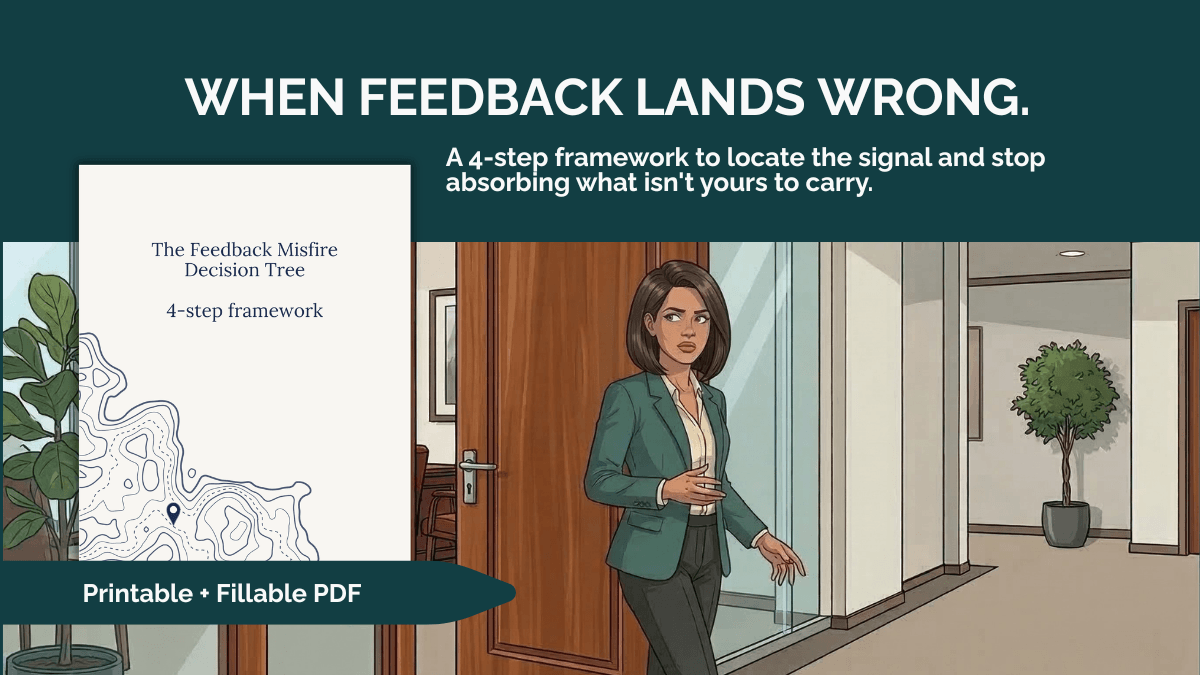
The Feedback Misfire Decision Tree
A decision tool for sorting feedback before you respond to it. It gives managers a way to slow the moment down and check what the feedback is actually pointing to.
What it helps you do
It helps you separate a real behavioral issue from a vague impression, a contextual team reaction, or a broader culture problem. It also gives you a cleaner next move, so you are not stuck in the fog that follows a loaded conversation.
What is included and how it works
A 4-step decision tree that walks you through the feedback in order
A script bank with questions for clarifying abstract or identity-based feedback
A pattern tracker so repeated themes can be logged across weeks instead of judged from one conversation
A response selector with 3 clear routes: Integrate, Contextualize, or Release
A 60-second reset protocol for settling yourself before replying or setting a follow-up conversation
Those elements come directly from the source material and are the strongest practical part of the offer. The tool includes the decision tree, the script bank, the pattern tracker, the response selector, and the reset protocol. It is meant for the moment after feedback lands and before the manager writes back, spirals, or books the next conversation.
Is this tool for you?
This tool is for you if you keep getting feedback that feels broad, loaded, or hard to translate into action.
It fits managers who leave feedback conversations with more doubt than direction. It also fits managers who have started to notice a pattern, where the comments sound different on the surface but keep pushing toward the same personality adjustment underneath.
It is useful when you need to sort a conversation before responding to it.
It is not the right route if the issue is already specific and behavioral. If someone clearly pointed to a missed deadline, a broken commitment, or a concrete communication failure, the next step is performance correction, not interpretation.
It also does not replace HR guidance, formal performance management, or a real conversation with your manager when accountability is on the table.
Choose Your Next Route
A tool only works if it fits the hand using it.
You have the tactical fix for the friction. Now, make sure you know how to wield it. Get Your Map to see how your inherent orientation interacts with this terrain.

If the issue runs deeper, go to Leadership Identity Map.
For the full library, visit The Supply Post