
Weekly Update to Boss Template (Weekly Status Report for Managers)
How do I report up without sounding lost?
It’s late Friday afternoon and your boss asks, “What’s going on?”
You pause. Not because the week was empty. Because too much happened. Decisions moved. Conversations piled up. Priorities shifted. The work is moving, but turning that motion into a clear weekly update to your boss feels harder than it should.
So you send a list. Or a rushed paragraph. Or nothing yet.
Why weekly updates get hard fast
A weekly update usually breaks down when the week has too many loose parts and no structure for sorting them. Most managers are sitting on enough information. The problem is turning that information into something a leader can read quickly.
Your boss usually does not need the whole week reconstructed. They need a fast read on progress, risk, and what may need their attention. When that read is missing, they ask more questions, check in more often, or start building their own version of what is happening.
That changes the relationship. The work may still be moving, but the visibility around it gets weaker.
What this costs when the update stays unclear
An unclear update creates more work.
You send one note. Then come the follow-up questions. What got done. What is slipping. What needs help. What changed since Tuesday. Now you are explaining the week twice.
Over time, that can start to affect trust. Not because the work is poor. Because the movement of the work is harder to read. When momentum is hard to read, leaders check more often.
What changes when reporting gets simpler
A useful weekly update gives your boss orientation.
They can see what moved, what may cause delay, and what needs a decision. That makes the update easier to read and easier to use. It also cuts down on extra explanation later.
A steady reporting rhythm changes the tone of managing up. The update stops feeling like proof of effort and starts working as a clear summary of where things stand.
What should a weekly update to your boss include?
A weekly update does not need to reconstruct everything that happened. Most managers only need to give their boss four things:
Progress: What materially moved this week?
Risks and blockers: What could slow the work down?
Decisions needed: Where do you need your boss’s input or authority?
Next priorities: What are you moving next?
That gives your boss enough information to understand where the work stands without turning the update into another meeting.
Weekly update to boss example
Progress this week
Completed vendor pricing review and finalized the recommendation for the Q4 contract renewal. The implementation timeline is still on track for October 1.
Risks, blockers, or dependencies
Legal review is running three days behind schedule. If approval is not complete by Wednesday, the implementation date may need to move.
Decision or leadership input needed
I need a decision by Tuesday on whether we are willing to accept the revised termination language or want Legal to negotiate further.
Next week’s priorities
Finalize the contract, confirm implementation dates with Operations, and begin manager communication.
Your boss can now see what moved, what may go wrong, what you need from them, and what happens next.
Weekly Status Report Template.
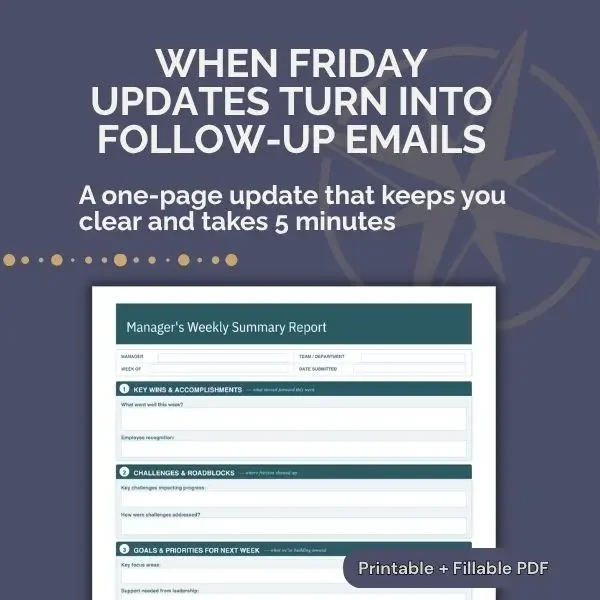
The weekly update eats time you do not have — and still leaves leadership without the full picture
The Manager’s Weekly Summary Report gives managers and team leads a structured one-page format for capturing wins, challenges, priorities, and team updates before the conversation starts. Every section has a purpose. Nothing gets lost because there was no place to put it.
What’s Inside
Key Wins and Accomplishments: space for milestones, completed work, and specific employee recognition — contributions that deserve documentation, not just a mention in passing
Challenges and Roadblocks: what impacted progress, any resource or personnel constraints, and what steps were already taken to address it
Goals and Priorities for Next Week: focus areas, upcoming deliverables, and what support is needed from leadership before the week begins
Employee and Team Updates: staffing changes, training and development gaps, and a morale and engagement check — all in one documented place
Notes and Additional Comments: room for context that does not fit anywhere else but leadership still needs before the conversation
How to Use It
Fill it in at the end of each week — digitally in any PDF reader or printed for desk use. Share it with leadership ahead of your one-on-one or standing weekly meeting so the conversation can go deeper than the recap.
Product Details
Format: Fillable PDF — instant digital download, printable
Pages: 1 — one complete fillable form
Interactive fields: 14 form fields across 5 sections
Brand: The Manager’s Mind Mapping Company / Your Leadership Map™
The Weekly Status Report Template is a one-page weekly update to boss template for managers. It gives you a simple structure for summarizing progress, risks, decisions, and next steps without writing a long email from scratch each week.
It helps you turn a busy week into a short update your boss can read in under a minute.
It includes:
a section for concrete progress from the current week
a section for risks, blockers, and dependencies
a section for decisions or leadership input needed
a section for next week priorities
a printable and fillable format you can use again each week
Is this tool for you?
This tool is for you if your week has a lot of moving parts and you need a cleaner way to report up. It is useful when your boss keeps asking for updates, when your reporting feels messy, or when you want a repeatable format instead of rewriting the same kind of email every Friday.
Use this when the problem is clarity, consistency, or speed.
This tool will not replace a deeper conversation about expectations if your boss wants a different level of detail, a different cadence, or a different reporting format. It also will not fix a bigger managing up problem on its own if the real issue is decision bottlenecks, unclear authority, or shifting priorities across the relationship.
Choose Your Next Route
A tool only works if it fits the hand using it.
You have the tactical fix for the friction. Now, make sure you know how to wield it. Get Your Map to see how your inherent orientation interacts with this terrain

If the issue runs deeper than the update itself, go to the Managing Up Map. Use it when the real pressure is coming from unclear expectations, weak visibility, or decision bottlenecks.
If your communication keeps getting read differently than you intended, use the Feedback Pattern Map. Use it when the update may be only one part of a larger communication problem.