
When the office became a factory floor
How scientific management turned typing into the typing pool, and what the layout still teaches managers today.
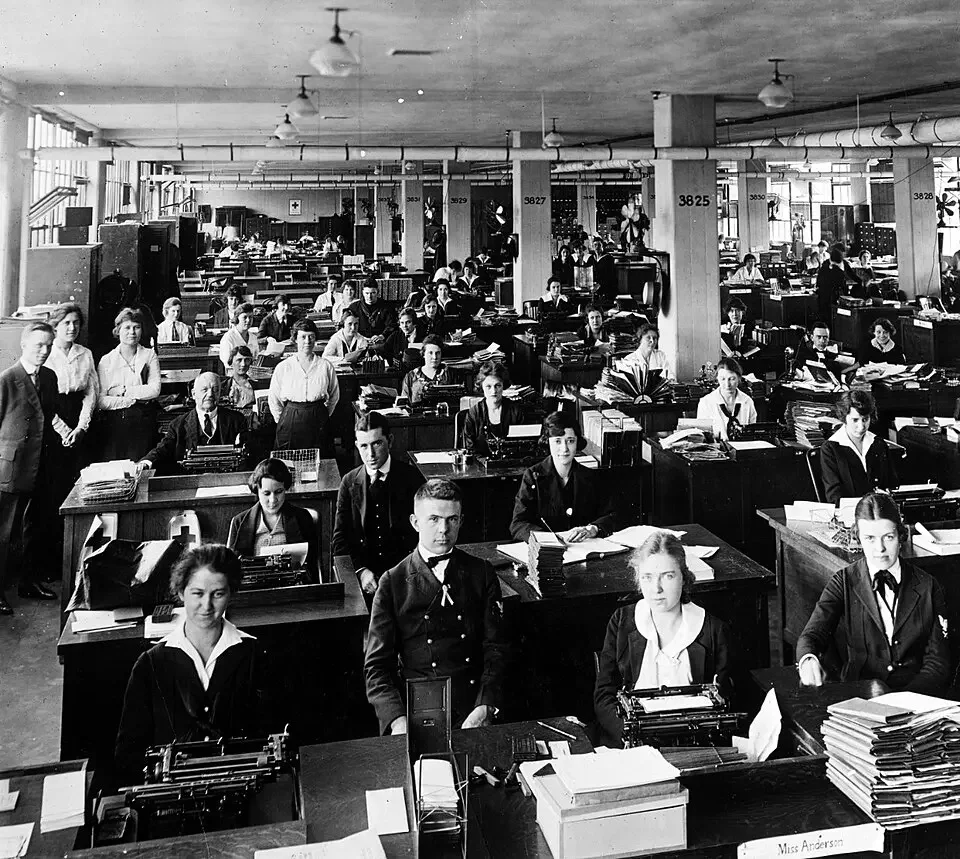
Typing Pool: Analytical Historical Hobbyist, Public domain, via Wikimedia Commons
A century before software tracked your mouse movements, a man with a stopwatch stood behind rows of typing women and counted.
In 1917, William Henry Leffingwell published Scientific Office Management, the book that carried Frederick Taylor's factory methods into clerical work. Leffingwell had started out as a stenographer, so he knew exactly which minutes a typist could lose in a day, and he built a system to take those minutes back for the company. The result was the typing pool: rows of women at matched desks in one centralized room, with a count kept of every line they typed. The office had its factory floor.
How did the office become a factory floor?
The office of 1870 ran on a different arrangement. Clerical work belonged to men, and a clerk was something close to an apprentice. He copied letters, kept the books, learned the business from the inside, and could reasonably expect to run a piece of it someday. In 1870, women were 2.3 percent of all clerical workers in the United States.
Then corporations outgrew their paper. A room of clerks could no longer keep up with the filing, the billing, and the letters. The typewriter solved the speed problem. Women solved the cost problem, because companies could pay them a fraction of a clerk's wage.
By 1930, women were 49.4 percent of clerical workers and 95 percent of typists and stenographers. The companies that hired them removed the apprenticeship entirely. Typing was separated from thinking, centralized into pools, and supervised by men whose old jobs had just been carved into pieces. The historian Margery Davies calls what emerged a secretarial proletariat: standardized labor performed by women who were given no route into the business they typed for all day.
Leffingwell gave this arrangement its instruction manual, and his measurements show how far the counting went. In his 1925 textbook Office Management, he calculated that 100 clerks walking 50 feet to the water fountain five times a day cost the company nearly 10 miles of walking daily, 3,000 miles a year. Water came to the desks after that. So did everything else, because a woman away from her machine was producing nothing the supervisor could count. Every task had a standard time, and the supervisor's job was to compare each woman to the standard.
The cost: what did the typing pool demand?
A typist in the pool sat at her machine for the full shift while dozens of typewriters hammered around her. The noise alone did damage. Histories of the 1920s pools record nervousness, fatigue, inflamed tendons, and hearing loss as the ordinary cost of the job. Nothing about her day was hers to shape. The work came in batches, the format was standardized, and her performance was two numbers: lines per day and errors per page. A clerk in 1870 copied a contract and learned what made it work. A pool typist in 1925 typed the same contract and was timed doing it.
The pool had a ceiling built in. The men whose clerk jobs had been broken apart were made its supervisors, so the path upward was occupied before any typist could reach it. The women were hired young, paid less than the men they replaced, and in many companies dismissed when they married. The job was never meant to lead anywhere. It was designed to be left.
Why does your office still think like a pool?
The pools are now gone. The assumption they were built on stayed. Leffingwell's question was how to make a typist's work visible enough to count, and every generation of office design since has answered it with new equipment. The open floor plan, the activity dashboard, the green status dot, the badge-swipe report: each one makes work easier to see, and each one was sold to managers as a way to manage.
When an organization arranges people so their work is easy to count, counting becomes the management method. Whatever shows up in the count starts to stand for performance, and the work that resists counting, the judgment calls, the problems caught early, drops out of what gets noticed and rewarded.
This is the Leadership Cartography systems issue. The pool solved a measurement problem: corporations drowning in paper needed clerical output they could price and predict. The measurement outlived the problem. A century later, you are handed a dashboard that counts what is visible, and your reviews ask you to manage to the count.
If you lead through infrastructure, the Lead with Support™ pathway, you choose the systems your team works inside, and most systems on offer were built downstream of the pool: they show work to the company first and help the team second.
If the typing pool arranged a hundred women in rows so one supervisor could count their output, and your company arranges its tools so your output is countable from anywhere, was the factory floor ever removed from the office, or did it just get carpet?
Where does this land for you
If the system you have been managing inside is starting to feel more familiar than you would like, the Leadership Map Source Assessment can help you name what you are working with.
Identify Your Legacy

Related Reading
The Invention of the Interchangeable Person: Why Your Job Description is a Ceiling—job descriptions did to the role what the pool did to the work.
The Dictaphone: When the Boss's Voice Arrived Without Him— the machine that kept the pool fed with words while the boss stayed upstairs.
Sources
Leffingwell, W.H. (1917). Scientific Office Management. A.W. Shaw Company. Davies, M.W. (1982). Woman's Place Is at the Typewriter: Office Work and Office Workers, 1870-1930. Temple University Press. Goldin, C. (1988). Marriage Bars: Discrimination Against Married Women Workers, 1920's to 1950's. NBER Working Paper 2747. Heinz Nixdorf MuseumsForum. Typing Pool in the 1920s. Wikipedia. William Henry Leffingwell.