
The Review Was Built to Decide Who Was Expendable
A wartime scale taught offices to score people, and the annual review never put it down
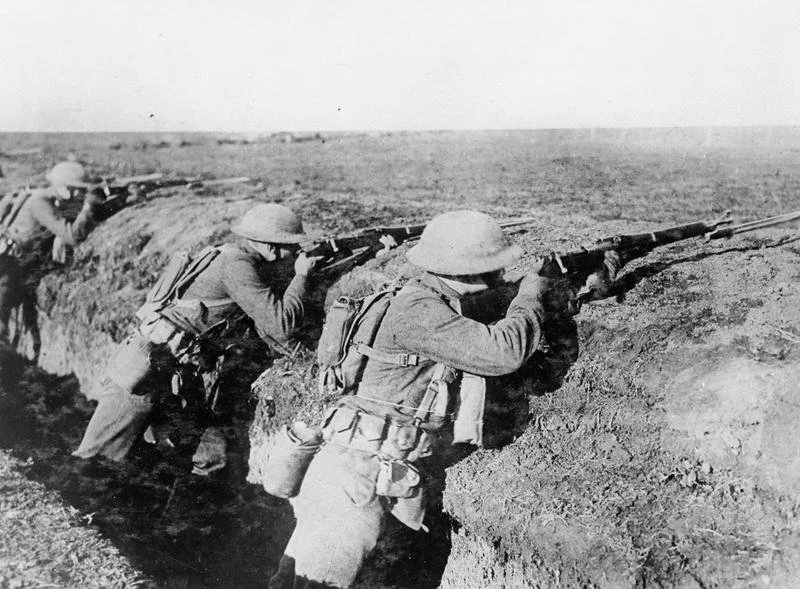
The US Army on the Western Front 1914-1918
American marines ready to fire at the enemy in the trenches, Breuvannes-en-Bassigny, France.
The form your manager fills out once a year was built to decide which soldiers were expendable.
In 1917 the United States Army had a sorting problem. Millions of men were arriving, and someone had to rank them, place them, and decide who led and who was sent forward. So the Army turned to a psychologist. Walter Dill Scott, out of the Carnegie Institute of Technology, built a rating scale for the Committee on Classification of Personnel and put it to work on officers. His instrument was called the man-to-man scale. You did not measure a man against the job. You measured him against a list of other men, one by one, and his score was simply where he fell among them.
Read that again. The first modern rating system never asked whether the work was good. It asked who ranked above whom. A person was reduced to a position on a comparison list, and the list decided where he went.
Sit inside the role for a second. You are an officer in 1918. A private in your war earns about thirty dollars a month, and his posting, his rank, and his odds of coming home are being shaped by a card he will never see, filled out by a man comparing him to strangers. He cannot read the scale. He cannot argue it. The rating travels with him whether it is right or not. Nobody asked him what he could do. They asked how he stacked up. That was the whole machine. Rank, sort, assign, and move the line along. The point was speed at scale, and speed at scale meant a person had to be shrunk to a number small enough to move.
The war ended. The machine did not.
Here is the part that should make you put the coffee down. Scott did not retire the scale. He took it to work. In 1919 he founded The Scott Company, one of the first personnel consulting firms in the country, and the rating method walked out of the Army and into the corporation wearing a suit. Merit rating spread through the 1920s. By mid century the annual appraisal was standard furniture in every large company. In 1957 Douglas McGregor wrote in the Harvard Business Review that managers dreaded the appraisal because it forced them to "play God," to sit in judgment on another human being and pretend a form made it fair.
The instrument never changed its job. It was built to rank and sort fast, and a century later it still ranks and sorts. The only thing that changed is the room. It used to live in a war office processing thousands. Now it lives in a quiet one on one, across a desk, with your name at the top. Nobody chose to keep using a war machine to judge office work. It simply was never replaced, and a habit no one questions is the most durable thing an institution owns.
This is where Leadership Cartography names the system for what it is. The performance review was engineered to be a sorting tool for an institution that needed to move people through a war. It was never engineered to measure a human being's worth. But that is exactly the weight we hand it now. We take an instrument built to compare strangers and we use it to tell a person what they are. The Purpose pathway sits right here, in the gap between what the system was built to do and what it does to identity today.
You have felt the result even if you never had the history. You walk out of a review and you do not know what to change. You only know you have been weighed. The number was supposed to describe your work. It described you. And the oldest reflex in the building takes over, the one that says where you landed on the list is what you are worth.
You are not bad at receiving feedback. You are standing inside a hundred year old sorting machine that was never built to hold a person's value, and it is doing precisely what it was designed to do.
If a tool invented to rank soldiers for war and mark who was expendable is the same tool we use to score each other every December, what exactly are we deciding when we fill it out?
Where does this land for you?
If the system you have been managing inside is starting to feel more familiar than you would like, the Leadership Map Source Assessment can help you name what you are working with. Identify Your Legacy

Related Reading
When personality became something management wanted to sort. The same move as the rating scale, an instrument built to sort people and dressed up as insight.
When the office became a factory floor. What happened when measurement built for the factory came for the desk.
Sources
Scott, W. D., and the Committee on Classification of Personnel in the Army (1917 to 1919). Rating scales for officer classification. US War Department.
von Mayrhauser, R. T. (1989). Walter Dill Scott and applied psychology in World War I. Journal of the History of the Behavioral Sciences.
McGregor, D. (1957). An Uneasy Look at Performance Appraisal. Harvard Business Review.
Walter Dill Scott, Wikipedia, The Whip and the Mirror, Business History Conference.
US Army pay tables, World War I. Private base pay raised to approximately thirty dollars per month, 1917.