
The Dictaphone: When the Boss’s Voice Arrived Without Him
The shift from the live room to the recorded cylinder changed who held the burden of clarity.
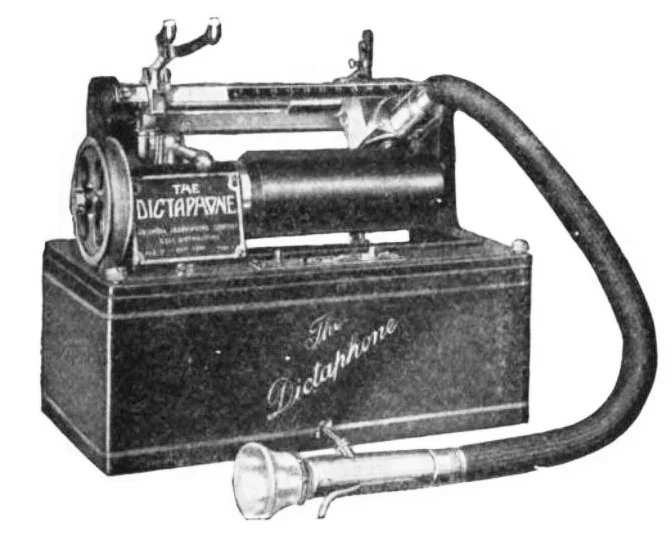
Columbia Phonograph Co., Public domain, via Wikimedia Commons
In 1907, the Columbia Graphophone Company trademarked the Dictaphone. The machine captured a manager’s voice on a wax cylinder, allowing him to speak his correspondence alone and pass the physical recording to a typist. For the first time, business dictation did not require two people to inhabit the same room at the same time. The technology untethered the executive from the desk of the stenographer, turning spoken words into a portable, delayed commodity.
Before the Dictaphone, shorthand required shared presence. A stenographer heard the sentence as it was formed, reading the pause before a correction, the drop in volume, or the hesitation over a name. When the office replaced that presence with a cylinder, the worker received the voice but lost the room. The task shifted from transcription to translation.
Today, managers do not use wax cylinders, but they use the same logic. We send voice notes, drop brief instructions into project cards, and post open-ended requests in Slack threads before jumping into the next meeting. The modern tool makes a manager’s absence workable, but it leaves the team to carry the missing context.
The Hidden Labor of the Unattended Voice

Public domain, via Wikimedia Commons
The trademarking of the Dictaphone in 1907 solved a specific scheduling problem for the early twentieth-century executive. Large American businesses were producing more correspondence and internal records than managers could handle through face-to-face dictation. The Dictaphone allowed an executive to speak into a tube whenever he was ready, pull the wax cylinder from the machine, and leave the building.
The system was marketed as pure efficiency, but efficiency is rarely neutral. It usually means moving the friction from one part of an organization to another.
When the stenographer was removed from the live room, her job changed from capturing language to decoding it. In person, she could ask for clarification on an unfinished thought or an unfamiliar name. With a wax cylinder, she had to guess. She had to interpret the gaps, the muffled audio, and the missing intent.
We live in the architectural legacy of that cylinder. When a manager drops a three-sentence directive into a channel at 5:00 PM and logs off, they are using the Dictaphone logic. The tool makes the sender's absence convenient, but it makes the receiver's job complex.
When direction arrives without presence, the team is forced to spend its energy answering basic structural questions: What did they actually mean? Which priority does this replace? Is it safe to point out the missing information?
In the Leadership Cartography™ framework, this is a Lead with Support™ pattern. The systems a manager builds to communicate direction are part of how a team experiences being led. When those systems consistently put distance between your reasoning and your team's execution, the information gets through but the context doesn't. Your team can't ask the question they would have asked in the room. They miss the signal that would have changed how they handled the task.
Efficiency that costs your team their confidence is a bad trade. If you are saving time by leaving incomplete directions, you aren't actually scaling your leadership. You are just exporting your confusion.
If the Dictaphone made it possible for the boss’s voice to arrive without his presence, how much of your team’s work is now built around interpreting direction you were too far away to explain?
Where does this land for you?
If the systems you manage inside are starting to feel more familiar than you would like, The Source Assessment can help you identify your legacy and locate how you lead.

Related reading
Shorthand Speed: The Hidden Gatekeepers
The Stenographer and the Speed of Invisible Accuracy
Sources
National Museum of American History. “Model 10X Type A Dictaphone.” Smithsonian Institution.
Strom, Sharon Hartman. Beyond the Typewriter: Gender, Class, and the Origins of Modern American Office Work, 1900–1930. University of Illinois Press, 1992.
Yates, JoAnne. Control through Communication: The Rise of System in American Management. Johns Hopkins University Press, 1989.