
Shorthand Speed: The Hidden Gatekeepers
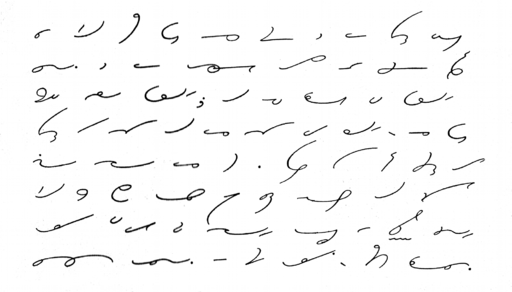
Example of Gregg Shorthand: The original uploader was Kilobytezero~eowiki at Esperanto Wikipedia., Public domain, via Wikimedia Commons
How speed writing opened boardrooms to women but demanded their silence.
Imagine sitting in a room where every word you speak is instantly captured in a secret code of swoops and dots. You are surrounded by the most powerful men in the city, yet you are the only one who truly knows exactly what was said. In the late 19th century, the boardroom was a fortress of mahogany and male silence. To enter, you needed a key that most women were denied until the invention of shorthand. Before this, the executive world was a slow-moving system of longhand letters and delayed decisions. Then came Isaac Pitman and John Robert Gregg. They turned spoken words into a specialized code that moved at the velocity of thought.
This change was a mathematical necessity for an industrializing world. Business was accelerating, and longhand simply could not keep up with the new pace of commerce. Suddenly, a woman with a notebook was the most vital person in the room. She was the only one who could capture the high-stakes energy of a meeting in real-time. But this entry came with a heavy cost. The system demanded she be a human recording device. She was expected to be present in the room but absent from the decision. Shorthand was a tool for access, but it was also a tool for containment. It allowed women into the room while ensuring they remained silent witnesses to the power they were documenting.
The Job Description: The Stenographer
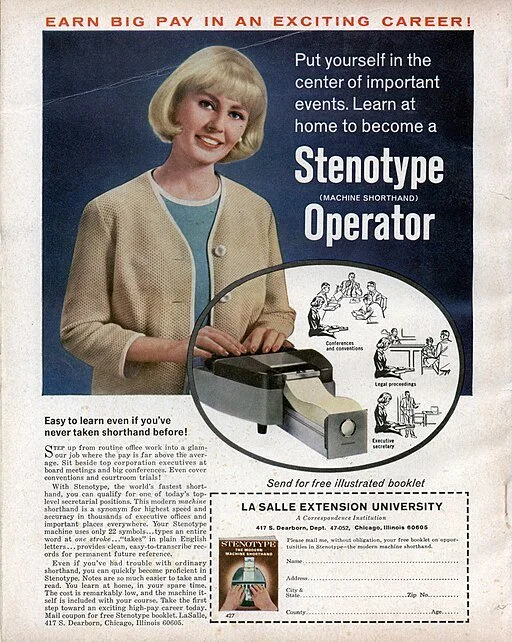
Employees of LSEU, Public domain, via Wikimedia Commons
The Stenographer sat at the edge of the table, her hand moving at 120 words per minute. Her job was to maintain total neutrality while capturing the emotional and financial shifts of the company. She was a biological hard drive. If her hand lagged, the record of the company broke. Her value was not found in her insight, but in her precision. She was tasked with the invisible workload of tracking everyone else's intent while burying her own.
The Stenographer had to navigate the friction of being the smartest person in the room while the system demanded she remain a silent tool. She was the gatekeeper of the company record, yet she had no key to the company's future. Her day was a high-velocity sprint of capturing data, leaving no room for her own perspective. She was a traveler in a boardroom who was forbidden from drawing her own map. She lived in the gap between the spoken word and the written record, a space where precision was a requirement and personal agency was a liability.
Modern Correlation: Leadership Cartography™
We no longer use Gregg shorthand, but we still expect leaders to be always-on recording devices for their teams. We use digital transcripts and back-to-back meetings to capture every word, yet we often miss the underlying signal. The friction has shifted from speed writing to information overload. We are obsessed with the precision of the record, but we are losing the precision of the purpose.
This is where Leadership Cartography™ and the Lead with Precision™ pathway change the vibe. Instead of just recording what happened, we use our tools to read the terrain. When you Lead with Precision™, you aren't just a Stenographer of status updates. You are a navigator. You stop monitoring the noise and start identifying the real obstacles slowing your team down. You move from being a silent witness to a steady guide who can see where the signal is breaking.
Are you in the meeting to record the status, or are you there to change the terrain?

Your Next Step
Identify Your Terrain—Are you leading with Precision™ or is your "Stenographer" instinct causing friction? Take the Leadership Style Quiz.
Lower the Pressure—Stop monitoring minutes and start mapping results. I’ve chosen the Remote Team Check-In Agenda for this piece because it helps you move from "attendance" to "achievement" without the 19th-century oversight.
Join the Map Drawer—Get monthly tactical kits delivered to your inbox, designed to help you lead with clarity and boundaries. Subscribe here.