
Why Questions From Your Boss Feel Like a Verdict

The night before a meeting with my boss, I would build the case. Slides, backup numbers, answers to questions he hadn't asked yet. From the outside it looked like diligence, and I called it that for years.
Somewhere in the middle of all that preparing, the meeting stopped being about the intended subject and became about me, and when it went badly, or even when it just went sideways, the conclusion was always the same one: I'm bad at this. The thought never showed up alone. It went looking for company, and it always found some. The recommendation that got picked apart the spring before, the initiative I ran behind the scenes because I didn't want the questions, the promotions I was sure came only because people were tired of dealing with my defensiveness. (This last one makes no sense, but it was wired in all the same.)
None of that evidence had anything to do with the meeting in front of me, and it came anyway.
Those who over-prepare for conversations with senior stakeholders are often described as anxious or short on confidence, when over-preparation is usually a learned response to scrutiny that has no agreed meaning. When a powerful person's questions can signal anything from routine diligence to doubt, the history decides which one lands, and preparation becomes armor. The pattern costs hours, hides judgment, and deepens with each cycle, because heavy defense invites heavier review. The condition is structural, and it responds to structural moves.
TL;DR
This is about the loop between being questioned and bracing for it: what the bracing does inside a capable manager, what organizations do that keeps it running, and where the pattern came from.
At the end there's a free one-page worksheet for separating what a conversation is from what you're carrying into it.
When the meeting becomes about you
The pattern underneath the over-preparing is collapse. The difficulty of the conversation and the weight you bring to it stop being separate things, and the whole experience compresses into a single conclusion about you.
The condition does the compressing. When scrutiny has no agreed meaning, every question lands as a possible verdict, and a mind waiting on a verdict starts gathering evidence. The evidence reaches backward. The meeting mishandled last year, the person who stopped looping you in, the moments when everyone else seemed to know what to do, all of it gets pulled into the case, and for a few seconds the difficulty in front of you becomes proof of something about you.
What the collapse takes is real. It takes the hours spent building defenses for questions that never come, and it takes something harder to count: a manager bracing for judgment shows conclusions and keeps reasoning private, and reasoning kept private is the opposite of what builds trust with power. The more capable the manager, the more convincing the case against themselves, because capable people have long memories and high standards to prosecute themselves with.
The collapse feels personal, and the conditions producing it aren't.
What keeps the bracing running
Review is everywhere, and its meaning is nowhere. Organizations run on approval rituals: sign-offs, steering meetings, check-ins, business reviews. The rituals get scheduled, and what a question inside them means never gets established. The structure produces constant scrutiny while leaving every manager to price it alone.
Output has artifacts, and reasoning has none. Status reports, dashboards, and decision logs capture what was decided and what it produced. Nothing in the standard toolkit captures why, so the thinking behind a recommendation lives only in the manager's head, where it can't earn trust and can always be questioned.
Authority is granted without endorsement. The system promotes people into responsibility and rarely tells anyone else to trust their judgment. A new title changes the org chart and leaves every relationship to be renegotiated from scratch, one questioned recommendation at a time.
Each of these conditions is survivable alone. Together they produce a manager who is reviewed constantly, has no place to show their thinking, and holds authority nobody was ever asked to honor. The bracing is a reasonable response to that arrangement, and the arrangement is what keeps it running.
The job was built to be reviewed
The arrangement has a birthday. In 1855, Daniel McCallum, superintendent of the New York and Erie Railroad, drew what business historians widely credit as the first modern organizational chart, a diagram designed to move information up the line and authority down it. Alfred D. Chandler Jr., in The Visible Hand, traces how McCallum's design became the template for the modern corporation: every position reporting upward, every decision reviewable by the level above.
The chart solved a real problem, since a railroad spread across hundreds of miles couldn't run on personal supervision. It also built something into the structure of managerial work that never left: the assumption that judgment lower in the chart exists to be reviewed by judgment higher in it. Review wasn't added to the manager's job. The job was built around being reviewable.
A century and a half later, the tools changed and the assumption didn't. The manager preparing three days of defense for a ten-minute meeting is responding to an architecture older than the company they work for.
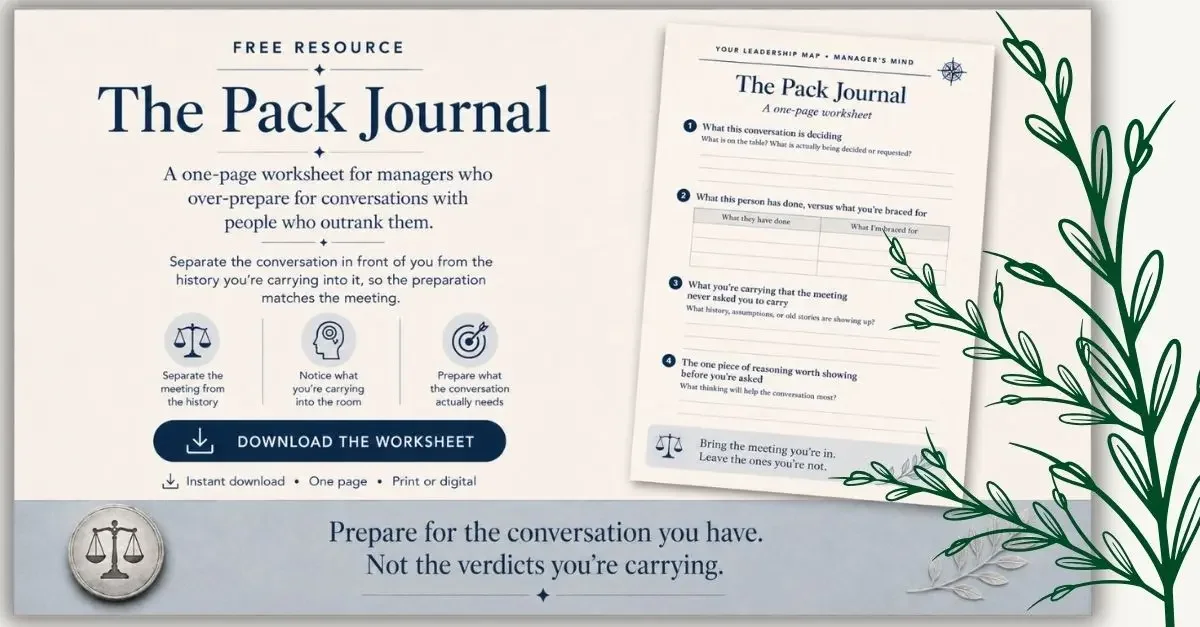
The Pack Journal
What it is. A one-page worksheet for managers who over-prepare for conversations with people who outrank them.
Why use it. It separates the conversation in front of you from the history you're carrying into it, so the preparation matches the meeting.
Best used when.
You're building slides for a conversation that needs none
A stakeholder's questions feel like verdicts
You keep rehearsing answers to questions nobody has asked
The same meeting keeps costing you days of dread
Time to complete. 5 to 10 minutes.
You'll work through.
What this conversation is deciding
What this person has done, versus what you're braced for
What you're carrying that the meeting never asked you to carry
The one piece of reasoning worth showing before you're asked
Three steps before the next heavy conversation
The split. Before the preparing starts, the useful question is what this person has actually done with your work, since the answer separates the stakeholder in front of you from the ones your history keeps supplying. Sometimes the record shows real doubt, and sometimes it shows three years of approved recommendations you've been bracing against anyway.
The reasoning, in view. A recommendation that travels with the options you rejected leaves less blank space for doubt to fill. When the thinking is visible before the question comes, the question has somewhere to land besides you.
The scorecard. After the meeting, the comparison worth keeping is what happened against what you braced for. Kept over a few weeks, that record does what no amount of confidence advice can, because it corrects the evidence the collapse has been using.
A manager can spend years trying to get stronger while carrying weight the climb never required.
If only the meeting were in the room
If the same conversation keeps costing you days, it may be worth asking what part of the load is the conversation and what part is history riding along with it. The meeting has a real weight, and most managers have never had the chance to weigh it separately from everything else they haul in.
That separation is what Leadership Cartography is for. The framework reads the friction a manager feels as information about the terrain they're standing on, which includes the structures doing the reviewing, the relationships carrying no agreed meanings, and the old rooms still supplying interpretations. A reading like that doesn't make the conversation easy, and it does make the load accurate.
What would the meeting weigh if only the meeting were in the room?
If this resonated, these go further:
Managing Difficult Stakeholders: A Guide to Influencing Without Authority
When Your Boss Is the Bottleneck: Why Managing Up Feels Impossible
How to Say No to Your Boss Without Damaging Your Reputation
If the same weight keeps showing up in your pack, the Source Assessment maps the pattern that keeps putting it there. Discover Your Pattern