
Why Every Team You Manage Ends Up With the Same Problems
When the same friction appears on team after team, the read traveling between them deserves a look.

By the third team, the pattern is hard to miss. The names change, the company changes, and the same problem appears in every team: someone who cannot prioritize, someone who goes quiet in meetings, someone who needs everything checked twice. After 2 jobs, you may call it bad luck. After 4, the repetition becomes harder to explain away.
The wondering tends to get filed under hiring, or under the industry, or under people lately. One other thing has been present on every one of those teams: the eye that sorted them. It has traveled the whole route, and nothing along the way has ever put it on paper.
When the same problems appear on every team you run, the repetition usually travels in your interpretation layer. Every workplace crossed adds to it: what silence means, what pushback means, what a missed deadline means. The layer moves with you and supplies meaning automatically, so different people on different teams end up sorted into the same familiar categories. Organizations reinforce the pattern by promoting for output and treating people-reading as something that transfers with the title. The repetition starts thinning when the layer becomes visible, and you have probably never been handed anything built to show it.
The pattern has a mechanism, and the mechanism has a history. Below: what the traveling read is, what keeps it running, where the assumption behind it came from, and a free one-page worksheet, the First Survey, for putting yours on paper.
Why do the same problems follow you from team to team?
The constant across those teams was built long before any of them existed. Call it the traveling read: the accumulated layer of interpretation assembled by every boss, culture, and consequence you have crossed. The workplace that punished questions taught the eye that questions mean challenge. The culture that rewarded speed taught it that deliberation means stalling. Lessons like these have no expiration built in. They ride along to the next team and meet new people already translated.
The layer itself is ordinary. Experience often supplies meaning before conscious interpretation catches up. The trouble starts when the layer runs unexamined, under pressure, on people.
What it costs adds up slowly. Energy goes to managing patterns that are not in the room, so an employee deliberating in 2026 gets managed like the staller a 2014 culture invented. Real differences between people flatten into familiar categories, which means the team's actual information never fully lands. And underneath the operational cost sits a personal one: the exhaustion of fighting the same battle on every team, and the private suspicion that something is wrong with how you lead. That suspicion deserves to be set down and examined. The places you worked helped build the layer you look through. Each new team then meets the accumulated interpretation those places left behind.
What keeps a layer like this running is the more useful question, and the answer sits in the structure around it.
What keeps the read running unexamined?
Promotion treats people-reading as included with the title. The structures that decide who becomes a manager measure output. The ability to read people accurately gets assumed rather than assessed, so you can run teams for a decade on an interpretation layer no process has ever tested.
Review systems collect verdicts and discard reasoning. Performance tools store the rating and drop everything underneath it. No field exists anywhere in the stack for how you reached your conclusion about a person, so the reasoning stays private and unexamined by design.
Certainty performs as competence. In most cultures, knowing your people reads as strength, and revisiting a verdict reads as indecision. Revision carries a social cost that confirmation never does, so the incentives run toward staying sure.
No mirror comes back up. Judgment about people flows downward constantly. The team's experience of being read almost never flows back, and where it does, engagement surveys arrive aggregated and anonymized past the point of being useful to you.
So the layer runs for an entire career with no scheduled maintenance, and the loop closes on itself. The organization supplies pressure and no mirror. The layer supplies fast verdicts. The verdicts produce a team that behaves more like they describe, since people adapt to how they are seen. And that adaptation supplies the confirmation that keeps the layer invisible.
Why was nothing ever built to check the reader?
The assumption that a manager is a neutral instrument is older than the modern manager. During the First World War, psychologist Walter Dill Scott developed rating scales the US Army used to evaluate its officers, and he carried the approach into industry afterward. The scales treated judgment as a formatting problem: give the rater better categories and the ratings would come out true.
In 1920, Edward Thorndike published A Constant Error in Psychological Ratings in the Journal of Applied Psychology, based on officers rating the men under them. The scores told on the raters. Ratings for intelligence, physique, character, and leadership rose and fell together, because the rater's general impression of a man bled into every category he scored. Thorndike had documented what became known as the halo effect, and inside it a larger finding: the instrument doing the rating was never neutral.
The century that followed kept refining the scales. Performance appraisal added competencies, behavioral anchors, calibration meetings, and rater training. The central difficulty remained: the form could organize a judgment without making the judge's accumulated interpretation visible. Thorndike's warning survived inside the research on rater bias, while most workplace systems continued recording the verdict more carefully than the reasoning that produced it.
How does the traveling read show up?
Your layer may read conflict everywhere: a survived workplace where disagreement turned personal trained the eye to see pushback as threat, so healthy friction gets managed down until the team stops offering it. It may read silence: a culture that punished not-knowing taught the eye that quiet means disengagement, so reflective people get nudged to perform participation. It may read pace, so careful work registers as resistance.
Whichever version rides with you, it runs strongest under pressure, when there is no time to translate and the layer supplies the meaning first. The moments right after a slipped deadline or a tense meeting are where the layer runs purest, and where it is most worth catching on paper.
THE FIRST SURVEY
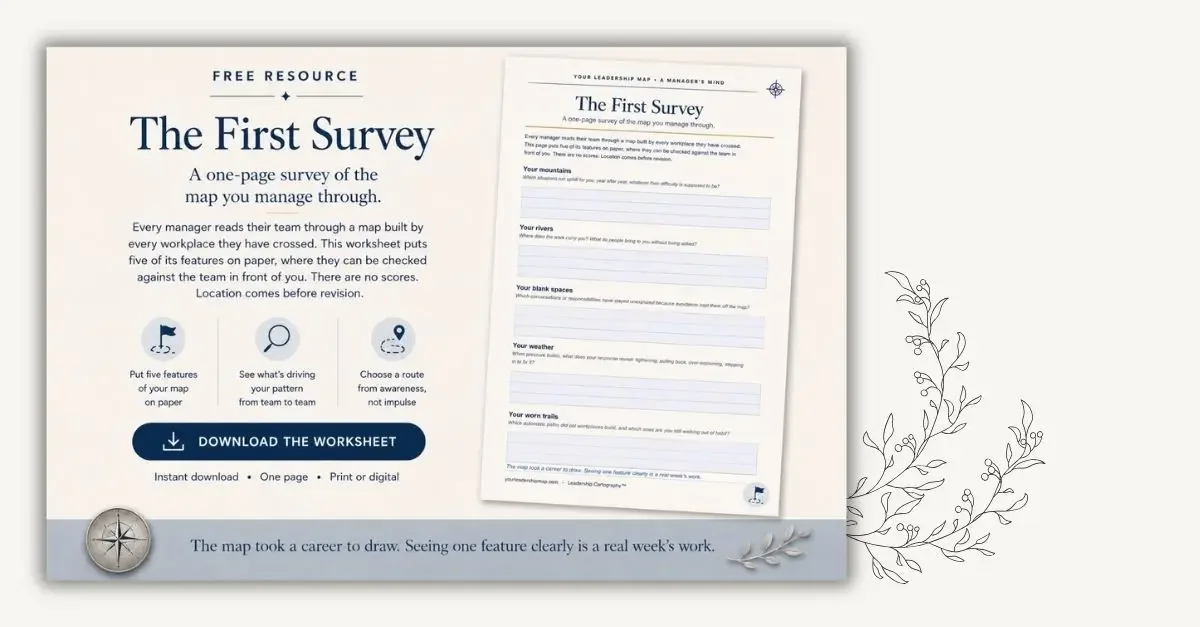
What it is. A one-page worksheet for the manager who suspects the same problems keep following them from team to team.
Why use it. It puts the traveling read on paper, where it can be checked against the team actually in front of you.
Best used when.
The same friction has now appeared with a second or third team
A verdict about one person has not changed in months
A performance conversation is coming and the conclusion already feels written
A peer you trust reads someone differently than you do
Time to complete. 10 to 15 minutes.
You'll work through.
Your mountains: the situations that always run uphill for you
Your rivers: the work that carries you, where people come to you unasked
Your blank spaces: what avoidance has kept unexplored
Your weather: what pressure reveals about how you move
Your worn trails: the automatic paths built by old workplaces
The pattern follows you because the map travels with you, and the map was drawn by every place you had to survive.
Where this leaves you
The repetition that looks like a career-long streak of difficult teams has a smaller and more workable explanation, and the worksheet above is one way to test it. An interpretation put on paper can be compared against the person in front of you. One that stays automatic can only be obeyed.
Surveys of this kind are slow, and they are allowed to be. The layer took a career to build. Seeing one feature of it clearly is a real week's work.
The next time the familiar problem appears on a new team, there is a question worth sitting with before the verdict files itself: is this the person in front of you, or the place that trained your eye?
If this is your terrain, return to the Leadership Identity Map to choose your route.
If this resonated, these go further:
Discover Your Pattern: The friction that repeats across your teams follows a pattern, and a pattern can be mapped. A pattern that has followed you through 3 teams is not luck; it is terrain, and terrain can be surveyed