
Why Two Managers Read the Same Team Differently
Two managers can watch the same behavior and reach different verdicts. Their position determines what becomes visible, what gets missed, and what the behavior appears to mean.
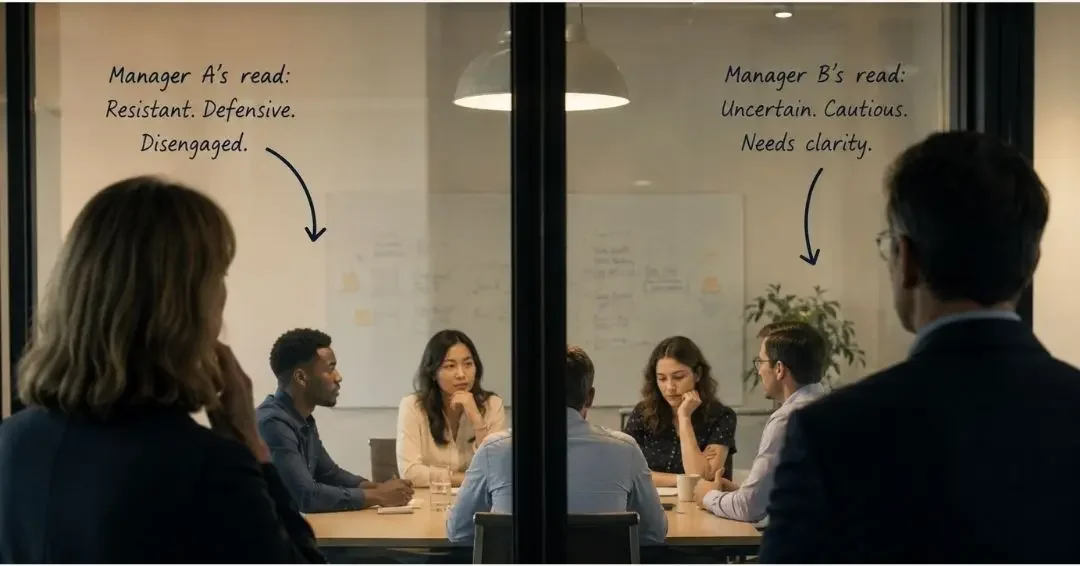
Two managers can watch the same team and reach different verdicts, because a read of a team is made from a position. Where the manager stands determines what becomes visible, what gets missed, and what the behavior appears to mean. One position shows resistance where another shows uncertainty. Most organizations treat a manager's read as neutral observation and never ask where it was made from, so a verdict formed at one vantage point shapes staffing, feedback, and trust as if it were fact. The cost is a team managed according to what one position could see.
Who have you already decided about?
Somewhere on your team right now, there is a person you have already decided about.
The decision came early. A meeting where they pushed back on a plan you had already cleared, a deadline that slipped the same week you needed a win, a silence in the room that read a certain way. Since then, everything they do has been filed under that decision. The late reply confirms it. The question in standup confirms it. Even the good week gets read as an exception. In your mind, this is simply knowing your people.
Then a manager from another team borrows this person for a project and comes back with a review that does not match your file. Careful, they say. Asks the right questions. Wants to get it right before moving. You listen for the person you know inside that description and cannot quite find them.
It would be easy to decide the other manager has not seen it yet. That is the move most managers make, and it can cost a whole quarter of managing the wrong person.
The other explanation asks more of you. You watched from where you stand. They watched from where they stand. And the same person showed up differently in each view.
Why does a misread survive so long?
Because nothing in the structure of management ever checks the verdict. That absence is what lets a misread run for years.
The system pays for fast reads. A manager who sizes up a person in one meeting looks decisive. The reward lands on the speed of the verdict, and nothing in the structure tests the verdict itself. A careful read and a misread earn the same nod in the moment.
No review examines the interpretation. Organizations audit outcomes. Performance systems track what a manager decided about a person, never how the manager reached the decision. There is no meeting where anyone asks what evidence sat under the word resistant. The interpretation stays private, so it stays permanent.
Early reads compound. The first verdict becomes the file the next observation gets added to. A person read as difficult in March gets watched for difficulty in April, and the behavior that fits the verdict is the behavior that gets noticed. Each pass adds confidence to the verdict and subtracts checking.
Culture sets the legend. The same behavior reads differently depending on the container around it. Directness registers as an asset in one organization and a liability in the next. When a culture cannot make room for the way someone works, the friction gets recorded as a fact about the person, and the manager inherits that recording as if it were a read.
The cost shows up in every direction at once. People get managed for problems they do not have. Real problems go unread. And the manager grows more confident in a read that fits the team a little less every month.
One question opens the way through: what does your position allow you to see in this team, and what might someone standing elsewhere notice first? That question is where the Leadership Identity Map begins.
The Identity Threshold: What Can This Position See?
The Identity Threshold is the point where a manager stops treating one view of the team as the whole view. The question becomes less certain and more useful: what can this position see clearly, and what requires another vantage point?
Two routes lead out of this post, and they serve different moments.
The terrain first. You want to understand how position, history, and context shape the way managers interpret the people and patterns in front of them. The landscape comes first, and your location on it can wait.
Your location first. You want to know where you stand, what your position makes visible, and what it may leave outside your view. The position comes first, and the theory can wait.
One question separates the routes: do you want to understand the landscape, or find yourself on it?
The uncertainty you are feeling comes from a gap in the structure. No part of your working life was built to show you what your position filters out; the system rewards the verdict and never asks where it was made from. The terrain has conditions. The conditions have names. And the first step is locating which one you are standing on.
The Leadership Identity Map is where both routes begin. One walks the whole territory. The other reads your position directly through the Source Assessment.
What determines what a manager can see?
What a manager can see is set by vantage point, and a vantage point has three elements.
Elevation. Where the role sits in the structure. Information reaches each level already filtered, and the same team looks different from one layer up or one layer down.
Prior ground. The teams, bosses, and cultures a manager has already crossed. Past terrain trains the eye, and whatever once meant trouble gets recognized fastest, whether or not it means trouble here.
The container. What the current culture rewards noticing and makes expensive to say. Some readings are available in one organization and out of reach in another.
Reading a team well requires checking all three before a verdict becomes a decision. That checking is a locating exercise, and the two routes above are built for it. The terrain page lays out the landscape. The assessment reads your position on it.
What do these differences mean in practice?
Why do two managers see the same team differently? A read is made from a position. Each manager stands at a different elevation, carries different prior ground, and works inside a container that rewards noticing different things. The team supplies the behavior. The manager's position shapes which parts become visible and how they are interpreted.
Does a different read mean one of the managers is wrong? A difference between two reads marks the places where position is shaping the verdict, and those are worth checking before any decision about a person gets made. Some differences turn out to be misreads. Others are two partial views that are both carrying something true.
How can a manager tell their read of a person is off? The clearest signal is a verdict that never updates. When months of new behavior keep landing in the same file, the verdict is running on old evidence. A second signal is disagreement from a peer you trust who sees the same person differently, since that gap usually comes from a difference in position rather than a difference in attention.
Can a manager change what they can see? A position can be located and supplemented. Once a manager knows what their vantage filters, other vantage points become useful instead of threatening: a peer's read, a skip-level view, the person's own account. Location comes before revision, which is why an assessment of where you stand does more at the start than any attempt to look harder.
Why does reading a team deserve a map?
Cartographers do not begin by drawing. They begin by paying attention. They notice where travelers lose their way, compare what they expected against what the ground shows, and only then put ink to paper.
Leadership Cartography is built on that discipline. The read a manager gives a team is a mapmaking act, and every mapmaking act carries the position of the mapmaker. The framework exists to make that position visible before its verdict hardens into someone's performance file: what the container rewards, what the elevation filters, and where the vantage and the ground disagree. Learning to account for the limits of a vantage point before judging the person seen from it starts as something you do for your team.
Someone above you is reading you from a position too. Their view is partial in the same way yours is partial. Once you understand how vantage shapes a verdict, you begin to see both sides of the management relationship differently.
A team deserves more than one unexamined view.