
The Conversation Went Well. The Work Didn't.
When a capable person keeps missing and coaching keeps failing, the reflex to try harder is the loop that keeps it stuck.
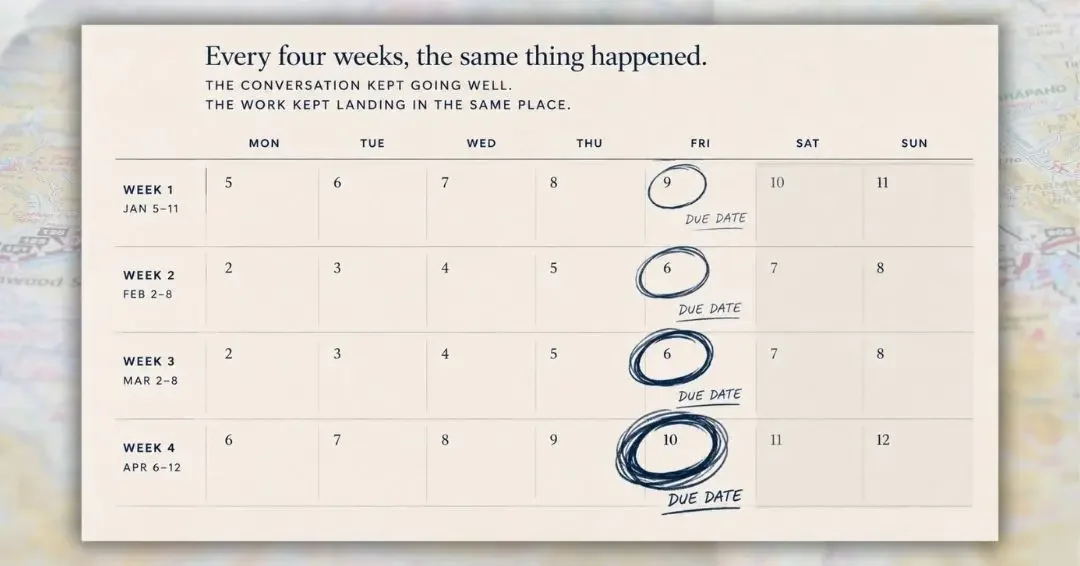
For a stretch of my career I ran a promotion cycle every four weeks, and every four weeks the same thing happened. The analysis I needed came in late. I would sit down with the analyst, a genuinely brilliant one, and we would have a good conversation. He understood. He agreed. He committed to a date and meant it. Then the next cycle would come and the work would land late again.
What I remember is not the missed deadline. It is the private feeling in my own head between the conversations. The recurring question of whether I was managing this wrong, or whether he simply would not do it, and the slow slide into reading a careful person as a discipline problem.
So I did the thing that felt like leadership. I coached harder. I had the conversation earlier, framed it better, got a firmer commitment. And the cycle kept returning the same result, which only tightened the loop I was already standing in.
When coaching an employee does not improve their performance, the reflex is to read it as a motivation or ability problem in the person. More often the work has no shared definition of done and no checkpoint between the conversation and the deadline. Coaching keeps landing on the individual and sliding off the actual gap, which sits in the structure around the work. The harder a manager coaches without changing that structure, the more entrenched the pattern becomes.
Why does more coaching make the problem feel worse?
The pattern underneath this is worth stating plainly: let’s call it the coaching loop. A capable person misses a standard, the miss reads as a personal shortfall, and the move that feels most like leadership is another conversation. The conversation goes well, because understanding was never the gap, and then the result returns unchanged.
Each turn of the loop does something to you. A conversation that lands and changes nothing is hard to file, so you reach for the only explanation available, which is that the person will not or cannot. A careful employee slowly gets recategorized as a performance risk. You lose hours to conversations that do not move the work, and lose a little confidence in your own read every cycle.
There is a second cost, and it lands on the employee without anyone deciding it should. Standing is sticky. Once a capable person is filed as an underperformer, the label outlives the missed deadline, and it shapes the assignments, the trust, and the next review long after the actual gap could have been closed.
The loop feels like diligence from the inside, and that is what makes it hard to see. Under it sits a structural gap the conversation was never built to fill, which is the thing the system keeps producing.
What makes a structural gap look like a personal one?
The loop survives because several structural conditions keep producing it.
Performance systems record the outcome, not the path to it. Reviews and targets capture whether the deadline was hit, not whether the work had a shared definition of done or a midpoint check. The structure records the failure and contains nothing that would have prevented it.
Coaching is the default tool the system hands managers. Management training and performance-improvement processes center the conversation: feedback, one-on-ones, development plans. When the gap is structural, the manager reaches for the tool the system trained them to use, and it has nothing to grip.
Done is treated as self-evident, so it rarely gets defined. Most roles inherit deadlines without an agreed standard for what finished means, which leaves a thorough employee and an anxious manager chasing two different targets. The organization assumes the standard is obvious, and it is not.
Reviews locate the result in the person, even when it comes from the process. W. Edwards Deming argued that the great majority of performance problems come from the system rather than the individual worker (Out of the Crisis, 1986). The review form has no column for the process around the work, so the result lands on the person alone.
The cost compounds across a team. Managers spend their hours on conversations that cannot reach the gap, capable people accumulate labels the structure created, and the work keeps missing on a schedule everyone has stopped questioning.
Why do we look for the shortfall in the person first?
The reflex to locate a performance problem inside the individual has an origin, and it sits at the start of modern management. In 1911, Frederick Winslow Taylor published The Principles of Scientific Management, which separated the planning of work from the doing of it and made each worker's task something to be measured, standardized, and improved through instruction. Performance became an individual output, and a shortfall became an individual training problem.
That framing solved a real problem for early industrial work, and it built a habit that outlived the factory floor. When the unit of measurement is the person, the unit of correction becomes the person too. A hundred years later the deliverable is a spreadsheet instead of a pig-iron load, and the reflex is unchanged: the work is late, so the fix must be aimed at whoever is late.
What the framing never accounted for is the structure around the work. Taylor's system assumed the task was well defined and the standard was clear, which is exactly what a modern knowledge role often lacks. The origin gave managers a century of practice at correcting the individual and almost none at examining the workflow the individual is standing in.
What actually breaks the loop?
The loop breaks when the work gets an edge and an early read, which is a change to the structure rather than another conversation. The Checkpoint Map has four parts, and a manager can set it up for a single deliverable in a few minutes.
Define done before the work starts. Written in plain terms, what finished looks like for this specific deliverable gives a thorough person an edge to stop at and makes the deadline mean something.
Set three check-ins instead of one deadline. An early read near the start, a middle read at the halfway mark, and a late read before the deadline surface the miss while there is still time to move it.
Make the last check a shipping decision. At the late read, deciding together what goes out and what waits lets thoroughness meet the deadline instead of running past it.
Read what the checks reveal. If the work moves once the structure exists, the gap was structural. If it still does not move, the case for a harder conversation is now clean and fair.
The Checkpoint Map
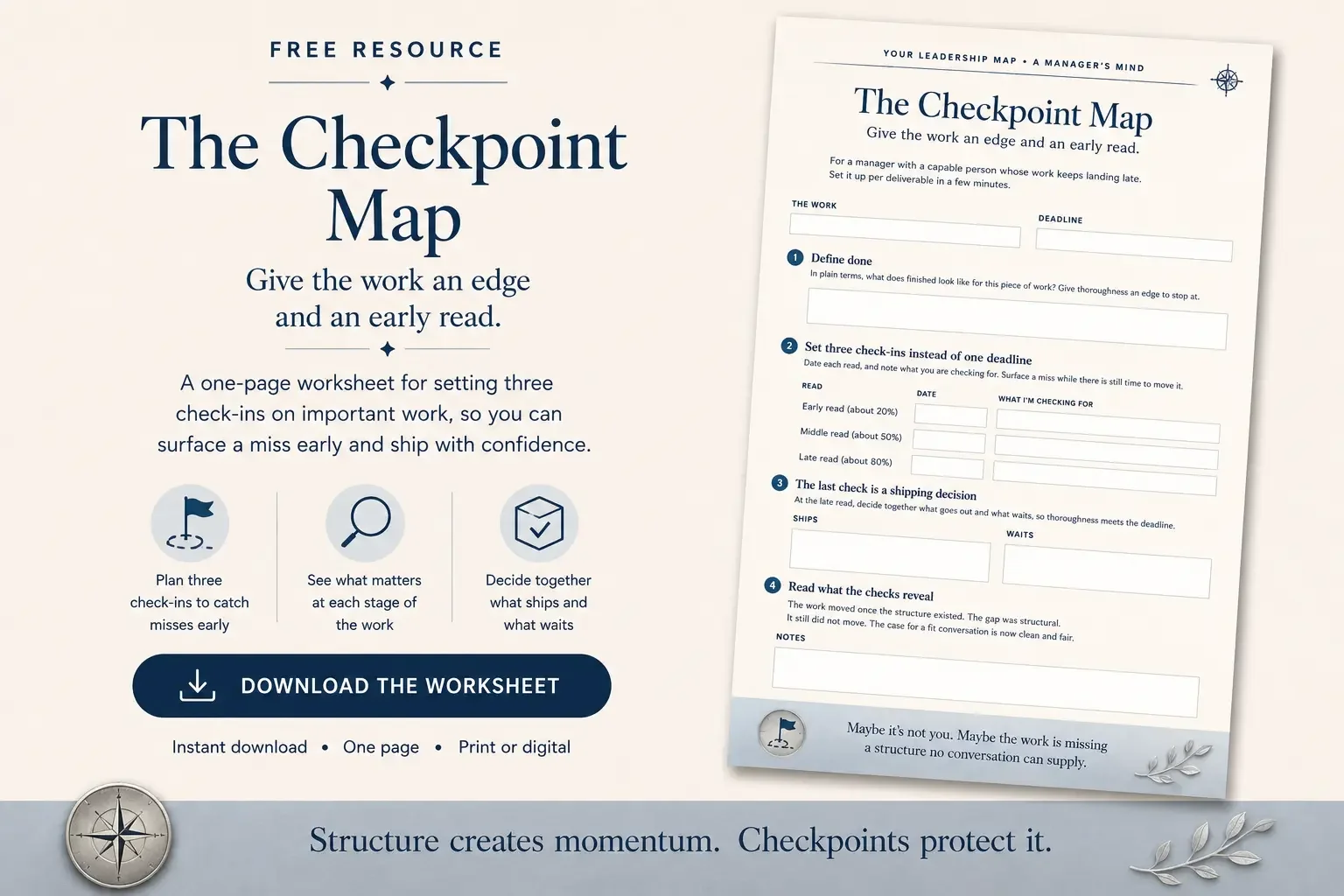
What it is. A one-page worksheet for a manager with a capable person whose work keeps landing late.
Why use it. It gives the work a shared definition of done and three early reads, so a missed deadline becomes information instead of a verdict.
Best used when.
A capable person keeps missing deadlines and coaching has not moved it.
Thoroughness is running past the date with no stopping point.
You find out the work is off only when it is already too late to fix.
You cannot tell yet whether this is a structure problem or a fit problem.
Time to complete. 5 to 10 minutes to set up per deliverable.
You'll work through.
Writing down what done means for this specific piece of work.
Setting the early, middle, and late check-in points.
Deciding, at the late check, what ships and what waits.
Reading what the checks tell you about structure versus fit.
When a capable person keeps missing the deadline, the work is missing a structure that no conversation can supply.
Where this leaves you
Leadership Cartography reads a stuck performance problem as terrain, not as a verdict on the person or the manager standing in it. The loop that keeps a capable employee filed as an underperformer usually traces to a structural gap the conversation was never built to fill. Seeing that changes what a manager does next, and it changes who gets to keep their standing.
The Checkpoint Map is one way to give the work an edge and an early read, so the next missed deadline becomes information. It will not settle every case, and some genuinely are a fit problem. It will show you which is which, which is more than another conversation can do.
If you have a capable person whose work keeps landing late, the question worth sitting with is what the work is missing that no conversation has been able to supply.
If this resonated, these go further:
How to Handle Underperformance When Coaching Isn't Working
Coaching Star Performers: Building the Next Level Pipeline
Why Performance Reviews Feel Like a Verdict on Your Worth
The Source Assessment shows you the lens you lead from, so the next time a capable person keeps missing, you can tell whether your first instinct is the route the work actually needs. Discover Your Pattern.