
The Org Chart Moves. Relationships Remember
The way you treat people during this version of the org chart becomes the terrain you work inside during the next one.
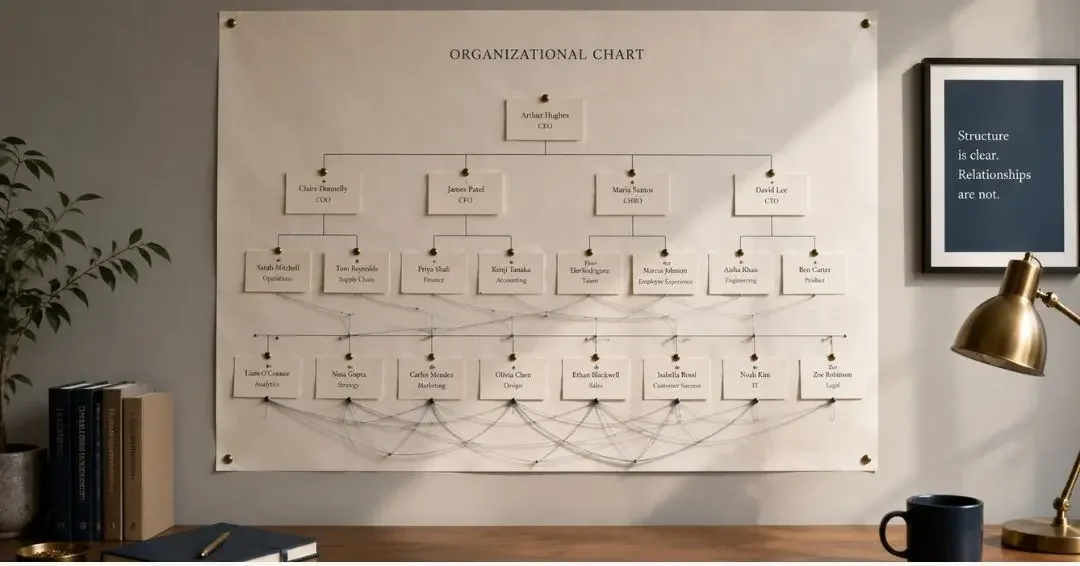
Years into my career, I did a short stint with a company that promoted from within as a matter of practice. The person beside you today could be your boss next year. The person reporting to you now might end up running a function you depend on. The org chart kept changing, and everyone knew it would keep changing.
While I was there, a pair of leaders went through their own version of this. There was tension. A little kerfuffle. The kind of workplace friction that happens when someone gets promoted before the relationship is ready for it.
Watching it play out, my boss said something to me that I never forgot: "You really need to manage relationships because you never know who's going to become your boss."
At the time, I knew he was right. It took me years to learn how much deeper the advice went.
Relationship building at work is often filed under networking, soft skills, or office politics. Inside most organizations it functions as infrastructure. Org charts get redrawn through promotions and reorganizations and every redraw moves authority between people who already know each other. Everyone remembers how they were treated before the titles moved.
A manager's relational habits today become the conditions that manager works inside tomorrow.
TL;DR
Managers who treat relationships as overhead pay for it at the next reorganization, usually without connecting the bill to the behavior. What follows makes the pattern visible: what it costs, where it came from, and how it reads differently depending on how you lead. A free one-page value map at the end offers a way to take stock of what tending relationships actually carries in your workplace.
Why does relational effort keep flowing toward rank?
The pattern underneath this has one rule: attention follows rank. You give your best attention to the people above you, because they make the decisions that affect you. The people below you get politeness, but less of your real attention. Your peers get whatever is left over. Almost nobody chooses this on purpose. There is never enough time for everyone, and the org chart ends up deciding who gets yours.
The rule feels efficient in the moment. The cost shows up later. The people you barely make time for now are the same people you will need when the chart moves. The peer who got your leftover attention last year can be your boss this year, and they remember the leftovers. The direct report you managed on autopilot can end up running a function you depend on.
The pattern feeds itself. When the chart keeps changing, nobody feels secure, so you point your time toward the power. Everyone else gets less of you. Then the next reorganization comes, the relationships you barely made time for feel risky to depend on, and you hold even tighter to whoever has the power.
There is a second cost, and managers who lead through relationships feel it most. When everyone around you spends attention by rank, steadily tending relationships starts to look naive, or political, or like time taken away from real work. Managers who do it well begin doubting the thing they are best at.
What makes relationship building invisible at work?
The pattern persists because several structural conditions keep producing it.
Authority moves without a relational handoff. Promotion processes transfer decision rights overnight and provide nothing for the relationships underneath them. Two people who worked side by side get a new reporting line and no occasion to renegotiate what changed. The relationship is left to absorb the shift on its own.
Relational infrastructure appears nowhere on a review form. Performance systems measure output, targets, and delivery. The work of tending relationships across the chart shows up in no metric, so it earns no recognition and competes for time against everything that does. What goes unmeasured gets treated as optional.
Managing-up advice concentrates effort where rank already is. An entire genre of career guidance trains managers to study their boss's preferences, priorities, and communication style. Almost none of it suggests the same attentiveness toward peers or direct reports. The advice is rational for each individual and corrosive in aggregate, because it teaches attention to follow power.
Promote-from-within cultures raise the stakes without saying so. Organizations that fill leadership roles internally keep recycling the same people through new configurations. Every relationship is a future reporting line in waiting. The practice has real benefits for continuity and morale, and it turns every hallway interaction into something the org chart may later reprice.
The cost lands on everyone eventually. Managers inherit bosses they underinvested in, direct reports they managed transactionally, and peers who remember. The work still has to move through those relationships, whatever condition they are in.
Why was the relationship never on the diagram?
The org chart itself has a birthday. In 1855, Daniel McCallum, general superintendent of the New York and Erie Railroad, worked with civil engineer George Holt Henshaw to produce a diagram of the railroad's plan of organization: who reported to whom, who held authority over which division, where information should flow. The original, drawn from the returns of September 1855, is held at the Library of Congress and is generally credited as the first modern organizational chart. Business historian Alfred D. Chandler placed McCallum's management system at the start of modern American management in The Visible Hand.
The diagram solved a real problem. A railroad spread over hundreds of miles couldn't run on personal familiarity, so authority had to be made visible and formal. What the diagram couldn't show was everything else: trust between two division heads, the history between a superintendent and the foreman he was promoted past, the relational memory that determined whether an order moved smoothly or ground through friction.
Organizations inherited the diagram and its blind spot together. 170 years later, reporting lines are documented, versioned, and redrawn at will, while the relationships underneath them remain unmapped and unmeasured. The modern workplace runs on a chart that has never once shown the thing that determines how work actually moves.
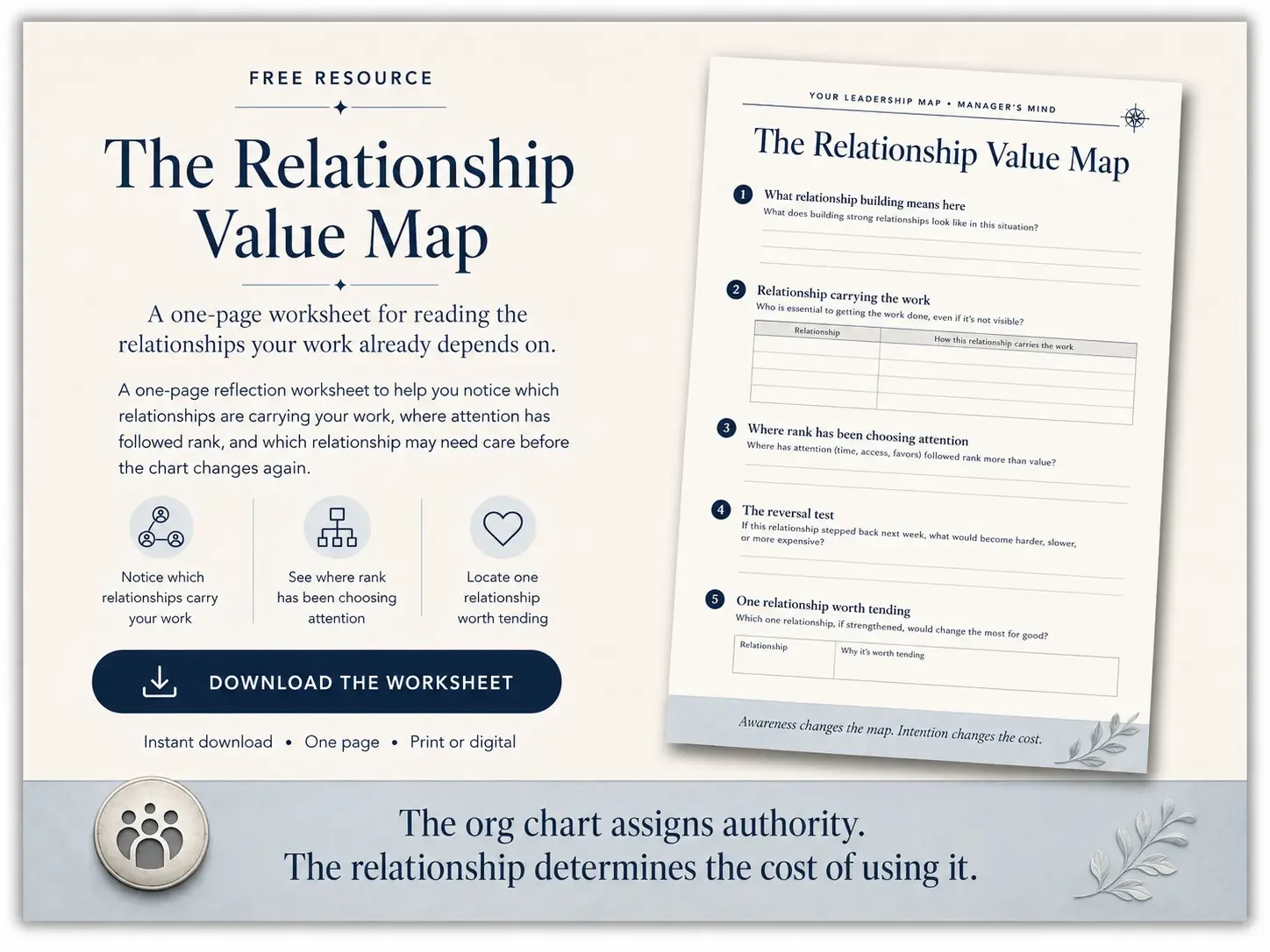
The Relationship Value Map
What it is. A free one-page worksheet for managers who want to read what their workplace relationships mean to them and what those relationships carry.
Why use it. It surfaces the relational infrastructure you already have, and the places where rank reading has been choosing for you.
Best used when.
A reorganization, promotion, or role reversal is coming and the relationships around you feel unexamined
You lead relationally by instinct and want language for the value that work creates
You just watched a title change strain a relationship you care about
You are inheriting a boss or direct report you share history with
Time to complete. 5 to 10 minutes.
You'll work through.
What relationship building means to you, in your own words
What value it carries in your workplace, visible and invisible
Which relationships carry your work today, regardless of rank
Where your attention has been following the org chart instead of the person
One relationship worth tending before the chart moves again
How does this pattern read for different managers?
If relationships come naturally to you, this pattern shows up as self-doubt. You check in on people who can do nothing for you, you remember what someone's kid had going on last month, and somewhere along the way you started wondering whether that counts as work. In a system that reads relational effort through rank, your steadiest skill can start to feel like a hobby you should be doing less of.
If structure and delivery come more naturally, the pattern shows up later and harder. Relationships felt like overhead until the day a former peer became your boss, or a former direct report started running a function you depend on, and the account you never funded came due. And if you are standing in a reversal right now, leading someone who used to be your equal, both versions are in the room with you at once.
The org chart assigns authority. The relationship determines the cost of using it.
My boss's advice sounded like career protection when I first heard it, and there is a version of it that stops there: be careful with people, because power moves. That version keeps rank reading fully intact. It just extends the radius.
The version that stayed with me is about respect for the relationship itself. The relationships around you are the most durable thing in your working life. Charts get redrawn, titles change hands, functions merge and dissolve, and the same people keep showing up across every version, remembering how they were treated in the last one. Leadership Cartography reads relationships as the terrain that persists underneath every map redraw, which makes tending them terrain work.
If the chart above you moved tomorrow, which relationships would carry you? The worksheet above is one way to look at that honestly before the chart moves again.
How you answer that question depends on how you lead, and the Source Assessment reads the pattern you're answering from. Discover your pattern

RELATED READING
If this resonated, these go further:
How to Lead Someone Who Used to Be Your Equal
How to Master the Former Peer Transition
When Your One-on-Ones Are Full of Connection and Empty of Development