
New Manager Confidence: Why Competence Isn't Enough
The pattern the promotion does not tell you about
Most new managers arrive with real competence. The confusion that follows promotion is rarely about what they know. A culture that rewarded execution and responsiveness to direction built a specific pattern in them. That pattern served the organization well for years. The promotion changes what the role requires without recalibrating the signal the culture sends. The fog that descends is a terrain signal, not a capability verdict.

My boss looked at me across the desk and said, "Oh, I think we're having a possibility conversation, not a conversation for action."
I felt the relief first. I had been working so hard to understand what he wanted from me that I hadn't noticed I was operating in the wrong conversation entirely. Then the embarrassment arrived, quiet and immediate. I thought I should have known that.
The thing I didn't understand then, and wouldn't understand for a while, is that you can't know what you've never been shown. My boss was holding me capable in that room. He wanted to hear what I thought about a potential strategy. He was waiting for my perspective. And I was waiting for my marching orders, asking question after question, trying to define a project that wasn't actually a project yet, getting visibly frustrated when the definition wouldn't come.
I left that meeting in a fog. What landed wasn't the confusion about the project. It was something larger, and harder to place. It had never once occurred to me that my boss might want to know what I thought. That my read on a situation had value before anyone asked for it. That I was in the room as someone with standing, not someone waiting to receive instructions.
That's the gap competence doesn't close. I had the experience. I had the skills. What I didn't have was a working sense of my own standing in the room. And until that changes, confidence stays just out of reach, no matter how well you know the work.
This Article covers why new manager confidence stalls when competence is strong, what the condition is producing in the room, and a framework for relocating your standing when the fog arrives.
Why Does New Manager Confidence Stall?
Most new managers arrive with proof. Years of it. They know the work, they know the team, and in many cases they know the problems better than anyone above them. That competence is real. It earned the promotion.
What earned it matters here. Organizations reward the behaviors that fit their operating culture. For individual contributors, that usually means clarity of execution, responsiveness to direction, and a demonstrated ability to deliver inside defined parameters. Those behaviors get reinforced. They become the manager's working identity. They feel like professionalism because, inside that culture, they are.
The promotion changes the terrain. The organization promotes the manager and then assumes the shift is self-evident. The expectations change. The role changes. What does not change is the playbook the manager is holding. No one hands them a new one. No one sits down and explains that the culture now expects them to arrive with perspective rather than questions, to read the room rather than wait for it to direct them. The assumption built into most promotions is that the manager will figure it out. What that assumption misses is that figuring it out requires seeing a gap that the culture itself made invisible.
That is where the rub lives. The manager feels something is off. Meetings end without resolution. Conversations drift. The clarity that used to arrive with enough preparation stops arriving. The manager works harder, prepares more thoroughly, asks more questions. None of it closes the gap because the gap is not about preparation. The culture built a specific response pattern in this manager, and that pattern served the organization well until the role changed. Now it produces friction. The manager feels it but cannot place it, because nothing has told them yet that the terrain shifted under their feet.
What Does the System Do That Creates This Pattern?
Organizations are not built to develop interpretive confidence in new managers. They are built to produce consistent output. The systems that run underneath a workplace — how decisions get made, how performance gets measured, how feedback gets delivered — are calibrated to the behaviors that keep the organization operating smoothly. Individual contribution is legible inside that system. Perspective-offering before it is formally requested is not.
This is why the gap is structural. The organization did not fail to develop this manager out of neglect or indifference. It developed them precisely as intended. Every piece of feedback that reinforced execution over interpretation, every meeting where the manager was expected to deliver rather than weigh in, every performance review that measured output rather than read the room — those were not oversights. They were the culture producing what it needed.
The promotion does not come with a recalibration of those signals. The same culture that rewarded execution continues producing the same conditions. The manager is now expected to operate differently inside a system that has not changed how it communicates what it values. The feedback loop that would tell them the terrain has shifted either does not exist or arrives too late, usually after the manager has already absorbed several rounds of confusion as evidence of personal inadequacy.
What the system cannot see is that the manager's conditioned response is not a failure of capability. It is a precise reflection of what the culture built. The manager learned to wait for clarity because clarity was what the culture rewarded. That pattern served the organization well for years. The organization changed the role without changing the signal. The manager is still receiving the transmission the culture has always sent. They are just in a room now where a different transmission is required.
How to Relocate Your Standing When the Fog Arrives
The philosopher Fernando Flores spent decades studying how organizations actually function, and what he found was both simple and disorienting: organizations are networks of commitments, and commitments are made through language. The conversations happening inside a workplace are not background noise. They are the structure. They determine what gets coordinated, what gets built, and what gets left behind. (Flores, F., Conversations for Action and Collected Essays, 2012.)
Flores identified four distinct types of conversation, and each one asks for a different kind of presence.
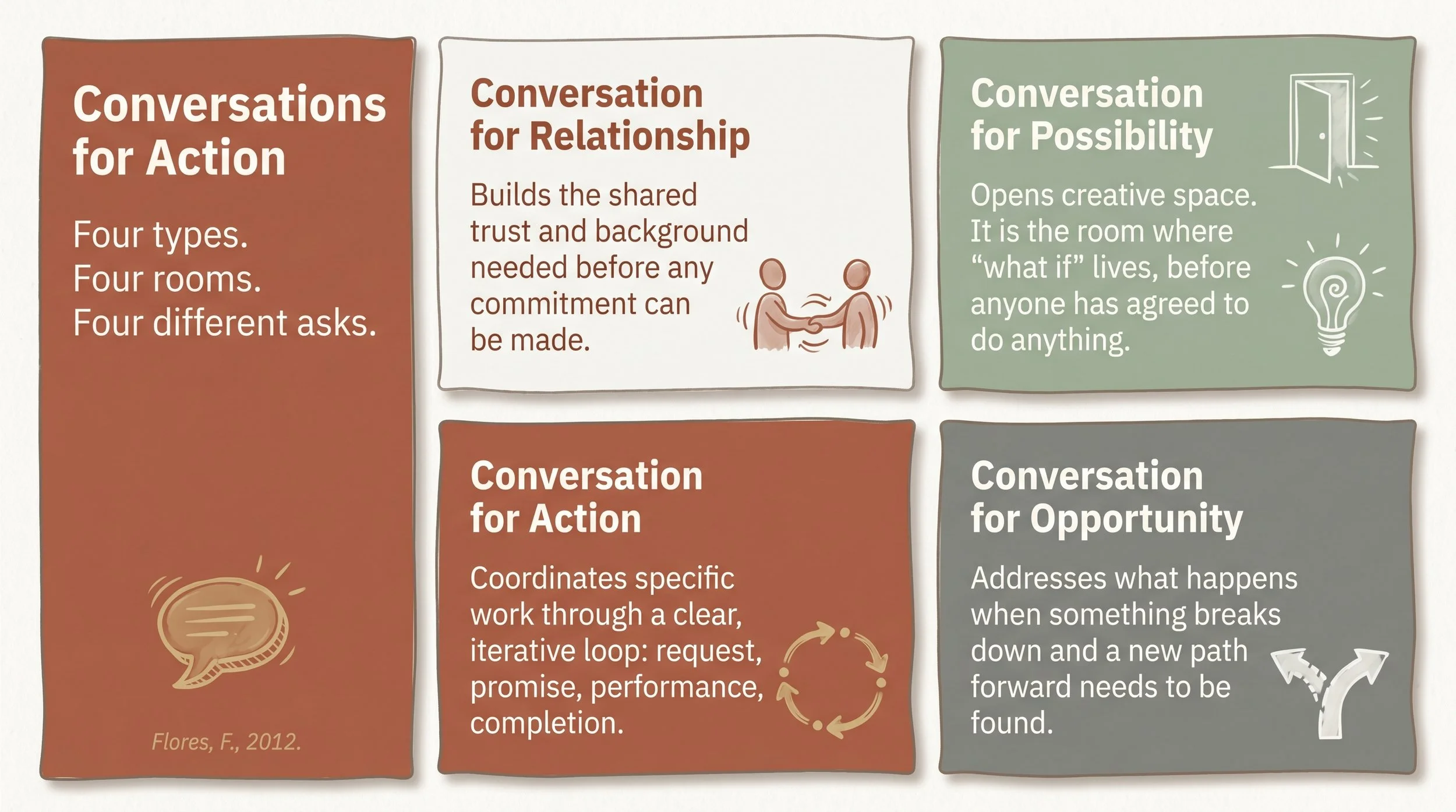
What the culture produces, over years of rewarding execution, is managers who are fluent in one conversation type and largely unaware the others exist. The individual contributor who delivered well learned a Conversation for Action as the default. Scope the work, define the ask, produce the output, close the loop. That pattern is precise and effective inside the terrain it was built for.
The promotion moves the manager into rooms where a different conversation type is operating. Possibility rooms. Relationship rooms. Rooms where the ask has not yet been formed and the value being requested is perspective, not output. The manager arrives with the wrong fluency and reads the resulting friction as personal failure. The culture did not prepare them for a shift it assumed would be self-evident.
The organization already gave you the title. The systems around you may still be calibrated for your compliance, but the room is waiting for your interpretation. You do not need to wait for a lull in the conversation or a formal invitation to speak.
You are already in the room. The only thing left to do is arrive.
Related Reading
Why Culture Fit Keeps Filtering Out Good Managers
How Do I Stop Disappearing Into My Work
When Your Boss Is the Bottleneck: Why Managing Up Feels Impossible
When the Map is Blurry at the Top, Staying Silent Hides the Cliff
What kind of leader are you when the room shifts? Take the Leadership Cartography assessment and find out which pathway fits the terrain you're actually navigating.