
How to Delegate Without Micromanaging: Support Leader's Guide
Delegation works when you set clear authority levels, give only essential resources, and define future standards that build steady autonomy
Support Managers excel at providing resources and stability but often become the single point of failure when they can't delegate. The 3×3 Empowerment Grid helps you shift from micromanagement to true empowerment in ten minutes by defining autonomy levels (how much freedom do they have?), identifying minimum necessary resources (what do they actually need, not what would be nice?), and setting future standards (what will they do differently next time?). When you stop being the provider of all answers and start being the architect of the system, you transform dependency into capability.
You're the ultimate resource provider on your team. But delegating without micromanaging feels impossible. You fix every problem, clear every blocker—and you can't take a day off.
Your first instinct when someone comes to you with a problem is to fix it. You build systems, you clear blockers, you make sure your team has the tools, budget, and stability they need to succeed. You Lead with Support, making empowerment, resource management, and operational excellence your primary navigational tool.
And you can't take a day off.
You know the feeling. The constant stream of questions. The tiny "check-ins" that derail your own work. That sense that if you step away for even a day, the whole system might collapse because every decision—even small ones—still runs through you.
I learned this the hard way when I tried to take a vacation. Three days in, I was on my laptop at the beach, reviewing a purchase request for $200 worth of office supplies. My partner looked at me and said, "You do realize you've trained them to need you for everything, right?"
Are you struggling to get decisive outcomes? If you are stuck in endless consultation and need to move from input to action, read the decision-flow strategies in the Together Pathway.
He was right. I had. And I didn't know how to stop.
🎧 Want the full Lead with Support™ pathway exploration?
Episode 9 covers why you're a "stability anchor" and "operational backbone," the hazards when support becomes control (micromanagement, being indispensable), and tools for building systems that don't require you.
Or keep reading for the 3×3 Empowerment Grid—the tool you need when you can't step away without everything collapsing.
Listen to Episode 9: Lead with Support™ — The Supportive Leader's Map
The Dependency Loop
If you've taken the Explorer Quiz and found yourself on the Support Pathway, your gift is stability. You're the operational backbone of your team. You're the one who makes sure nothing falls through the cracks, who anticipates needs before they become emergencies, who creates the infrastructure that lets everyone else do their best work.
But under pressure, that gift turns into its shadow: control. You start believing that if you don't oversee every detail, something will break. You confuse being supportive with being indispensable. And you end up trapped in what I call the Dependency Loop—where every question, every approval, every tiny decision still runs through you.
The panic point looks like this: you feel completely overwhelmed by details and dependencies. What started as being "available" has turned into micromanagement or self-sabotage, as you take on work yourself to ensure quality. You're exhausted from being the single point of failure.
Being the resource provider shouldn't mean being the resource.
I had a direct report—let's call him Alex—who was brilliant. Capable, reliable, strategic. But he came to me for everything. Should he schedule this meeting? Should he approve this expense? Should he respond to this email this way or that way?
At first, I thought I was being helpful. I was removing friction. I was making his life easier. What I was actually doing was teaching him that he couldn't make decisions without me.
The Moment I Realized I Was the Problem
One day, Alex came to my office to ask if he could approve a $75 software license. I was in the middle of preparing a board presentation. I looked up and said, "Alex, you've made more complex decisions than this a hundred times. Why are you asking me?"
He hesitated. "Because... I don't know. I guess I just wanted to make sure it was okay."
"What would happen if you just decided?" I asked.
"I don't know. Maybe you'd be mad?"
That hit me like a brick. I'd created an environment where a capable, senior team member was afraid to spend $75 without my approval—not because of policy, but because I'd trained him to check with me first.
I was the blocker. And I'd built the entire system around me being the blocker.
The 3×3 Empowerment Grid™: Your 10-Minute Delegation & Freedom Tool
This tool is designed for managers who lead with Support. It restores efficiency by defining clear levels of autonomy and resources needed for every major task. Use it when a team member asks for approval, and you need to stop asking "Do I have time to review this?" and start asking "What level of freedom does this person need to succeed?"
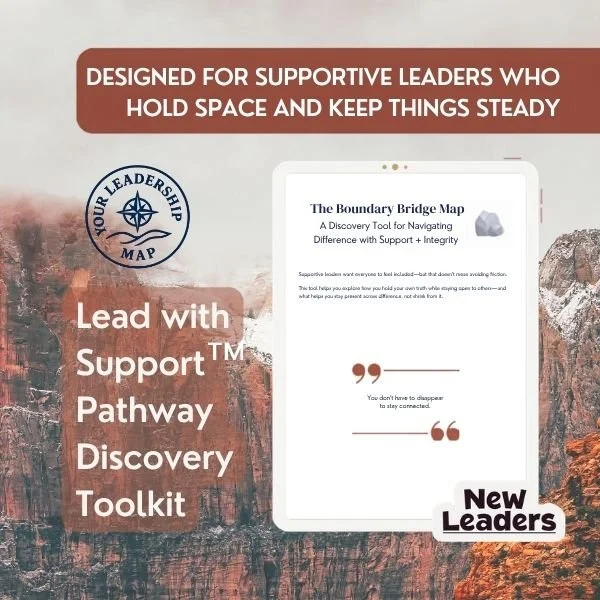
Lead with Support™ helps new managers bring steadiness and structure to their teams without slipping into bottlenecks or over-control.
What you’ll get:
A guided discovery sequence to clarify your natural pace and rhythm
Fillable tools to map responsibilities and track sustainable workflows
Reflection prompts for balancing support with accountability
A one-page map to guide check-ins and team momentum
Format: Fillable PDF (instant download)
Ideal for: New managers, operators, and team leads who want to create dependable structure without stifling growth
1. Define the Autonomy (The "How much freedom?")
Start by clarifying the expected level of independence for the specific task or decision. Don't assume they know. Tell them explicitly.
The Authority Level
Question: What is the maximum dollar amount, time commitment, or risk level they can decide on without me?
Example: You have authority for purchases up to $500 and decisions with less than 24-hour impact.
The Info Boundary
Question: What information must they share with me (and why)?
Example: I need a one-sentence summary of the outcome after you've implemented it (for tracking, not approval).
The Learning Risk
Question: Is this a low-stakes task where failure is acceptable for learning?
Example: Yes. If this fails, the only cost is time, and the learning gained outweighs that cost.
2. Chart the Resources (The "What do they actually need?")
A Support Manager's reflex is to give everything. This step forces you to define the minimum necessary resources and prevent future dependencies.
The Missing Resource
Question: Is the blocker a Tool, Time, or Skill? (Provide only the missing one.)
Example: The blocker is Skill. I will connect you with Jane who did this last quarter.
The Key Person
Question: Who is the single best point of contact who isn't me? (Delegate the dependency.)
Example: Ask Mark (Finance) directly; he has the full spending breakdown.
The System Fix
Question: Can I document the answer in a system (e.g., FAQ, template) so they don't have to ask me again?
Example: I will create a 5-step checklist in our project tool and share it.
3. Set the Coaching (The "What is the new standard?")
This final check transforms the dependency into a future state of empowerment. This is where you teach them how to operate without you.
The Future State
Question: What will you do differently next time this same problem appears?
Example: I will consult the documented checklist before asking for guidance.
The Empowerment Affirmation
Question: Remind the team member of their inherent capability.
Example: I trust your judgment on this. I delegated this to you because you own the outcome.
The Mission Link
Question: Remind yourself why system-level support links back to the larger company mission.
Example: By empowering others, I free up my time to secure the long-term resources the team needs for growth.
What Changed After That Conversation with Alex
After Alex asked me about the $75 software license, I did something I should have done months earlier. I sat down with him and mapped out his authority levels explicitly.
"Here's what you own," I said. "You have approval authority for any purchase under $500. You have decision authority for anything with less than 24-hour impact. If you make a call within those boundaries, you don't need to check with me—you just need to tell me what you decided afterward so I can track it."
His face changed. "Really?"
"Really. And if you make a decision I disagree with, we'll talk about it—but that's how you learn. I'd rather you make ten decisions where two are wrong than wait for me to approve every single one."
Two weeks later, he scheduled a vendor meeting, approved three software licenses, and reorganized the team's project board—all without asking me. And when I came back from a three-day conference, nothing was on fire.
For the first time in two years, I wasn't the single point of failure.
Leading with Intention
Leading with Support isn't about being the human shield. It's about building a self-sustaining system where your team feels confident and capable. When you stop fearing delegation and start clarifying the nine coordinates above, you transform micromanagement into true empowerment.
You show up as the leader your team needs: the one holding the map who designs the infrastructure for success—and then steps back to let others drive.
Have you ever realized you were the single point of failure on your own team?
What did it take to step back?
Common Questions About Delegation and Empowerment
"What if I delegate and my team member makes a mistake that costs us money or reputation?"
That's a real risk—which is why you define authority levels explicitly. For high-stakes decisions (budget, reputation, legal), keep tighter boundaries. For low-stakes tasks (internal process, $100 purchases, scheduling), give full autonomy. The $500 threshold isn't universal—adjust based on your team's experience and the consequences of failure. Start small, expand as trust builds.
"What if my team doesn't want more autonomy? What if they actually prefer checking with me?"
This often means they've been trained (by you or previous managers) that independent decisions are punished or second-guessed. Start with explicit permission: "You're authorized to make this call. If you make a decision I disagree with, we'll discuss why—but I won't be mad, and you won't be in trouble. That's how learning happens." Most people will rise to the autonomy once they trust it's real.
"How do I know what's a reasonable authority level vs. too much freedom too soon?"
Ask yourself: What's the worst-case scenario if they decide wrong? If the answer is "we lose $50 and 2 hours," that's learnable. If the answer is "we breach a contract or lose a major client," that stays with you. Authority levels should match the cost of failure. As their judgment improves, expand the boundaries.
"What if I step back and the system actually does collapse?"
Then you've discovered valuable information: your system is fragile and depends on you specifically, not on good process. That's fixable. Document the decision framework ("here's how to handle X when it comes up"), create templates, identify backup decision-makers. The goal isn't to disappear—it's to build a system that works whether you're there or not.
"How do I delegate when I'm genuinely faster at doing it myself?"
You're faster now. But every time you do it yourself, you reinforce the dependency and prevent your team from building the skill. Yes, it takes longer to coach someone through a task than to do it yourself—the first three times. By the fourth time, they're faster than you, and you've freed up recurring time. Think in weeks and months, not hours and days.

Ready to explore how you naturally lead?
Take the Leadership Pathway Explorer to discover your instinctive management style.
If you're on the Lead with Support™ pathway, learn more about the Leadership Cartography™ system and how all five pathways work together.
Want tools like this delivered monthly?
Join Map Drawer and get three practical management tools every month for $15.
Go Deeper Into the Support Pathway
This post gave you the 3×3 Empowerment Grid for delegating without micromanaging. But there's more to explore about leading with stability and operational excellence.
Episode 9 covers:
Your strengths: stability anchor, operational backbone, infrastructure builder, reliability keeper
Your hazards: control addiction, indispensability trap, over-managing, system rigidity
Additional tools for defining autonomy levels and building self-sustaining systems
How to remember that true support means creating capability, not dependency
Listen to Episode 9: Lead with Support™ (10 min) →