
How to Make Team Decisions Without Endless Meetings: A Manager's Guide
Together Managers excel at building collaboration and trust—but often get trapped in endless meetings where discussion never becomes decision. The 3×3 Commitment Compass helps you convert collaboration into commitment in ten minutes by defining the input process upfront (who's consulted, when does discussion end?), crystallizing the decision clearly (what's the one-sentence outcome?), and setting execution ownership (who holds the map now?). When you pair inclusion with clarity, you transform meeting paralysis into decisive action.
You're the ultimate connector on your team. You know the best decisions come from collaboration and buy-in. But turning discussion into decisions feels impossible.
You intuitively understand that the best decisions are built on shared understanding, buy-in, and inclusion. You're the one who makes sure every voice is heard, every perspective is considered. You Lead Together, making collaboration, team harmony, and open communication your primary navigational tool.
And your calendar is a nightmare.
You know the feeling. You schedule a meeting to make a decision. Everyone shares their opinion. The clock runs out. And somehow, the outcome is... more meetings. You're stuck in what I call the Consensus Trap , mistaking consensus for commitment, and your projects are stalling while your calendar fills up with "alignment discussions" and "working sessions" that never actually work.
Do you get buy-in but lack a clear mission? If your team is collaborating well but doesn't know why they are doing the work, you need to align with the Purpose Pathway.
I lived in this trap for two years. I thought I was being a good leader by making sure everyone had input. I thought collaboration meant hearing every voice equally. I thought if I just kept facilitating discussion, eventually we'd reach a decision everyone could get behind.
What I actually did was train my team to believe that every decision was negotiable, every meeting was optional, and nothing was ever final.
🎧 Want the full Lead Together™ pathway exploration?
Episode 11 covers why you're a "coalition builder" and "bridge maker," the hazards when collaboration becomes paralysis (consensus addiction, decision avoidance), and tools for balancing inclusion with decisive action.
Or keep reading for the 3×3 Commitment Compass—the tool you need when meetings never end in decisions.
Listen to Episode 11: Lead Together™ — The Collaborative Leader's Map
The Consensus Trap
If you've taken the Explorer Quiz and found yourself on the Together Pathway, your gift is collaboration. You create high-trust environments where people feel safe contributing ideas. You're the engine of psychological safety on your team, and that's not nothing—that's the foundation of everything good that happens in organizations.
But under pressure, that gift turns into its shadow: the Consensus Trap. You start believing that you need universal agreement before you can move forward. You confuse hearing every voice with needing every voice to agree. And you end up circling the same conversations over and over while your team gets increasingly frustrated.
The panic point looks like this: you feel responsible for hearing everyone, but the cost is paralysis. What started as noble inclusion has become a stall. You're exhausted from facilitating endless discussions, and your team is frustrated because they're circling instead of moving forward.
Collaboration without decision-making isn't leadership. It's just really expensive therapy.
I learned this the hard way during a major platform redesign. We needed to choose between two architectural approaches. I scheduled a meeting to discuss it. Then another meeting to revisit the concerns raised in the first meeting. Then a working session to explore a hybrid option. Then another meeting to "finalize" the decision—which just opened up new concerns.
Six weeks later, we still hadn't decided. The engineering team was furious. My manager pulled me aside and said something I'll never forget: "Your job isn't to make everyone happy. It's to make a decision and move forward."
The Meeting That Changed Everything
After that conversation, I called one final meeting. But this time, I started differently.
"Here's how this is going to work," I said. "We have 30 minutes. The first 20 minutes are for input. At the 20-minute mark, I'm closing the discussion. At the 30-minute mark, I'm making a decision based on what I've heard. The decision will be final for 90 days unless we discover a critical technical flaw."
You could feel the room shift. People sat up straighter. They spoke more directly. They knew their input window was limited, so they made their points clearly and moved on.
At the 20-minute mark, I closed the discussion. At 25 minutes, I made the call: we were going with Option B. I explained the rationale in two sentences. I assigned Jane to translate the decision into three action steps. I assigned Mark to draft the internal announcement.
The meeting ended at 27 minutes. The decision held. The project launched three months later, on time.
The 3×3 Commitment Compass™: Your 10-Minute Decision Flow Tool
This tool is designed for managers who lead with Together. It converts collaboration into concrete commitment by ensuring the decision flow has clear on-ramps and off-ramps. Use it when you're about to launch a discussion or feel a decision beginning to drift, and you need to stop asking "What does everyone think?" and start asking "How do we move from discussion to decision?"
1. Define the Input (The "How will we decide?")
Before opening the floor for discussion, clarify the rules of engagement. This sets an immediate boundary on the length and scope of the collaborative process.
The Consulted
Question: Who must be consulted for input, and whose input is secondary?
Example: Jane (Engineering) and Mark (Finance) are mandatory voices; everyone else is optional.
The Input Window
Question: When does the input window close and the decision window open?
Example: The discussion ends at 10:30 AM. A decision will be made by 11:00 AM.
The Decision Type
Question: Is this a 100% consensus, a majority vote, or a unilateral call by the Decision Maker?
Example: This is a Decision Maker call (Owner: Sarah) based on consulted input.
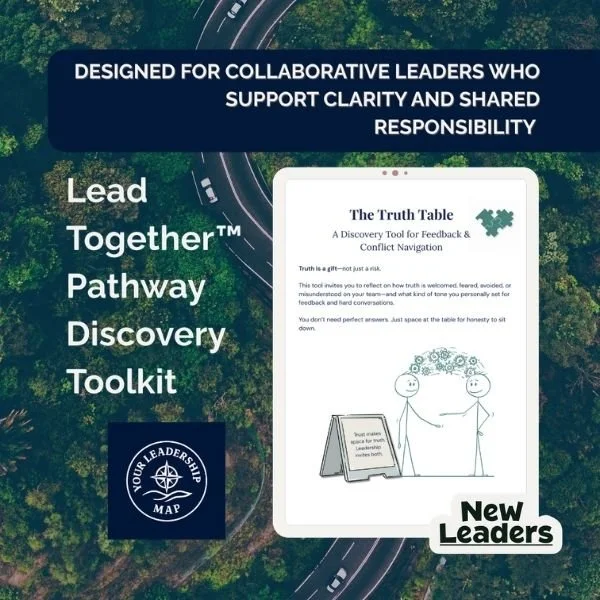
Lead Together™ helps collaborative managers build trust, navigate consensus traps, and create momentum through shared ownership.
What you’ll get:
A guided discovery sequence to map your natural collaboration style
Fillable tools for team decision-making and role clarity
Reflection prompts for balancing inclusion with direction
A one-page map to anchor agreements and next steps
Format: Fillable PDF (instant download)
Ideal for: Collaborative leaders, facilitators, and new managers who want to create buy-in without losing pace
2. Chart the Decision (The "What is the commitment?")
After the consultation phase, you must use your authority to crystallize the outcome and close the loop. This is where leadership happens.
The Clear Decision
Question: What is the final, single sentence outcome of this process?
Example: We are proceeding with Option B for the architecture redesign.
The Rationale Link
Question: Briefly connect the decision back to the mission—why does this choice serve the larger goal?
Example: Option B best serves the goal of "Enterprise Customer Security and Trust."
The "No Retreat" Signal
Question: What boundary are we setting now to prevent re-opening this discussion next week?
Example: This decision is locked for 90 days unless a critical security flaw is discovered.
3. Set the Execution (The "Who is holding the map?")
Collaboration stops being effective when accountability is shared or vague. Use this to ensure clear, single ownership of the next steps.
The Communicator
Question: Who is responsible for communicating this decision to external stakeholders?
Example: Mark will draft the one-paragraph internal announcement and send it by EOD.
The Tracker
Question: Who is responsible for creating the first three action steps in the project tool?
Example: Jane will own translating the decision into three clear project steps.
The Team Identity
Question: What value are we demonstrating to the company by delivering this clear outcome?
Example: We are demonstrating Trust—the ability to move from collaboration to commitment with speed.
What I Learned About Collaboration
The thing nobody tells you about collaborative leadership is that true collaboration requires boundaries. When you don't set limits on the input process, you're not being inclusive—you're being unclear. And unclear leadership creates anxiety, not trust.
After I started using the Commitment Compass, something unexpected happened. My team actually trusted me more, not less. They knew when their voice mattered. They knew when the decision window was closing. They knew I would listen, synthesize, and decide—and they didn't have to carry the burden of making every decision collectively.
One of my engineers told me later, "It's such a relief to know that you're going to make the call. I can give my input and then go back to work instead of wondering if we're going to have another meeting about it next week."
That's when I understood: collaboration without decision-making isn't leadership. It's just really expensive therapy.
Leading with Intention
Leading with Together isn't about being passive or waiting for everyone to agree. It's about building a high-trust environment where input is valued but action is prioritized. When you stop fearing conflict and start clarifying the nine coordinates above, you transform meeting paralysis into decisive commitment.
You show up as the leader your team needs: the one holding the map who knows when to start—and when to stop—the conversation.
Have you ever been stuck in the Meeting Vortex, circling the same decision over and over?
What finally broke the cycle?
Common Questions About Collaborative Decision-Making
"What if my team accuses me of being autocratic when I set input windows?"
Setting boundaries on discussion isn't autocratic—it's respectful of everyone's time. Frame it clearly: "I want to make sure everyone's voice is heard, and I also want to make sure we make a decision today. We'll discuss for 20 minutes, then I'll synthesize what I've heard and make a call." Most people feel relief, not resentment, when they know the meeting will actually end.
"What if someone raises a valid concern after I've closed the input window?"
You have two options: (1) If it's truly new information that changes the decision, acknowledge it and adjust: "That's a critical point I hadn't considered. Let's address it." (2) If it's a rehash of something already discussed, hold the boundary: "I hear you, and that was part of the input I considered when making the decision. The decision stands unless we discover new information." Trust your judgment on which it is.
"Can this work for decisions that require genuine consensus, like team values or culture changes?"
Yes, but adjust the timeline. For high-stakes, values-based decisions, extend the input window (days or weeks instead of minutes), but still set a clear end point: "We'll gather input through Friday, synthesize over the weekend, and finalize the decision in Monday's meeting." Even consensus-building needs structure and deadlines, or it becomes endless and exhausting.
"What if I make the wrong decision and my team loses trust in me?"
Making a clear decision—even if it turns out to be wrong—builds more trust than endless indecision. If you realize you made the wrong call, own it: "I made this decision based on what we knew at the time. We've learned [new information], so we're adjusting course." Teams respect leaders who decide, learn, and adapt. They lose respect for leaders who avoid deciding altogether.
"How do I know if I'm being collaborative enough vs. too collaborative?"
Ask yourself: Are decisions getting made and implemented, or are we circling the same topics repeatedly? Is my team energized or exhausted by our process? Do people know when their input window is and when the decision is final? If decisions are stalling, you're over-collaborating. If people feel steamrolled or unheard, you're under-collaborating. The sweet spot is when your team says, "I didn't agree with every decision, but I felt heard and I understand the rationale."
Ready to explore how you naturally lead?
Take the Leadership Pathway Explorer to discover your instinctive management style.
If you're on the Lead Together™ pathway, learn more about the Leadership Cartography™ system and how all five pathways work together.
Want tools like this delivered monthly?
Join Map Drawer and get three practical management tools every month for $15.
Go Deeper Into the Together Pathway
This post gave you the 3×3 Commitment Compass for turning collaboration into commitment. But there's more to explore about leading with shared ownership and trust.
🎙️ Episode 11 covers:
Your strengths: coalition builder, bridge maker, trust architect, shared ownership champion
Your hazards: consensus addiction, decision avoidance, over-consultation, boundary erosion
Additional tools for setting input windows and closing discussion loops
How to remember that collaboration requires clear boundaries
Listen to Episode 11: Lead Together™ (10 min) →