
How to Align Daily Tasks with Strategic Goals for Managers
Purpose Managers excel at strategic thinking and long-term vision—but often struggle to connect the executive mission statement to Monday morning tasks. The 3-Tiered Alignment Check helps you bridge that gap in ten minutes by linking daily work to immediate outcomes (what are we building?), strategic goals (where are we going?), and organizational mission (why does this matter?). When your team understands how their work connects to the horizon, execution transforms from compliance into commitment.
You're the strategic thinker on the team. You see the long game clearly. But connecting your team's daily work to the company's mission feels impossible.
You can see six moves ahead. You understand the long game, the market forces, the competitive landscape. You're the one mapping the five-year vision while everyone else is worried about next week's deliverables. You Lead with Purpose, making mission, vision, and strategic meaning your primary navigational tool.
But there's a problem.
You know the feeling. That demoralizing silence when you announce a new initiative. That glazed-over look in the team meeting when you're explaining why this project matters. Your team is running fast, but they don't actually know why they're running—they're just following orders.
Are your strategy sessions lacking clear action? If you have the vision but struggle to translate it into accountable steps, check out the delegation tools in the Support Pathway.
I learned this the hard way when I was leading a major systems integration project. We were three months in, the team was executing flawlessly, and morale was in the basement. I couldn't understand it. We were hitting every milestone. The work was important. Why did everyone seem so... hollow?
One of my best engineers finally told me the truth: "We know what we're building. We just don't know why it matters."
🎧 Want the full Lead with Purpose™ pathway exploration?
Episode 10 covers why you're a "horizon keeper" and "meaning maker," the hazards when vision outpaces reality (impatience, overlooking details), and tools for pacing your vision so your team can keep up.
Or keep reading for the 3-Tiered Alignment Check—the tool you need when your team is executing but doesn't understand why.
Listen to Episode 10: Lead with Purpose™ — The Visionary Leader's Map
The Vision-Execution Gap
If you've taken the Explorer Quiz and found yourself on the Purpose Pathway, your gift is foresight. You can see the destination clearly. You understand how all the pieces fit together. You know exactly why this work matters in the grand scheme of things.
But under pressure, that gift turns into its shadow: abstract communication. You talk about the mission, the vision, the strategic imperatives—and your team hears words that have nothing to do with the code they're writing or the spreadsheet they're building.
The panic point looks like this: you feel like a high-level administrator, a mechanism for conveying commands from above, rather than a true leader. Your team has all the Precision and Heart they need, but they lack the meaning that ties it all together. And you don't know how to translate the executive mission statement into something that matters on a Tuesday afternoon.
Your team doesn't need you to repeat the vision. They need you to show them how their work builds it.
I've been in rooms where leaders talk about "empowering customers" and "driving innovation" while the team sits there thinking about the bug they're supposed to fix by Friday. The vision doesn't connect to the work. It just floats above it like a corporate poster nobody reads.
The Question That Changed Everything
After my engineer told me the team didn't understand why the work mattered, I did something I should have done months earlier. I stopped talking about the strategic initiative and started asking a different question.
In our next team meeting, I pulled up the task board and pointed to a specific feature: "Export to CSV." Small, tactical, boring.
"Tell me why we're building this," I said.
Silence.
Finally, someone said, "Because it's on the roadmap?"
"Okay," I said. "But why is it on the roadmap? What happens when we ship this?"
We spent fifteen minutes unpacking that one feature. By the end of it, the team understood that this tiny export function would eliminate a massive friction point for 25% of our users, which would reduce churn, which would help us hit our enterprise customer retention goal, which would free up budget for the platform redesign they actually cared about.
Suddenly, they weren't just building a feature. They were building a path to something that mattered.
The 3-Tiered Alignment Check™: Your 10-Minute Meaning Connector Tool
This tool is designed for managers who lead with Purpose. It restores meaning by forcing a connection between daily work and the ultimate destination. Use it when you're launching a new project or feel the team losing momentum, and you need to stop asking "Did you finish the task?" and start asking "How does this task move us toward the mission?"
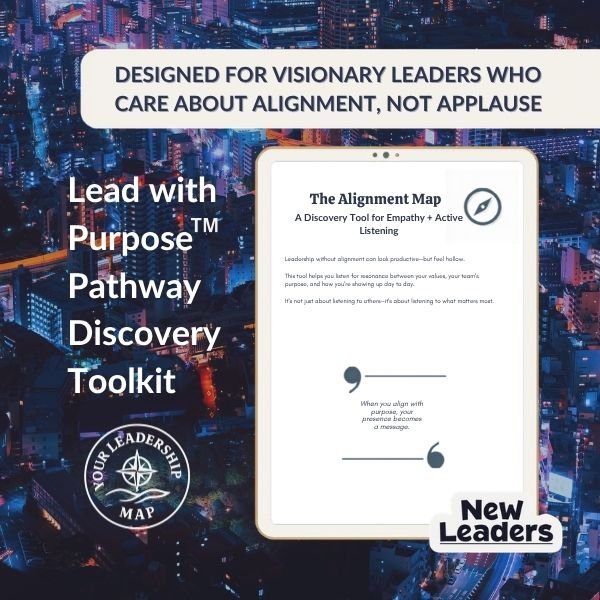
Lead with Purpose™ helps visionary managers clarify direction and align their teams around what matters most.
What you’ll get:
A guided discovery sequence to connect values with team goals
Fillable tools to map vision, priorities, and alignment practices
Reflection prompts for clarifying purpose and avoiding distraction
A one-page vision map to anchor focus and momentum
Format: Fillable PDF (instant download)
Ideal for: Visionary leaders, new managers, and anyone seeking to lead with clarity and purpose
1. The Tactical Link (The "What are we building?")
Start by ensuring everyone is crystal clear on the immediate, tangible contribution of the work. Don't assume they know. Ask.
The Feature Link
Question: What specific feature or output does this task create right now?
Example: This task creates the "Export to CSV" functionality that users are asking for.
The Success Hook
Question: How does this tactical delivery immediately help the customer/user?
Example: It removes the friction point of manual data entry for 25% of our monthly users.
The Feedback Loop
Question: How will we measure the immediate impact of this delivery?
Example: We will track the reduction in customer support tickets related to data export in the first 7 days.
2. The Strategic Link (The "Where are we going?")
Elevate the conversation to the 6-month or 1-year strategy to show the work's trajectory. This is where you connect the dots between the task and the bigger picture.
The Initiative
Question: Which major strategic initiative does this project serve?
Example: This serves the Q3 goal of "Enterprise Customer Stickiness."
The Competitive Angle
Question: How does this execution differentiate us from the competition?
Example: It ensures we are the only platform offering seamless data portability in our segment.
The Internal Benefit
Question: How does completing this work make our future work easier, cheaper, or faster?
Example: Completing this now frees up the engineering team for the full-stack architecture redesign in Q4.
3. The Mission Link (The "Why does this matter?")
This is the ultimate anchor. Connect the daily task to the organizational mission and the team's identity. This is where the work becomes more than just a job.
The Organizational Purpose
Question: Which line of our mission statement does this work directly fulfill?
Example: It fulfills our mission to "Empower teams with effortless data mobility."
The Team Identity
Question: What value are we demonstrating to the company by delivering this?
Example: We are demonstrating Trust—the ability to reliably bridge vision and execution.
The Legacy
Question: If this succeeds, what will be the lasting change for the company and our users?
Example: We will have cemented our role as the most trustworthy platform in the industry, enabling future growth.
What Changed After That Meeting
After we mapped the "Export to CSV" feature through all three tiers, something shifted. The team stopped treating it like a checkbox item and started treating it like something that mattered. They asked better questions. They pushed back on requirements that didn't serve the actual goal. They shipped it two weeks early.
And when it launched, and we saw customer support tickets drop by 40% in the first week, the team celebrated like they'd just won something. Because they had. They'd built something that mattered, and they knew exactly why it mattered.
That's what happens when you stop hoping your team "gets it" and start connecting the dots for them.
Common Questions About Connecting Work to Mission
"What if my team thinks mission statements are just corporate fluff?"
They're right to be skeptical—most mission statements are fluff. That's exactly why you need the 3-Tiered Alignment Check. Instead of repeating the mission statement, show them the actual chain: this task → this customer outcome → this strategic goal → this mission element. When they see the real connection (not the poster-on-the-wall version), cynicism turns into clarity.
"How do I connect work to mission when I don't fully believe in the mission myself?"
Start with what you do believe in: the strategic goal, the customer benefit, or the team's growth. You don't need to love every word of the corporate mission statement. Focus on the tier where you find authentic meaning—even if that's just "this makes our users' lives easier" or "this builds our team's capability." Authentic alignment at one tier is better than fake enthusiasm at all three.
"What if the connection feels obvious to me but my team still doesn't get it?"
What's obvious to you (the strategic thinker) is rarely obvious to people focused on execution. You've been living in the vision for months; they're seeing it for the first time. Walk through all three tiers explicitly, even if it feels redundant. The fact that you have to explain it doesn't mean they're slow—it means you're finally translating your thinking into language they can use.
"How often should I do this alignment check?"
At minimum: every new project launch, every quarter for ongoing work, and anytime you sense momentum dropping. For critical initiatives, do it weekly in standups. It takes 10 minutes and prevents weeks of misaligned execution.
"What if I map the alignment and realize the work actually doesn't connect to the mission?"
Perfect—you just saved everyone from wasting time on work that doesn't matter. Either kill the task, or escalate to leadership with your alignment analysis: "I can't connect this to our strategic goals. Should we proceed, or is there context I'm missing?" This is leadership—not just executing, but filtering for what actually serves the mission.
Leading with Intention
Leading with Purpose isn't about being abstract or distant. It's about building a chain of meaning that runs from the mission statement down to the smallest line of code or single task. When you clarify the nine coordinates above, you transform compliance into commitment.
You show up as the leader your team needs: the one holding the map and pointing to the horizon, while also showing them exactly where their feet are right now.
Have you ever felt like your team was executing perfectly but completely disconnected from the mission?
What did it take to reconnect them?

Ready to explore how you naturally lead?
Take the Leadership Pathway Explorer to discover your instinctive management style.
If you're on the Lead with Purpose™ pathway, learn more about the Leadership Cartography™ system and how all five pathways work together.
Want tools like this delivered monthly?
Join Map Drawer and get three practical management tools every month for $15.
Go Deeper Into the Purpose Pathway
This post gave you the 3-Tiered Alignment Check for connecting work to mission. But there's more to explore about leading with vision and strategic meaning.
Episode 10 covers:
Your strengths: horizon keeper, meaning maker, resilience well, clarity beacon
Your hazards: overlooking details, impatience with execution, pushing too hard, reframing without fixing
Additional tools for pacing vision and grounding strategy
How to remember that the horizon is reached by steady, grounded steps
Listen to Episode 10: Lead with Purpose™ (10 min) →