
The Pencil and the Permanent Record
When portable writing made every thought worth documenting
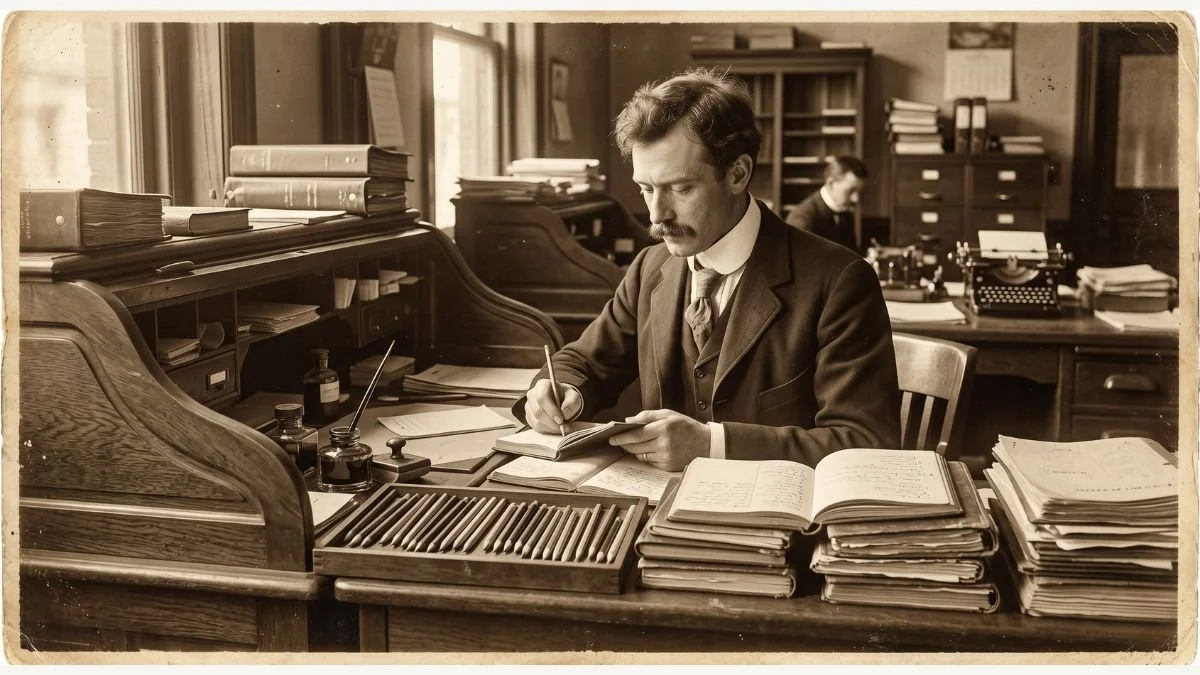
Some tools make work easier, then make forgetting unacceptable.
The history of the pencil is usually told as a story of convenience. In 1795, Nicolas-Jacques Conté developed a method for mixing graphite with clay, firing it, and enclosing it in wood after France lost access to high-quality English graphite during wartime trade disruption. (British Library, 2019; Petroski, The Pencil, 1992)
The result was small, portable, erasable, and cheap enough to spread. A pencil could go where ink could not. It could be carried into a shop, warehouse, field, classroom, or office. It could capture a number before the number disappeared from memory.
That changed the history of office documentation.
Before portable writing tools became common, documentation belonged to fixed places. Ink required a bottle, a pen, a stable surface, and time to dry. A ledger was a place. A desk was a place. Recordkeeping happened where the materials could be managed.
The pencil changed where written memory could begin.
What changed when writing became portable?
The pencil made temporary writing useful.
A clerk could jot down a number before entering it into a ledger. A supervisor could mark a count before sending a report. A warehouse worker could note inventory before a formal tally was made. A surveyor, bookkeeper, or shop manager could carry evidence back to the office instead of relying on memory.
The pencil did not create bureaucracy by itself. Offices already had ledgers, forms, correspondence, account books, and filing systems. The pencil gave those systems more access to the workday.
That is the part that matters.
More moments became recordable. A discrepancy could be marked before it disappeared. A decision could be written down before anyone forgot who said what. A number could be captured where it happened, then moved into the official record later.
Once writing became portable, a missing record began to look less like a limit of the system and more like a failure of the person.
If something mattered, someone should have written it down.
The cost: the clerk with a pencil
There is no need to invent a special pencil-era job to see the cost. The burden landed on clerks, bookkeepers, supervisors, surveyors, inventory counters, and anyone responsible for turning activity into records.
The clerk with a pencil worked inside a growing demand for accuracy.
A number written too quickly could become a payroll error. A smudged count could become a shipment problem. A misread note could become a dispute. The pencil was erasable, which helped. It also made revision part of the work.
First came the rough mark. Then the corrected mark. Then the formal record. Then the stored record.
The pencil made documentation easier at the moment of capture. The recordkeeping system became heavier because there was now another layer between the work and the official account of the work.
That layer still exists.
Why does this still shape modern leadership?
Today’s pencil is the meeting note, the Slack thread, the shared document, the task tracker, the recap email, and the screenshot saved because memory may be challenged later.
In Leadership Cartography, this belongs with the Lead with Precision™ pathway because the pattern centers measurement, proof, accuracy, and control through recorded evidence. The original system solved a real problem: memory fails, numbers shift, decisions get contested, and organizations need records. The modern cost shows up when documentation becomes the condition for trust.
Managers who lead through precision often use documentation to create clarity. Written decisions reduce confusion. Notes protect continuity. Records help teams see what was agreed to.
Then the record starts to weigh more than the work.
You can feel it in the extra email after the conversation. You can feel it in the meeting that produces a document, then another meeting to confirm the document, then a follow-up note to restate the confirmation. You can feel it when the team learns that spoken decisions are temporary until someone turns them into text.
The history of the pencil matters because portable writing changed the standard of proof at work. Once work could be captured almost anywhere, organizations learned to expect a written trace. Modern documentation tools extend that same logic. They make it easier to record decisions, assign accountability, and preserve context, but they also teach teams that work becomes legitimate only after it has been captured.
The pencil’s old promise still sits inside modern work: write it down and the organization will trust it.
That promise has a cost.
Leaders begin recording their leadership in order to prove it happened.
If the pencil made work easier to capture, and modern tools have made every exchange recordable, how much of your leadership is now spent proving that work happened?
Where does this land for you? If the system you have been managing inside is starting to feel more familiar than you would like, the Pathway Source Assessment can help you identify your legacy in what you are working with.

Related Reading
Source notes
The core pencil history is supported by the British Library’s account of Conté’s 1795 process and Henry Petroski’s broader pencil history. The Museum of Everyday Life also supports the point that Conté’s graphite-and-clay formula became the basis of modern pencil-making