
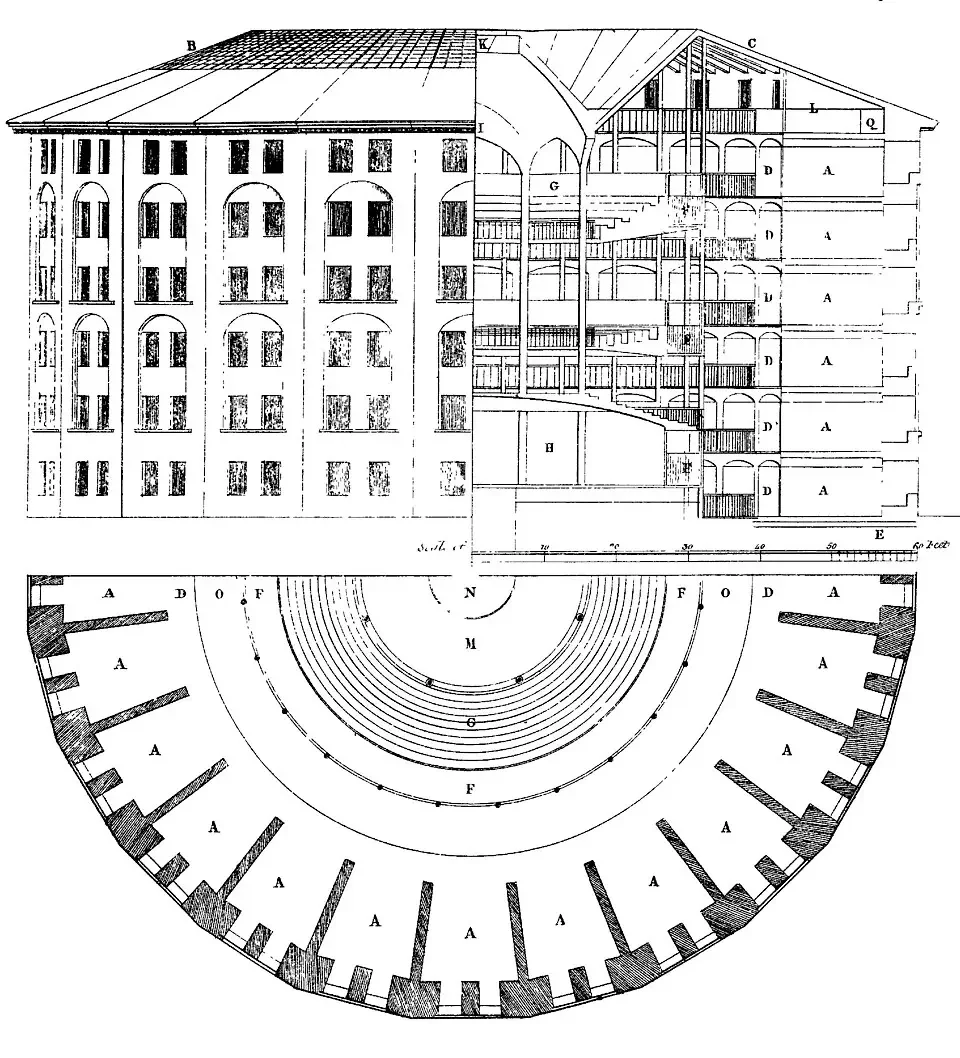
Jeremy Bentham, Public domain, via Wikimedia Commons
Management began as a place to stand where no one could watch you back.
In the 1780s, Samuel Bentham had a labor problem on a Russian estate. He was supervising a large workforce of unskilled men, and he could only be in one place. His answer was architecture. Build the workshop in a circle, put the inspector at the center, and every bench stays in view from a single point. His brother Jeremy wrote the idea up in 1791 as the Panopticon, the inspection house, and offered it to the world for prisons, schools, poorhouses, and factories. The design's real invention was unverifiable watching. A worker who cannot tell whether he is being seen behaves as if he always is. One position got the sightline. Everyone else got the feeling of being looked at.
The factory needed exactly this. A master craftsman had known his apprentices for years, their moods, their skill, their limits. A mill owner with 400 hands knew almost no one. Strangers at scale made acquaintance impossible, so the building did the knowing instead. Visibility replaced familiarity as the basis for judgment, and a new kind of job appeared: the person positioned to see.
English gave that job an honest name. Supervisor. From the Latin, the one who over-sees.
The Job: The Overlooker. The Cost: A Lancashire Weaving Shed
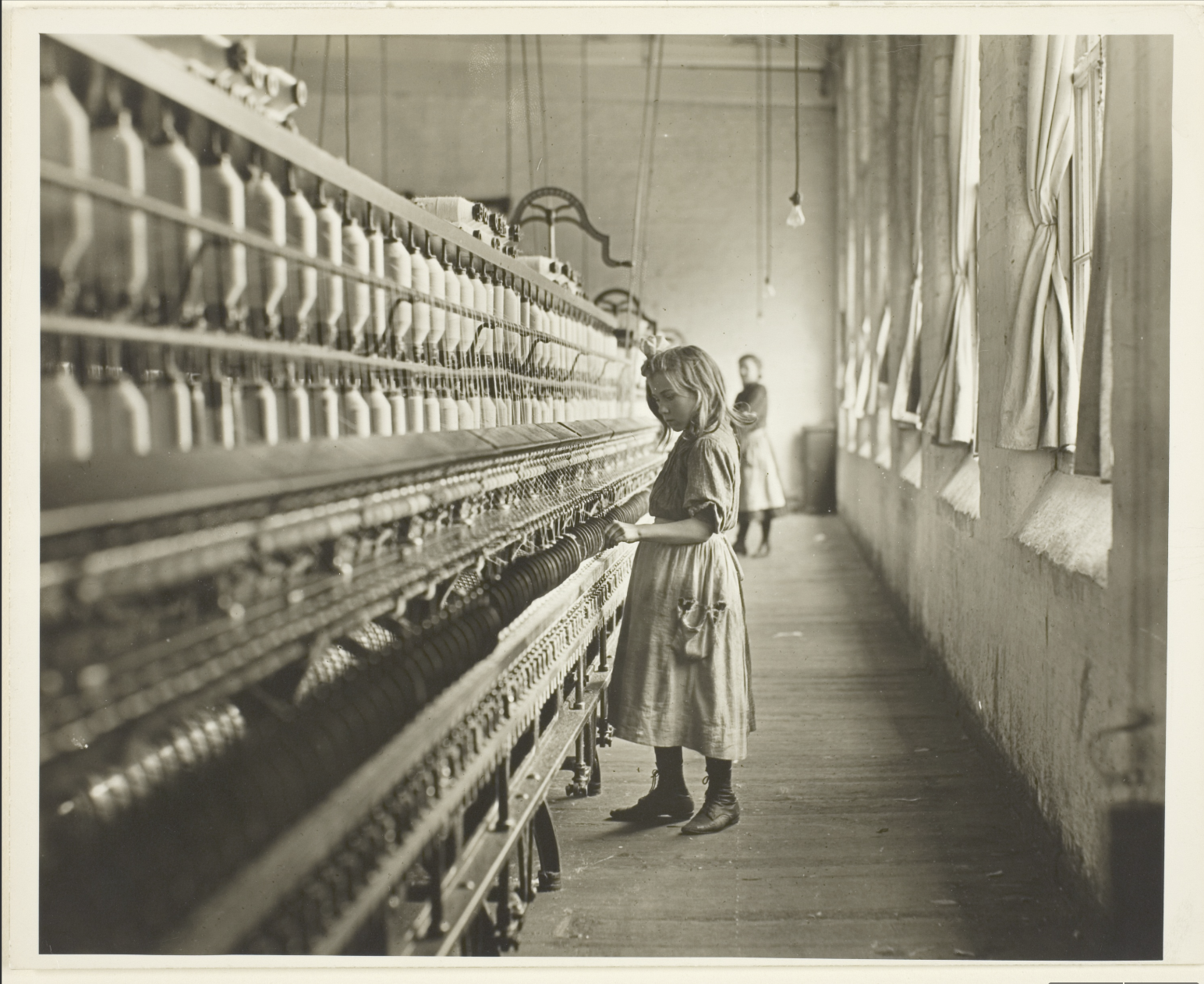
Lewis Hine's cotton mill interiors (Library of Congress, public domain)
Stand in the job for a shift. It is the 1890s, and you are an overlooker in a Lancashire cotton mill, the man the weavers call a tackler. Your alley holds rows of power looms and the women and children who run them, and your work is keeping every loom turning: setting warps, tackling repairs, enforcing the rule book. The rule book is specific. Fines for lateness. Fines for talking. Fines for opening a window against the heat. Your pencil marks the fine sheet, and your word decides whose broken loom gets fixed first, which decides who earns this week.
The people at the looms work the ten-hour days the Factory Acts finally forced after decades of twelve and fourteen. A weaver at century's end brings home roughly a pound a week. The overlooker watching her earns close to double that for standing where everything stays visible. And the arrangement runs all the way up. The shed manager judges the overlooker by his alley's cloth, from a further vantage point, with even less of the detail. Every layer sees less and decides more.
The mills closed. The sightline stayed open.
The platform became the foreman's window, then the glass-walled office, then the open floor plan, then the dashboard. Each generation kept the principle and modernized the furniture. A manager today watches output tiles refresh on a screen the way the inspector watched the ring of benches, and the software carries the same promise the architecture made: from here, you can see everything that matters.
Leadership Cartography reads this system plainly. It was built to solve strangers at scale, to let seeing do the work that knowing could no longer do. That was the original job, and it worked. What it does now is hand every promoted manager the watchtower's oldest illusion along with the keys: the belief that the view from the platform is the whole view. Everything the position cannot see, the context behind the slow loom, the reason for the silence, the work that happens between the tiles, gets recorded as fact about the person below. You have likely stood on both sides of this. Watched and misread from above. Then promoted, handed the sightline, and expected to judge strangers at scale by what it shows. The gap between where you stand and what you can actually see is the terrain the Leadership Identity Map charts.
If the floor was designed so one position could see everyone, and promotion still means being handed that position, are we developing leaders or staffing the watchtower?
Where does this land for you?
If the system you have been managing inside is starting to feel more familiar than you would like, the Leadership Map Source Assessment can help you name what you are working with. Identify Your Legacy.

Related Reading
Why Two Managers Read the Same Team Differently. What the vantage point shows one manager and hides from another, on the same team.
The Review Was Built to Decide Who Was Expendable. What the person in the watchtower writes down, and where the form came from.
Sources
Bentham, J. (1791). Panopticon; or, The Inspection-House. T. Payne.
Semple, J. (1993). Bentham's Prison: A Study of the Panopticon Penitentiary. Oxford University Press. (Samuel Bentham's workshop origin)
Thompson, E. P. (1963). The Making of the English Working Class. Victor Gollancz. (mill discipline and fines)
Wood, G. H. (1910). The History of Wages in the Cotton Trade During the Past Hundred Years. Sherratt & Hughes. (weaver and overlooker earnings)
UK Factory Acts of 1833, 1847, and 1850. (working hours)