
When the Decision Is Heavy Enough That Instinct Is Not Enough
The Friction Moment
I created this tool because I kept making decisions without enough time to think them all the way through. Not small calls — the ones that affected real people, real projects, real resources. I would commit to a direction before I had fully mapped what the consequences might be, and I would do it alone, without stopping to consider who else had a stake in the outcome. Sometimes the call was right. Sometimes it created problems I did not see coming. And when someone asked me to explain my reasoning, I did not always have a clear answer, because the reasoning had never been made visible, not even to me. The decision-making framework for managers exists because thinking through a decision and making a decision are not the same thing, and the difference between them is often the difference between a call you can stand behind and one you are still defending six months later.
What This Pattern Signals
Most managers are not taught to treat decision-making as its own kind of work. They are taught to be decisive, to move quickly, to trust their instincts and keep things moving. And those instincts are often good. The problem is that a meaningful decision, one that involves resources, people, competing priorities, and real trade-offs, requires more than instinct. It requires a way of seeing the full terrain before you step onto it.
When a manager skips that process, a few things tend to happen.
They make the call without understanding the consequences, so they are caught off guard when the downstream effects arrive.
They make the call without consulting the right people, so the decision lands as a surprise on stakeholders who needed to be part of it.
They make the call without documenting their reasoning, so when someone asks why they chose one priority over another, they cannot explain it in a way that holds.
The decision was made, but the thinking behind it was never made visible.
This is a Leadership Identity question as much as it is an operational one. Understanding how to carry a decision and what it means to think it through fully, to take responsibility for the consequences, and to communicate the reasoning clearly.
This is part of what it means to grow into a role.
The Structural Shift
What changes things is having a structure that slows you down before you commit. Not a process that delays action, but one that ensures that when you do act, you have actually seen what you are deciding. That means naming the decision clearly, including who it affects and when it needs to land. It means mapping the options that are genuinely available. It means thinking through the trade-offs honestly, including the ones that are uncomfortable. It means identifying the people who need to weigh in before the call is made and the people who need to understand it once it is. And it means being able to say, plainly, what you decided and why. Not just to your team, but to yourself.
When you can do that, the decision is not just made. It is defensible. It is communicable. And it belongs to you in a way that a rushed call never quite does.
The Tool
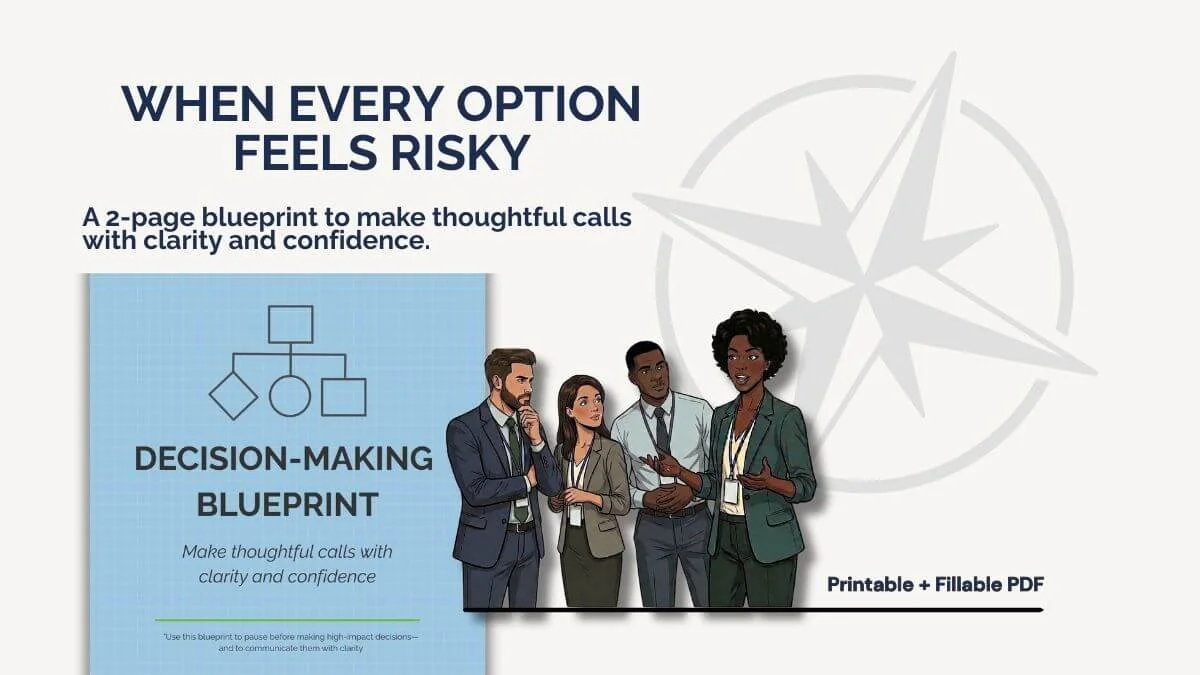
The Decision-Making Blueprint is a one-page structured worksheet for managers facing high-impact calls. It walks through six prompts in sequence: name the decision and its deadline; list the available options; map the trade-offs and short- and long-term consequences; identify who needs to weigh in or be informed; state the decision and the reasoning behind it; close with a communication plan. It works as a pause before the call goes public, a place to do the thinking before you announce the direction, or as a record that travels with the decision so the people affected understand not just what was decided but why.
The tool is especially useful for resource decisions, for calls that need to align with a broader strategic direction, and for any situation where you may be asked to explain your reasoning to your team. It turns the invisible work of thinking a decision through into something you can actually see, and when you can see it, you can defend it.
Names the decision, its deadline, and who it impacts before momentum moves in one direction
Maps available options and surfaces trade-offs across short- and long-term consequences
Identifies who needs to be consulted or informed before the call is finalized
Captures the reasoning behind the decision so it travels with the answer, not separately
Closes with a communication plan so the right people hear the call the right way
Related Reading
The System The Decision-Making Blueprint in the tools database, what it includes and how to use it.
Decision Making for Collaborative Leaders A closer look at what changes when you bring the right people into a decision before you make it.
When I Was Under Pressure to Make a Significant Decision A personal account of what it actually feels like to carry a high-stakes call without a map.