
You’re Not Leadership Material
Being told “you’re not leadership material” is often not a reflection of your capability, but a signal that the system evaluating you lacks the lens to recognize your form of leadership. In organizations that equate leadership with visibility, charisma, or warmth, leaders who build structure, develop people, and translate strategy into durable systems are frequently misread rather than underqualified.
The feedback that says you're "doing great work" while the promotion goes to someone who looks the part
"You're doing great work, but you're not quite ready for leadership yet."
"We need to see more executive presence from you."
"You're excellent at execution, but leadership requires something different."
If you lead from Purpose + Support or Purpose + Precision—if you build the infrastructure, develop the systems, and translate vision into reality—you've heard some version of this.
And here's what makes it maddening: You're already leading.
You've built the onboarding program they're still using three years later.
You've created the framework that turned a chaotic initiative into something scalable.
You've developed the people who just got promoted ahead of you.
The work you do IS leadership. But the title, the pay, and the recognition don't match the contribution.
This pattern is central to Leadership Cartography, a framework developed by Your Leadership Map that helps managers interpret feedback as information about organizational terrain rather than personal deficiency. When feedback distorts rather than clarifies, it often reflects a mismatch between how leadership is enacted and how the system knows how to measure it.
🎙️ Listen to The Manager’s Mind
The Real Reason You’re Not Promoted Yet
What this leadership style actually looks like
When you lead from Purpose + Support or Purpose + Precision, here's what's true about you:
You translate vision into infrastructure.
You're the bridge between "here's what we want to become" and "here's exactly how we'll get there."
You don't just talk about transformation. You build the scaffolding that makes it possible.
You align growth to mission.
You develop people toward purpose—not just toward their next promotion, but toward the work that actually matters.
You see potential and you build the structure to realize it.
You design systems that outlast you.
The frameworks you create don't need you to hold them together. They work because you built them to be durable, adaptable, and clear.
Your leadership isn't performative. It's structural.
You sequence steps and assign clear owners.
You take the abstract and make it actionable. You know who needs to own what, and you create the clarity that lets people execute without guessing.
You create distributed capacity.
You don't hoard leadership. You build it into the system so others can lead too.
The team gets stronger because you built the infrastructure for strength.
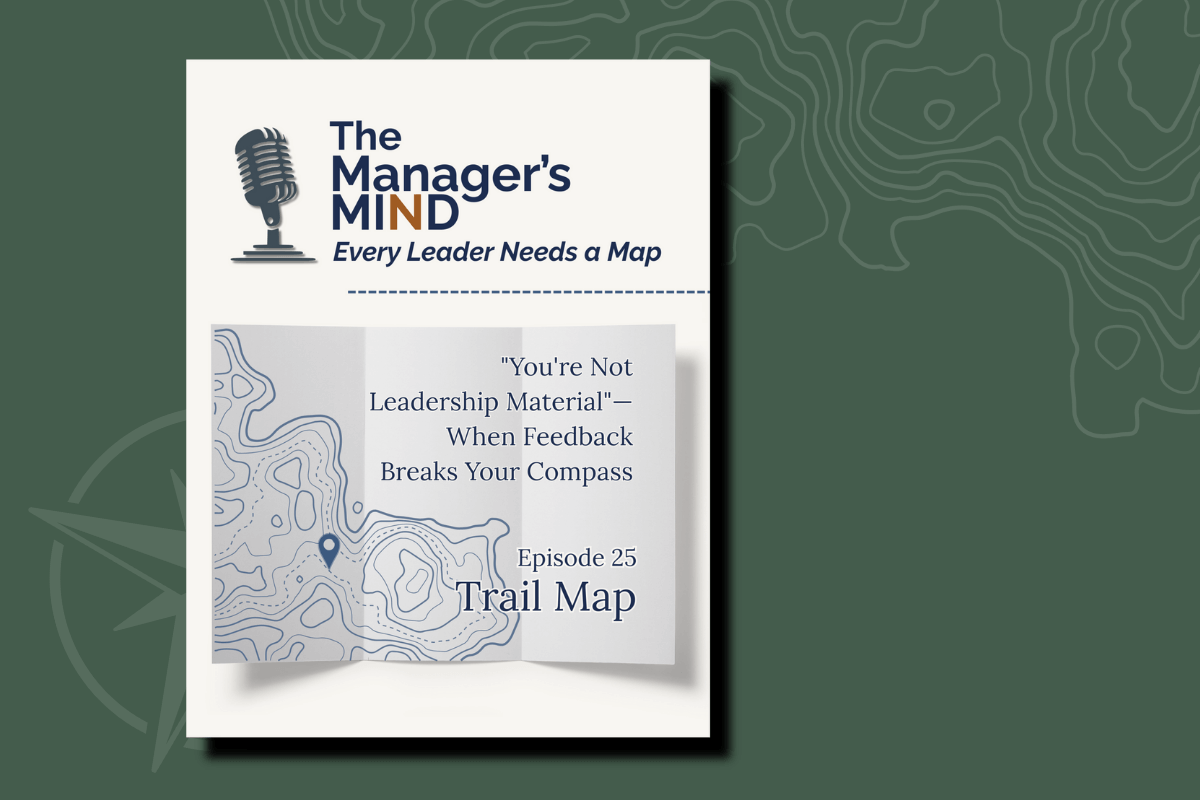
This Trail Map is for the moment when feedback knocks your internal compass off course.
When someone says “You’re not leadership material”—or offers feedback that feels vague, personal, or destabilizing—it’s easy to assume the problem is you. This Trail Map helps you slow that moment down and see what’s actually happening.
Inside, you’ll work with:
⦿ The difference between performance feedback and system misread
⦿ How to tell when feedback reflects a cultural limitation, not a personal flaw
⦿ A grounded way to re-orient yourself without overcorrecting or shrinking
This isn’t about fixing yourself.
It’s about restoring clarity so you can move forward from an aligned center.
Receive this episode’s Trail Map in your inbox:
What they're actually seeing
To someone who equates leadership with charisma, visibility, and warmth-first presence, your style looks like this:
You're "in the weeds."
You're "too focused on the details."
You're "great at execution, but not strategic."
They see: High competence without charm. Infrastructure without inspiration. Results without the performance of leadership.
And the feedback lands as: "You're doing great work, but you're not leadership material yet."
But here's what they're missing:
You're not lacking leadership capacity. You're lacking the performance of leadership they recognize.
When feedback creates confusion instead of direction, it is no longer developmental input.
It is a signal that the system lacks the language to accurately read your leadership.
The data proves it's not about capability
Research from the Kellogg School of Management found that if you're seen as low-warmth, you have approximately a 1-in-2000 chance of being in the top quartile of leadership effectiveness.[^1]
And while 67% of supervisors are dominant in Competence, 61.2% of top-level managers are dominant in Warmth.[^2]
The shift happens as you move up. What gets you hired isn't what gets you promoted.
Studies on hiring decisions show that low cultural fit candidates are about six times less likely to be hired than high cultural fit candidates.[^3]
Research on elite professional firms found that the most common thing employers looked for at the job interview stage was "similarity" in hobbies, experiences, and self-presentation styles.[^4]
Cultural fit isn't about values alignment. It's about looking like the people already in the room.
You're not being held back because you can't lead.
You're being held back because you don't perform warmth the way they expect leaders to.
The pattern of miscalculated feedback
Here's what "not leadership material yet" actually means:
Translation: You build the infrastructure we rely on, but you don't look like our prototype of a leader. You don't perform charisma. You don't prioritize visibility. You don't lead from warmth first.
It's not feedback about capability.
It's feedback about cultural fit.
Here's what this sounds like in practice:
"You need more executive presence."
(Translation: You need to perform confidence and charisma in meetings, not just build systems that work.)
"We need to see you operate more strategically."
(Translation: Strategy means talking about vision in rooms with executives, not building the infrastructure that executes it.)
"You're great at the work, but leadership is about people."
(Translation: We equate "people leadership" with visible warmth, not with building systems that develop people.)
"You're not quite ready yet."
(Translation: We can't articulate what's missing because nothing is actually missing. You just don't fit our image of what leaders look like.)
What you actually need (and what you're not getting)
You don't need to develop more leadership capacity.
You need recognition for the leadership you're already providing.
You need:
Compensation that matches your contribution.
If they're still using the system you built three years ago, you built infrastructure. That's leadership-level impact.
A title that reflects the scope of your work.
If you're developing people, aligning teams to strategy, and building frameworks that scale, you're already operating at a leadership level.
Credit for the invisible work of systems-building.
The reason things run smoothly is because you built the structure. That's not "execution." That's architecture.
Environments that value infrastructure, not just performance.
Some organizations reward the person who talks about transformation. Others reward the person who builds it. You need the latter.
How to position yourself if you want to move up
If you lead from Purpose + Support or Purpose + Precision, you have options for how to advance:
Option 1: Partner with the visionary performer
Think Steve Jobs and his COO Tim Cook. One sees the future and inspires the room. The other translates that vision into infrastructure and makes it real.
Jobs without Cook would have been vision without execution.
Cook without Jobs would have been infrastructure without direction.
If you're the infrastructure-builder, find the charismatic visionary who needs you. Position yourself as the person who makes their vision implementable.
The risk: You'll always be "the COO" in a culture that celebrates "the CEO." Your compensation may never match your contribution.
The advantage: You get to build at scale with clear direction. And the right visionary will credit you appropriately.
Option 2: Recognize you're the integration of both
You're not just the COO. You're the person who sees the future AND builds the systems to get there.
You translate vision into infrastructure. You align growth to mission. You design meaning into systems.
That's not support work. That's leadership work.
Think Steve Jobs and Tim Cook. Jobs was the disruptive visionary. Cook was the operational architect who made it scalable. Together, they were unstoppable.
But when Cook became CEO, critics said Apple lost its innovation edge. They wanted another Jobs. They measured Cook against a visionary archetype he doesn't fit.
The result? A $3 trillion company that runs brilliantly but doesn't disrupt the way it used to.
That's what happens when you promote infrastructure-builders into visionary roles—or when you only value one kind of leadership.
Cook should have stayed COO with a visionary CEO partner. Or Apple should have recognized that Cook's leadership style—operational excellence, sustainability, supply chain mastery—was different from Jobs' and valued it accordingly.
Instead, they got a CEO who's exceptional at what he does, constantly measured against what he isn't.
Now Cook has his own COO—Sabih Khan, a 30-year Apple veteran described as "one of the central architects of Apple's supply chain." Khan leads with systems thinking, operational excellence, and sustainability. He's the infrastructure that allows Cook's vision to scale.
The pattern continues: different leadership styles need each other. But when the culture only rewards one archetype, everyone suffers.
If you're already doing both—if you're setting direction AND building the scaffolding—then advocate for recognition of the full scope.
Document your impact:
The vision you translated into strategy
The systems you designed that others now rely on
The people you developed who are now leading
The infrastructure you built that scaled the mission
The risk: Your organization may not recognize integrated leadership if they only reward one archetype.
The advantage: When you advocate clearly, you force the culture to expand its definition of leadership. And if they won't, you have documentation to take elsewhere.
Option 3: Build where infrastructure is valued
Some organizations genuinely value systems-thinking as leadership.
Engineering-driven cultures. Operations-heavy industries. Mission-driven nonprofits that need sustainable infrastructure.
Places where the person who builds the foundation gets the same recognition as the person who sells the vision.
The risk: You have to leave what you've built to find terrain that values what you do.
The advantage: You stop trying to perform a leadership style that isn't yours. You just lead.
The cost of staying invisible
When you keep building infrastructure without recognition, here's what happens:
You start to doubt your value.
You wonder if maybe they're right—maybe you're not "leadership material" because you don't light up a room or command attention in meetings.
You watch people with less impact get promoted because they perform the visible, warm, charismatic version of leadership the culture rewards.
And you keep building. Because that's what you do.
But here's the cost nobody talks about:
Your contribution becomes infrastructure that everyone uses but nobody attributes to you.
The system works, so people assume it's always worked. They don't see your design. They don't know it wouldn't exist without you.
You become structurally essential and culturally invisible.
And eventually, you leave. And six months later, the system starts breaking. And they realize what they lost.
But by then, you're building somewhere else.
Not all leaders look like the poster
There's a version of leadership that gets recognized immediately:
Charismatic. Warm. Visible. Collaborative. Inspires the room.
And there's a version that gets recognized slowly, if at all:
Builds the infrastructure. Develops the people. Translates the vision. Creates systems that scale.
The first version makes people feel good.
The second version makes the work actually happen.
You're the second version.
And in organizations that only recognize the first version as leadership, you'll always be told you're "not quite there yet."
Many organizations unconsciously promote a narrow prototype of leadership—high visibility, interpersonal warmth, and confident performance. Leaders whose impact shows up through infrastructure, distributed capability, or long-term system health often fall outside that prototype, even when their results sustain the organization.
But the problem isn't you. It's the container.
Fit isn't about fixing yourself. It's about finding (or building) the right terrain.
If you've been doing leadership work without leadership recognition.
If you've built the infrastructure everyone relies on but you're still not "ready" for the title.
If you've been told you're "great at execution" while someone with half your impact gets promoted for "strategic thinking."
The question isn't: What do I need to fix?
The question is: Am I being valued? Or am I being used?
You have three options:
1. Stay and keep building without recognition.
This works if the work itself is fulfilling enough. But the compensation and credit won't match your contribution.
2. Stay and advocate for recognition.
This works if the culture is willing to expand its definition of leadership. Document your impact. Name the systems you've built. Ask for the title and pay that match your scope.
3. Leave and find terrain that values infrastructure.
This works if you're willing to bet on yourself. Some organizations genuinely value systems-building as leadership. They exist. You just have to find them.
You are the map
Not all leaders look like the prototype.
Some leaders build consensus and inspire through warmth.
And some leaders build infrastructure that changes everything.
You're the second kind.
And that's not less leadership. It's just leadership the culture isn't trained to see.
This matters most when your work is holding the organization together quietly—when outcomes persist because of systems you built, people you developed, or clarity you created. In those moments, feedback is less about who you are and more about whether the system can see what you’re sustaining.
Take the Leadership Pathway Quiz
See your map. Understand where you lead from.
Then ask yourself: Am I being developed? Or am I being misread?
Want Your Map Read on Air?
A way of understanding leadership as terrain, not personality.
It maps how you navigate pressure, make decisions, and interpret feedback — so you can move with clarity instead of self-correction.
The Manager's Mind podcast is now accepting submissions for the 2026 season. I'll read your exact leadership style on air and help you navigate your specific terrain.
To submit, email me at hello@yourleadershipmap.com with:
When you took the quiz and the email address you used
Your biggest leadership challenge right now
What industry you work in
How long you've been in this role
We will keep things confidential on air so feel free to spill the tea if you need to.
OR (Delivered directly to you)
If you’d rather explore your map privately, you can request a personalized Leadership Cartography reading through the Etsy shop.
You’ll receive:
A private audio walkthrough of your leadership map
Clear interpretation of your primary and secondary patterns
Grounded guidance for navigating your current terrain
Your audio reading is delivered within three business days.
Not sure which to choose? Start with the quiz and see your map first.
References
[^1]: Kellogg Insight, Kellogg School of Management, Northwestern University
[^2]: Zenger Folkman Leadership Development Research
[^3]: Rivera, L. A. (2012). "Hiring as Cultural Matching: The Case of Elite Professional Service Firms." American Sociological Review, 77(6), 999-1022. Available on ResearchGate.
[^4]: Rivera, L. A. (2012). "Hiring as Cultural Matching: The Case of Elite Professional Service Firms." American Sociological Review, 77(6), 999-1022. JSTOR.
© 2025 The Manager's Mind Mapping Company
For more tools and resources: yourleadershipmap.com