
You Don't Embody the Mission
What do you do when the feedback says you're not enough—but your results say otherwise?
This feedback often signals systemic mismatch. Embodiment comes from aligned values, role clarity, and believable expectations.
I was sitting in my coach's office when she said it.
"His feedback to me was that you don't embody the mission."
Not even her feedback. Someone else's. Filtered through her. Third-hand.
I asked what that meant. What I should do differently.
She didn't know. Or couldn't say. It stayed vague.
"Just... work on being more present with people. Show that you care."
I'd heard versions of this before
"You need to bring people along more."
"Work on your people skills."
"You're tough but fair." (Which sounds like a compliment until you realize it's a warning.)
I could never figure out what I was doing wrong. Because nothing was actually wrong with my work.
I advanced. I delivered. My systems worked. My projects landed.
But I never felt like I belonged.
🎙️ Listen to The Manager’s Mind wherever you get your podcasts — a grounded space to rethink how leadership actually works.
The cost of vague feedback
I spent years trying to fix whatever was broken.
I worked harder. Stayed later. Delivered more.
I tried to show up warmer, softer, more visibly caring. I tried to perform the kind of leadership they said I was missing.
But the feedback kept coming. Always vague. Never specific enough to actually fix.
And the internal conflict was exhausting.
Every time I tried to be warmer, I felt like I was performing. Every time I tried to "bring people along more," I felt like I was betraying the clarity I was hired to bring.
I started to believe something was fundamentally wrong with me.
Not my work. Me.
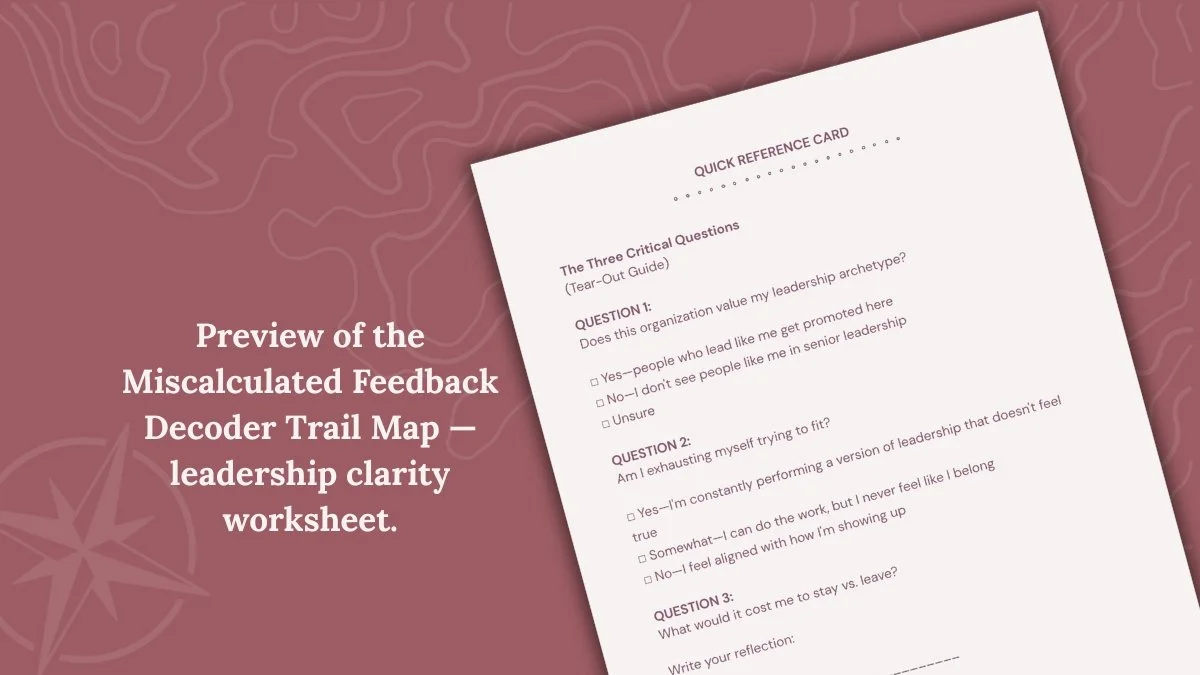
Feeling misread at work?
Download the Miscalculated Feedback Decoder — a free Trail Map that helps you name whether your feedback is developmental or cultural, and what to do next.
The moment it finally broke
I sat with that feedback for a minute.
You don't embody the mission.
I built the supply chain that company sits on today. I architected the foundational systems for operations. I was the COO.
Twenty-three years of combined service.
And I didn't embody the mission.
The question that came up wasn't What do I need to fix?
It was: If that's true, why am I still here?
That's when I finally saw it
The container was the problem. Not me.
I wasn't failing at embodying the mission. I was trying to fit into a culture that would never fully see what I did as leadership.
They needed my systems. They used my infrastructure. They advanced me because my talent was undeniable.
But they would never recognize me as their kind of leader.
And in that moment, I could breathe again.
Because the answer wasn't to work harder. Or try again. Or perform warmth in a way that felt false.
The answer was to stop.
I wasn't going to spend the final act of my career making that company good to great.
They would have to figure it out without me.
What I see now
Looking back, I can see the pattern clearly.
At one organization, I thrived. Same skills. Same leadership style. Same way of working.
But that environment valued systems thinkers. They promoted people who could see the future and build infrastructure to get there.
I wasn't trying to fit. I was just doing the work. And it was enough.
At another organization, I advanced—but only because my talent was too big to ignore. Culturally, I never fit. And the feedback never stopped reminding me.
The difference wasn't my skill. It was the terrain.
But I didn't have language for that yet. I just knew I felt successful in one place and like an imposter in another.
Yesterday, I finally saw my map
I was looking at my Leadership Cartography scores—data from the quiz I built to help other leaders understand where they lead from.
And I saw my entire career laid out in five numbers:
Heart: 4 (Low)
Together: 2 (Low)
Purpose: 21 (High)
Support: 20 (High)
Precision: 20 (High)
I'm a Purposeful Architect. I translate vision into systems. I build scaffolding so others can step into clarity.
That's not theory. That's what I actually did.
I built supply chains. I architected operational systems. I created infrastructure that outlasted my tenure.
But here's what those scores also reveal:
I don't lead from Heart first. I don't prioritize emotional warmth or relational connection as my entry point.
I don't lead from Together first. I don't build consensus or seek collaborative input before I move.
What those scores actually mean
I don't lead from Heart first
I don't prioritize emotional warmth or relational connection as my entry point.
That doesn't mean I don't care about people.
It doesn't mean I lack empathy.
It doesn't mean I can't build relationships.
And it doesn't mean I'm not present to my impact.
I see how my decisions land. I notice when someone's struggling. I adjust when my directness is creating friction instead of clarity.
I'm deeply aware of how I affect people.
I just don't lead from that awareness. I lead from vision, from structure, from building systems that protect people from chaos.
My first move isn't to check the emotional temperature of the room. My first move is to see the system, identify the gap, and build the structure that will solve it.
I care through clarity. I care through systems that work. I care by removing the chaos so people can do their jobs without guessing.
That's not less caring. It's just a different pathway to care.
I don't lead from Together first
I don't build consensus or seek collaborative input before I move.
That doesn't mean I don't value other people's input.
It doesn't mean I work in isolation.
It doesn't mean I'm a lone wolf.
And it doesn't mean I steamroll people.
I see where people are. I notice when someone needs to be brought along. I adjust when moving too fast is leaving people behind.
I'm aware of the team.
I just don't lead from consensus-building. I lead from seeing the future clearly and creating the first draft of the path to get there.
When I see the future clearly, I don't need a committee to validate it before I start building. I move. I create the scaffolding. Then I bring people in to refine it, own it, and scale it.
I collaborate after I've created the first draft of clarity. Not before.
That's not steamrolling. It's just a different sequencing of collaboration.
Low scores aren't deficits
They're just not where you lead FROM.
You can still:
Be warm (Heart 4)
Build relationships (Together 2)
Show empathy
Ask for input
Create connection
Be present to your impact
Adjust when needed
You just don't lead with it as your opening move.
Your opening move is Purpose. Vision. Structure. Support. Precision.
And that's not wrong. It's just different.
The problem isn't the low score
The problem is when the organization only recognizes ONE pathway as leadership.
When they say "leadership = warmth first, consensus always."
And anyone who doesn't fit that formula gets feedback that says "you're not quite there yet."
Even when you're building the entire supply chain.
The data proves it
Research from the Kellogg School of Management found that if you're seen as low-warmth, you have approximately a 1-in-2000 chance of being in the top quartile of leadership effectiveness.1
And while 67% of supervisors are dominant in Competence, 61.2% of top-level managers are dominant in Warmth.2 The shift happens as you move up. What gets you hired isn't what gets you promoted.
Studies on hiring decisions show that low cultural fit candidates are about six times less likely to be hired than high cultural fit candidates.3
And research on elite professional firms found that the most common thing employers looked for at the job interview stage was "similarity" in hobbies, experiences, and self-presentation styles.4
Cultural fit isn't about values alignment. It's about looking like the people already in the room.
I was statistically blocked. Not because I couldn't do the job. But because I didn't perform warmth the way they expected leaders to.
The pattern of miscalculated feedback
When you lead from an archetype that doesn't match the cultural norm, the feedback you receive will always feel off.
It won't be specific. It won't give you clear actions to take. It will feel vague, circular, and impossible to fix.
Here's what miscalculated feedback sounds like:
"You need to work on your people skills."
(Translation: You don't lead from Heart first. You lead from systems. We don't recognize that as caring.)
"You're tough but fair."
(Translation: You're competent, but you don't perform warmth the way we expect. This is a warning, not a compliment.)
"You need to bring people along more."
(Translation: You move from vision to execution too quickly. You don't build consensus. That makes us uncomfortable.)
"You don't embody the mission."
(Translation: You don't perform devotion in the way we recognize. Your version of care—building systems—doesn't look like leadership to us.)
None of that feedback is about a skill gap.
It's about archetype mismatch.
And if you spend your career trying to fix it, you'll exhaust yourself trying to become someone you're not.
How to tell the difference: Developmental vs. Gatekeeping
Not all feedback is miscalculated. Some feedback is genuinely developmental. It names a real gap and gives you a clear path to close it.
Here's how to tell the difference:
Developmental feedback:
Is specific ("In yesterday's meeting, you interrupted Sarah twice. Let her finish before you respond.")
Names a behavior you can change
Connects to a clear outcome ("When you interrupt, people stop contributing. We need their input to make good decisions.")
Feels hard but fair—you can see the gap and imagine closing it
Gatekeeping feedback:
Is vague ("You need to work on your presence.")
Can't be tied to a specific action or moment
Feels like a moving target—you fix one thing, and the feedback shifts to something else
Leaves you feeling like you'll never be enough, no matter what you do
If you've been getting the same vague feedback for years—and you keep trying to fix it, but it never lands—you're not failing.
You're being measured against an archetype you don't fit.
The cost of staying in the wrong terrain
Here's what happens when you stay in an environment that doesn't value your archetype:
You start to believe you're broken.
You work harder to compensate. You stay later. You deliver more. You try to prove your worth through output because you can't prove it through cultural fit.
And it's exhausting.
Because no matter how much you deliver, the feedback doesn't change.
You're still "not quite there yet." You're still "great at the work, but..." You're still missing something you can't name.
And eventually, you start to lose yourself.
You stop trusting your instincts. You second-guess your decisions. You perform a version of leadership that doesn't feel true because you think that's what it takes to belong.
But here's the part no one tells you:
The cost isn't just to you. It's to the work.
When you're spending all your energy trying to fit, you're not spending it doing what you're actually great at.
You're not building systems. You're not translating vision. You're not creating the infrastructure that makes the mission real.
You're performing. And performance isn't leadership.
The question worth asking
If you've been getting vague feedback for years.
If you've advanced but never quite felt like you belonged.
If you've been told you're "great at the work, but..."
The question isn't: What do I need to fix?
The question is: Am I being misread?
And if the answer is yes, the next question is: What do I do about it?
You have three options:
1. Stay and keep trying to fit
This works if you genuinely believe the feedback is developmental and you can close the gap. But if you've been trying for years and nothing changes, this option will break you.
2. Stay and stop trying to fit
This works if the environment values your output enough to tolerate your archetype mismatch. You won't get promoted into the highest levels of leadership. But you can do good work and stop exhausting yourself trying to belong.
3. Leave and find terrain that values what you do
This works if you're willing to bet on yourself. If you're willing to say: I'm not broken. The container is. And I'm not going to spend the rest of my career trying to prove I belong somewhere that will never fully see me.
I chose option three.
And it was the hardest and best decision I ever made.
The work you're here to do
There's a version of you that fits the mold.
That performs warmth even when it feels false. That builds consensus even when clarity would serve better. That slows down to bring people along even when moving fast is what the work actually needs.
And there's a version of you that doesn't.
That leads from your actual strengths. That builds systems that last. That translates vision into infrastructure. That creates clarity so people don't have to guess.
The first version will make some organizations comfortable.
The second version will change the world.
Your Next Step

Footnotes
Kellogg Insight, Kellogg School of Management, Northwestern University ↩
Zenger Folkman Leadership Development Research ↩
Rivera, L. A. (2012). "Hiring as Cultural Matching: The Case of Elite Professional Service Firms." American Sociological Review, 77(6), 999-1022. Available on ResearchGate. ↩
Rivera, L. A. (2012). "Hiring as Cultural Matching: The Case of Elite Professional Service Firms." American Sociological Review, 77(6), 999-1022. JSTOR. ↩