
Why Feedback Stays Vague
How Do You Spot the Real Signal Under Feedback You Cannot Act On?

Vague feedback gives you an impression without enough specificity to act on it. It may name a trait, tone, or reaction without identifying the behavior, impact, standard, or change expected.
I received feedback that I was tough but fair.
I understood the fair part. I cared about being fair. I cared about consistency, policy, procedure, and whether people knew where the line was. I didn’t want standards to move depending on who was asking, who was struggling, or who had the strongest personality in the room.
The tough part really stayed with me.
I didn’t experience myself as tough. I experienced myself as holding the line. I held boundaries. I held people capable. I expected the work assigned to be completed.
Later, I could see something more precise inside the feedback. Some of what people experienced as tough may have come from standards I had not communicated clearly enough. When expectations live clearly in the manager’s head but vaguely in the team’s environment, people are set up to miss a mark they cannot fully see.
That does not make accountability wrong. It means vague feedback often points to a translation problem before it points to a character problem.
Vague feedback is often a sign that several things have been mixed together. A person may be reacting to the manager’s behavior, the impact of that behavior, the standard being held, or the discomfort that standard created. Many managers hear vague feedback and assume it means something is wrong with who they are. Sometimes the more accurate signal is that the workplace doesn’t have clear enough language for what it is reacting to.
This article looks at why feedback stays vague, why unclear feedback is so hard to use, and how managers can read the signal underneath criticism that doesn’t tell them what to change.
Why Does Some Feedback Sound Useful But Still Leave You Confused?
Vague feedback creates strain because it sounds meaningful without being usable.
Tough but fair sounded like feedback. It had emotional weight. It carried a judgment. It suggested that something about my leadership was being experienced strongly by other people.
What it did not do was tell me what needed to change.
Was I being too direct?
Was I holding standards without enough context?
Was I enforcing policy in a way that felt impersonal?
Was I failing to explain the reason behind a decision?
Was someone uncomfortable with accountability itself?
Those are different signals. They require different responses.
When feedback collapses all of that into one phrase, you are left with a foggy mirror. Something is visible, but the shape is completely distorted.
When a manager hears only vague feedback, it stops being a simple comment about style. It becomes a sign that the feedback is mixing two things together: what the manager did, and how people felt about it.
That distinction matters. A manager can receive useful information inside vague feedback. The problem is that the useful information is buried. The manager has to sort through what was said, what was meant, what was felt, what was missed, and what the system failed to make clear. It’s exhausting.
Why is feedback sometimes so vague?
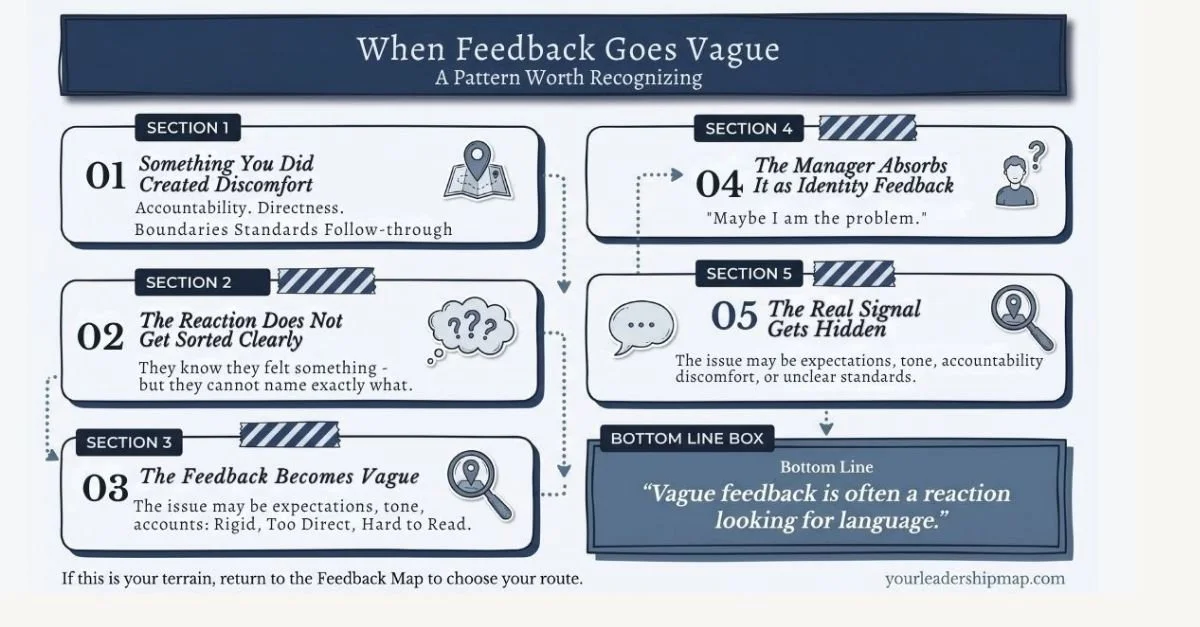
Sometimes people use vague language because something you said or did made them uncomfortable, and they have not sorted out what they are reacting to yet.
That discomfort can come from different places. They may not like being held accountable. They may feel exposed by a standard they did not meet. They may hear a boundary as rejection. They may experience directness as criticism. They may feel pressure when a manager asks for clarity, follow-through, or ownership.
When feedback stays vague, the vagueness itself is part of the signal. It may mean the feedback is less about what you did wrong and more about the reaction someone is having to what your leadership surfaced.
Vague feedback is often a clue that someone is reacting to you, but cannot yet say exactly why.
This does not mean the feedback should be dismissed. Sometimes the reaction contains important information. If several people experience the same pattern, something deserves attention. If a boundary is consistently heard as punishment, the communication around that boundary may need more care. If standards are clear to the manager but unclear to the team, the standard is not yet clear enough.
The point is not to reject vague feedback.
The point is to stop treating vague feedback as a complete diagnosis.
A vague label may contain truth, but it is rarely precise enough to guide growth on its own.
Why Do Systems Turn Discomfort Into Personality Feedback?
Systems often use vague language when they are reacting to discomfort they have not fully examined.
A manager who holds the line may be called tough. A manager who asks for follow-through may be called intense. A manager who notices gaps may be called critical. A manager who protects standards may be called rigid.
Sometimes those labels contain truth. Sometimes they contain projection. Often, they contain both.
When standards are present but poorly translated, systems tend to turn the tension into a personality read. Over time, this creates confusion for the manager, and people internalize the problem as a character flaw instead of recognizing the operational gap underneath.
This is how vague feedback gets sticky.
It gives the manager something to worry about, without giving them something specific to work with.
If the real issue is unclear expectations, the feedback needs to point toward expectation-setting.
If the real issue is tone, the feedback needs to point toward communication impact.
If the real issue is inconsistent accountability, the feedback needs to point toward structure.
If the real issue is that someone dislikes being held accountable, the feedback needs to separate discomfort from harm.
Vague feedback prevents that separation. It asks the manager to absorb the emotional residue of the system without giving them a clean view of the terrain.
Why Does Modern Work Make Feedback So Hard to Interpret?
Modern management inherited much of its language from systems built for compliance, efficiency, and supervision.
In earlier workplace models, managers were expected to enforce standards, monitor output, and make sure work moved according to procedure. The manager’s authority was tied to control of the workflow. Clarity mattered because the system depended on repeatable tasks and visible compliance.
As work became more relational, collaborative, and knowledge-based, the manager’s role changed faster than the language around management did. Managers were still expected to hold standards, but now they were also expected to be emotionally intelligent, adaptive, supportive, motivating, and relationally aware.
That shift created a language problem.
A manager can enforce a legitimate standard and still create unnecessary friction through poor communication. A team can need accountability and still need clearer context. A system can need boundaries and still fail to teach managers how to hold them without sounding punitive.
The result is vague feedback.
The old system reacts to whether standards were met. The newer system reacts to how people felt while being held to them. Many organizations still lack a clean way to talk about both at the same time.
That is why managers often receive feedback that sounds personal when the real issue sits inside the collision between standards, communication, authority, and trust.
How Can the Feedback Misfire Decision Tree Help Managers Find the Real Signal?
If this pattern is showing up for you, the Feedback Misfire Decision Tree was designed for the moment after feedback does not sit right.
It helps you ask four steadier questions:
Does this feedback name a behavior I can change?
Is the emotional weight proportional to the issue being named?
Would another capable manager in this role receive the same feedback?
Should this be integrated, contextualized, or released?
The tool also includes scripts for clarifying vague feedback, a pattern tracker, response options, and a 60-second reset for the moment when feedback starts turning into identity.
A repeatable operating system for managing feedback without absorbing what isn't yours.
Not all feedback is yours to integrate.
When feedback leaves you confused, hyper-vigilant, or questioning your leadership—it's rarely because you're resistant to growth. It's reacting to how much instability the system is carrying.
The Feedback Misfire Decision Tree + Scripts Pack helps you separate signal from noise, so you can respond clearly without internalizing system-level pressure.
What's inside:
The 4-Step Decision Tree (clean, printable map) A visual framework to help you decide whether feedback is something to integrate, contextualize, or release.
Clarify the Signal Script Bank Grounding questions for each step of the tree—so you can name what's vague and stop absorbing what's unclear.
Feedback Pattern Tracker A repeatable logging table to spot themes across weeks and stop treating feedback as identity.
Response Options Selector Clear guidance on when to Integrate, Contextualize, or Release—with one-line rules and safest next steps for each path.
60-Second Nervous System Reset Protocol A steadying practice to use after destabilizing feedback, before responding—so you're not editing your identity under pressure.
WHO THIS IS FOR:
This tool is for managers who:
Feel confused or hyper-vigilant after receiving feedback
Struggle to separate what's theirs to integrate from system-level noise
Want to stop absorbing displaced pressure and start responding cleanly
Need a repeatable system—not just a one-time worksheet
HOW TO USE THIS PACK:
Use the Decision Tree immediately after receiving feedback that doesn't sit right.
Log patterns over time in the Tracker—so you can see whether feedback points to your growth edge or to system instability.
Use the Script Bank to clarify vague signals before internalizing them.
Use the Nervous System Reset before responding, so you're steady—not reactive.
Choose your response path: Integrate what's actionable. Contextualize what's systemic. Release what was never yours to carry.
WHAT MAKES THIS DIFFERENT:
Most feedback tools assume all feedback is valid and actionable.
This tool teaches you to locate the signal first—so you're not integrating what was never yours to fix.
It's not about resisting growth. It's about discernment.
WHAT'S INCLUDED:
→ 8-page comprehensive PDF (fillable + printable) → The 4-Step Feedback Misfire Decision Tree → Clarify the Signal Script Bank (questions for each step) → Feedback Pattern Tracker (repeatable table for logging themes) → Response Options Selector (Integrate / Contextualize / Release guide) → 60-Second Nervous System Reset Protocol → Resources + connections to related tools
Format: PDF Delivery: Instant digital download Use: Personal leadership development (single-user license)
How Can You Read Vague Feedback Without Swallowing It Whole?
There is a steadier way to stand inside vague feedback.
If the feedback gives you a label, the first signal may be that the system has not named the behavior clearly enough.
If the feedback leaves you wondering what to change, the issue may sit inside missing examples, unclear standards, or unspoken expectations.
If the feedback feels partly true and partly unfair, the useful work may be in separating impact from identity.
If the feedback points to how people experienced your leadership, the signal may deserve attention without becoming a verdict on your character.
This kind of feedback does not have to be rejected. It also does not have to be absorbed whole.
It can be held long enough to ask what the system is actually revealing.
What Is the Real Signal Inside Vague Feedback?
Vague feedback becomes useful when it stops being treated as a verdict and starts being read as a signal.
What Should Managers Remember When Feedback Feels Personal?
This matters most when a manager is trying to lead responsibly and still receives feedback that makes them question their own judgment.
In those moments, the question is not whether the feedback hurts. It probably does. The question is whether the feedback is precise enough to guide growth, or whether it is asking the manager to decode someone else’s reaction with too little information.
Some feedback is imprecise. Some of it is useful. The work is learning how to separate the two.
A manager can hold standards and still improve communication.
A manager can be fair and still learn where expectations need to become clearer.
A manager can receive vague feedback without turning it into a personal flaw.
That is where the real signal begins.
Related Reading
If this is your terrain, return to the Feedback Pattern Map to choose your route.
Discover your pattern. When the terrain is unclear, your orientation provides the route. Take the quiz to see your map.