
What Institutions Skip Before They Start Building

Leadership programs tend to begin with design. An institution identifies a problem: inconsistent managers, stalled pipelines, uneven development outcomes. Content is selected, facilitators are engaged, cohorts are assembled. What happens before that sequence begins is the question most program designers answer too quickly. The diagnostic layer that should precede design is usually addressed inside the program rather than before it. Who is in this cohort, what identity patterns are operating, where terrain and identity are producing friction: those questions get answered after the design is locked. That sequencing is not neutral. It shapes what the institution can see when the program starts, and what it cannot.
Why do institutions design leadership programs before they can see what they are designing for?
The pressure on institutional buyers is to design for adoption. When leadership friction becomes visible, the organizational response is to build something. The friction takes familiar forms: inconsistent outcomes across manager cohorts, development that stalls in emerging leaders, programs that complete with strong satisfaction scores but weak behavioral transfer. Budget cycles follow identified problems. The question "what should we assess before we design?" competes directly with "what are we going to do about this?" The second question tends to win.
This is not a failure of intent. Institutions investing in leadership development are addressing a real problem. The global leadership development program market was valued at $82.2 billion in 2024. The investment is real and the problem it is trying to solve is real. What that investment often lacks is a sequencing logic that places diagnostic clarity before program construction.
McKinsey's research identified organizational context as a primary failure mechanism: programs that don't account for the specific conditions leaders will return to produce learning that doesn't transfer. That analysis locates the problem in the match between content and conditions: the organizational problems leaders are facing at work. The layer it doesn't reach is how the leader is coming to those conditions: what their identity brings to the terrain, how their defaults are shaping what they can see and respond to. Program diagnostics that stop at behavior or context description leave that layer unread.
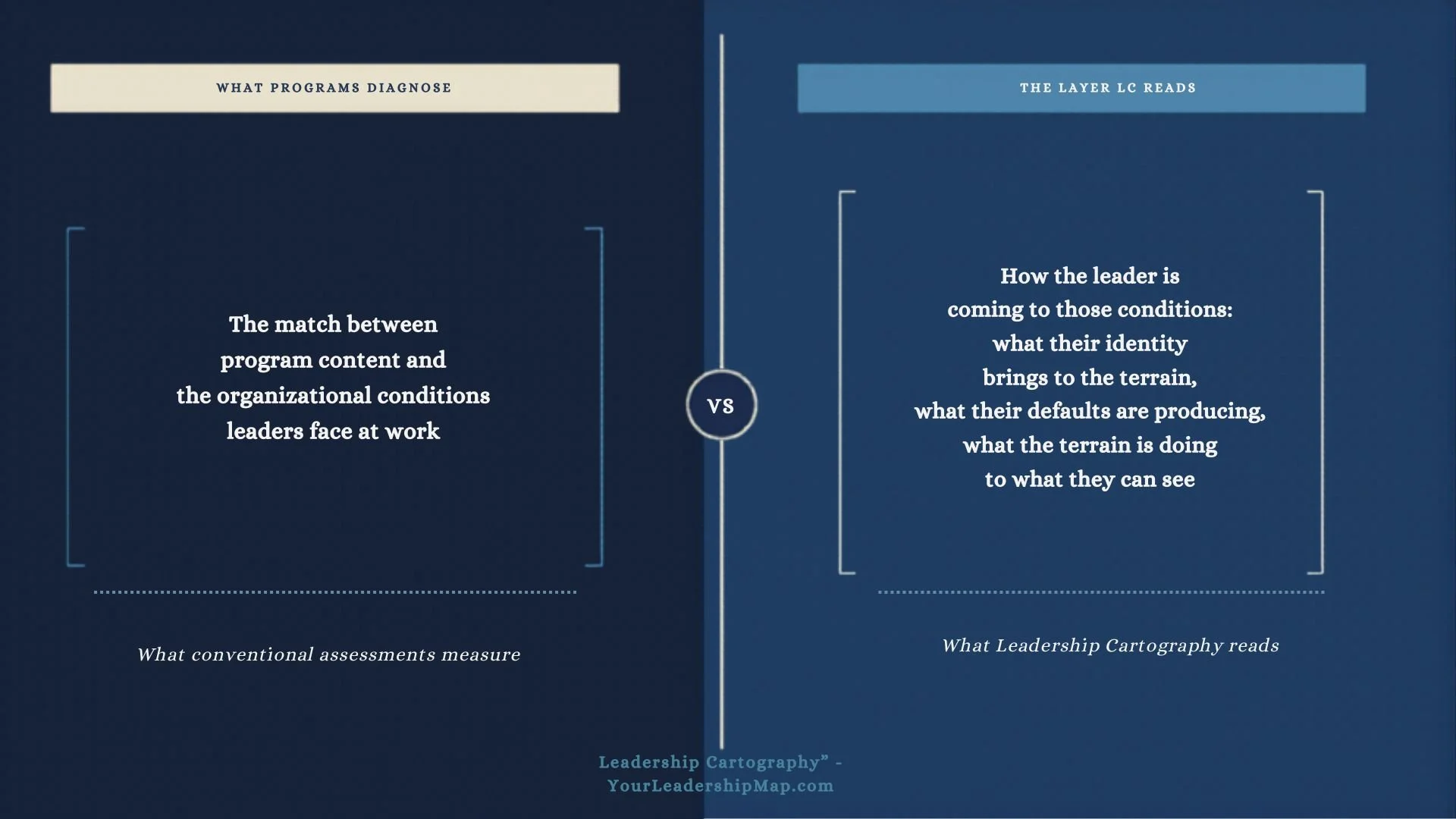
Better content, stronger facilitation, and more personalized delivery all address the design. The sequencing problem sits further back than those adjustments reach.
What do existing leadership program intake assessments actually measure?
Most institutional leadership programs include an assessment component. Participants complete a personality inventory, a 360-degree feedback process, a strengths survey, or a competency self-assessment in the weeks before the program begins. These tools produce real data. A 360 identifies how a leader is currently experienced by the people around them. A strengths inventory identifies thinking and behavioral patterns that hold across most situations. A personality assessment maps communication and decision tendencies. A program team that runs participants through a well-designed intake process ends up with something concrete: an accurate picture of the individuals entering the cohort.
Those tools were built for a specific question: who is this person and how do they tend to operate? The behavioral read they produce is accurate and useful for what it measures. The design question that precedes program construction sits outside that scope. It asks: who is this leader in relation to the terrain they are being placed into, and where in the cohort is friction already building?
The Harvard Business Publishing 2024 Global Leadership Development Study found that fewer than 6 in 10 surveyed L&D leaders reported being highly satisfied with the results of their leadership development efforts. Behavioral description is what most programs start with. The design table needs a different read before decisions are locked.
Assessment-as-infrastructure is a sequencing claim: the diagnostic layer comes before program construction, not alongside it. Leadership Cartography is that layer. It reads identity first, in relation to the learned interpretation a leader is bringing to their conditions: the patterns in how they are reacting to what they face, before those reactions produce the outcomes the program was built to address.
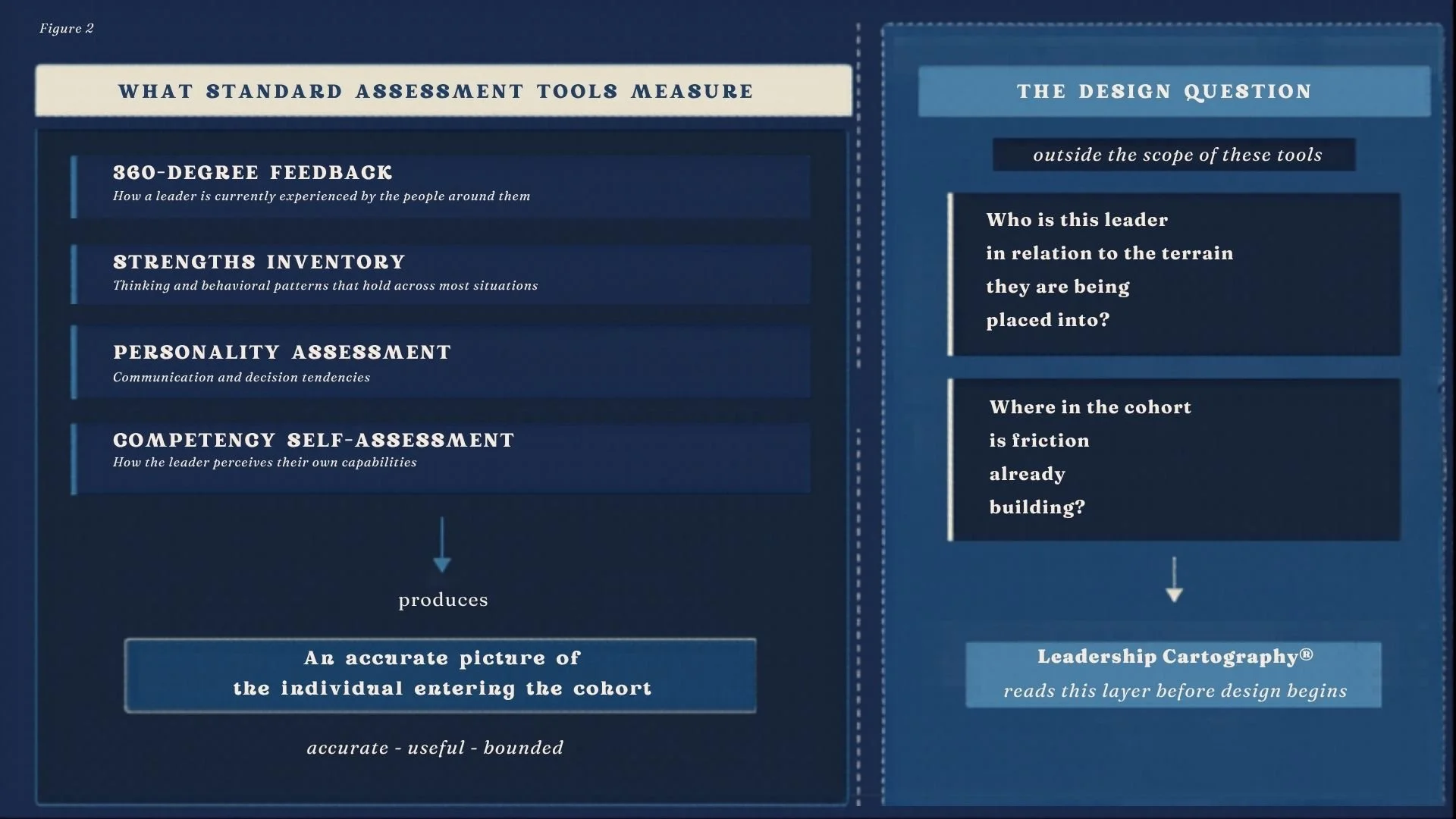
What does Leadership Cartography read that standard assessments don't?
Standard assessments produce accurate individual profiles. Leadership Cartography reads something different. It starts with how each leader's identity leads the way in reaction to the specific conditions they are operating within: what interpretation those conditions produce for them, and how that interpretation then shapes their response. The identity is not incidental to the read. It is where the read begins.
Leadership Cartography maps five identity pathways: Lead with Heart, Support, Purpose, Together, and Precision. These are not personality types or behavioral clusters. They are identity orientations: the consistent ways a leader approaches their conditions, generates meaning from what they encounter, and organizes their response to what the terrain asks of them. A leader operating from the Precision pathway brings a specific set of interpretive defaults to ambiguity, role pressure, and relational friction. A leader operating from the Together pathway brings a different set. Those defaults are not visible in a 360-degree feedback report, which maps how the leader is experienced externally. They are not visible in a strengths inventory, which maps what the leader does well across situations. They become visible when the lens is identity in relation to terrain: who this person is, specifically, when the conditions they are inside start to pressure the defaults they carry.
The terrain read is the second layer. Standard intake assessments describe the individual accurately but treat the organizational context as background. Leadership Cartography reads context as a co-variable. The same leader inside a stable organizational environment and the same leader inside a reorganization, a leadership transition, or a period of high ambiguity is not producing the same interpretation of their conditions. The terrain is doing something to what they can see, what they can prioritize, and what their identity generates in response. A diagnostic that does not read the terrain alongside the identity leaves the institution with partial information at the design table.
The output at the cohort level is what makes this institutional. Before an institution designs a program, it needs an accurate read on who is in it: which identity orientations are present, where terrain-identity friction is already building, and where specific patterns are likely to collide under the conditions the program will create. Leadership Cartography produces that read. The institution designs from it.
What becomes designable when assessment precedes program construction?
The design precedes the diagnosis. That is the problem.
The program becomes more specific. Specific in the sense that curriculum sequencing, facilitation choices, support structure design, and coaching matching all rest on a legible read of what the actual cohort is carrying before the program starts, not midway through it.
An institution that knows, before launch, that its incoming cohort contains a high concentration of leaders in a specific identity pattern operating under high role ambiguity can make different design choices than one that discovers this in the third session. Support structures can be calibrated before participants reach friction. Facilitation can anticipate where the cohort is likely to stall. Coaching relationships can be matched based on identity and terrain, not general preference or availability.
The organizational consequence is concrete. McKinsey's research identified inconsistent outcomes across cohorts as a direct result of programs decoupled from context. When the diagnostic layer captures identity patterns in relation to institutional terrain, the program works from a legible read of what is actually present. The Harvard Business Publishing data is clear on the return: organizations offering leadership development at all levels report landing in the top 10% of their industry's financial performance 54% of the time, compared to 31% for organizations without those programs. That spread is sensitive to the quality of information the program was built on. Programs designed on incomplete diagnostics produce inconsistent results at exactly the scale where consistency matters most.
Why does this sequencing gap persist even in well-resourced institutions?
The sequencing gap has existed for decades in well-resourced institutions. Programs have been designed this way and institutions have managed the inconsistency. The cost is growing.
As the complexity of the conditions institutions are asking their leaders to navigate increases, as organizational structures reorganize faster than development programs can be redesigned, and as institutional buyers face growing pressure to demonstrate that leadership investment produces visible and transferable outcomes, the diagnostic layer a program was built on starts to matter more. A program designed on an accurate behavioral description of its participants was always working with partial information. The gap between that partial read and a fuller one widened slowly in stable conditions. It widens faster when the terrain keeps moving.
The information needed to build programs on a more complete diagnostic is available before the design begins. The sequencing has to change first.
Sources
McKinsey & Company. (2014). Why Leadership-Development Programs Fail. https://www.mckinsey.com/featured-insights/leadership/why-leadership-development-programs-fail
SNS Insider via Yahoo Finance. (2024). Leadership Development Program Market to Reach USD 193.2 Billion by 2032. https://finance.yahoo.com/news/leadership-development-program-market-reach-140000488.html
Harvard Business Publishing. (2024). 2024 Global Leadership Development Study: Time to Transform. https://www.harvardbusiness.org/insight/2024-global-leadership-development-study-time-to-transform/